
BBCpresenter Michael Portillo brought his new show, Great Japanese Railway Journeys, to a halt minutes into his debut show for a major discovery. On Tuesday (April 14), the 72-year-old broadcaster returned to the airwaves for his next expedition in Japan. Tonight, the TV star travelled to the cultural heart of the country, Kyoto, the city that was the country's capital for a thousand years.
The first stop on his adventure was the Rozanji temple, where he learned about a book described as the world's first novel, The Tale of Genji. It was at this point that the doting husband discovered that the well-respected text, which dates back to the 11th century, was actually written by a woman, leaving him completely taken aback.
He was joined at the temple by a British expert, Dr Christopher Harding, who revealed the origins of the book, which has captured the hearts of the nation. He began: "We have this extraordinary work called the Tale of Genji by a writer called Murasaki Shikibu, and it's this wonderful window into the sophistication and the lavish lifestyles of people at that time."
This prompted Portillo to ask who the author was behind the classic work of literature, to which the specialist replied: "She was probably the most famous woman writer in Japanese history." It was at this point that the presenter interrupted his guest to clarify, "She?" to which the expert repeated: "Yes, she."
"She was a member of the Fujiwara family, this very, very powerful family. She married, but sadly her husband died quite young, and she, at that time, was expecting that her life was over. And then, amazingly, she creates the first few chapters of what became The Tale of Genji, and it starts getting passed around the court."
Harding continued: "And on the strength of that, we think, she gets this job as a lady in waiting to a very important empress, and really, her career takes off. I think it's extraordinarily rare for something of this scope to be produced. In this period, women did write, but they would be writing short stories, poems, the sort of thing where you have one character and a fairly simple narrative arc.
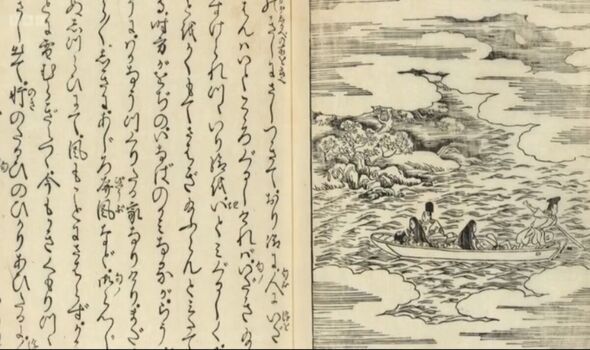
"What Murasaki did, which was unprecedented, maybe not just in Japan but across the world, was to put that kind of emotion and those sorts of literary devices into this enormous piece. It has more than 1,000 pages and more than 400 characters, where you don't just get a snapshot of people's emotions, but see how their emotional lives play out over decades.
"I don't think anyone else had done that before, and it's an extraordinary achievement," he concluded. Across the city, Michael visited the last remaining wagasa umbrella workshop in Kyoto. At Kyoto's Matsunoo shrine, Michael gets a beginner's guide to shrine etiquette and discovers the countless daily Shinto rituals that have become part of Japanese life.
The day ends with Michael taking a trip to a local restaurant to meet Satoha, an apprentice geisha, to find out how the ancient art form is adapting to modern life. Fans will have to tune in to see what is in store for the explorer next week on BBC Two or BBC iPlayer.