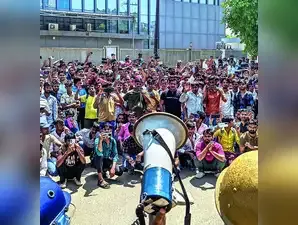
Industrial unrest has spilled over yet again in Delhi-NCR, which is prone to episodic outbreaks of violence over worker rights. The industrial belt girding Delhi draws a fair amount of foreign investment across a wide swathe of industries, and workers in the region are among the best-paid blue-collar employees in the country. Yet, industrial relations remain a tricky matter, compounded by the multiplicity of jurisdictions in NCR. The carnage on Noida's streets this week was triggered by an eruption of violence in Gurgaon over minimum wages. Haryana's wage revision led to a wide disparity with neighbouring Noida, and the UP government had to announce its own minimum pay for the affected districts on Tuesday. Violence and law-and-order breakdown like these cannot be tolerated in circa 2026 India. But at the same time, these acts of violence are shown to be effective. This cause-and-effect won't do.
Industrialisation in NCR follows a planned model, but is hampered by multiple stakeholders who intervene to check pollution and maintain industrial peace. NCR's rapid urbanisation contributes to pressure on living costs that need to be addressed harmoniously across the region. Capacity must be created for structured collective bargaining without creating negative externalities. Industry's contribution to NCR's economic output is considerably higher than the national average. This creates its own premium for industrial harmony.
The message of worker protests amplifies concerns about India's economic development that relies on profits over wage growth. Real wages have struggled to catch up since Covid disruptions, and GoI has kept growth on track through sweeping tax cuts. The stimulus is yet to work its way through the system during a period of low inflation being threatened by war in West Asia. RBI, in its latest monetary policy review, projects that inflation will stay within its comfort band if price of crude stabilises soon. The economy is better placed to absorb an energy shock. It must be able to avoid violent wage negotiation.
Industrialisation in NCR follows a planned model, but is hampered by multiple stakeholders who intervene to check pollution and maintain industrial peace. NCR's rapid urbanisation contributes to pressure on living costs that need to be addressed harmoniously across the region. Capacity must be created for structured collective bargaining without creating negative externalities. Industry's contribution to NCR's economic output is considerably higher than the national average. This creates its own premium for industrial harmony.
The message of worker protests amplifies concerns about India's economic development that relies on profits over wage growth. Real wages have struggled to catch up since Covid disruptions, and GoI has kept growth on track through sweeping tax cuts. The stimulus is yet to work its way through the system during a period of low inflation being threatened by war in West Asia. RBI, in its latest monetary policy review, projects that inflation will stay within its comfort band if price of crude stabilises soon. The economy is better placed to absorb an energy shock. It must be able to avoid violent wage negotiation.