The Nashik TCS case, which has drawn national attention, political intervention and a statement from Tata Sons chairman N Chandrasekaran, may have a more complicated origin than the dominant narrative suggests. According to the wife of one of the accused, speaking to The Indian Express on condition of anonymity, the entire chain of events traces back to a single falling-out between two colleagues.
“It was a relationship gone wrong between Danish Shaikh and one of the complainants that has ruined the lives of all the others,” she said. “Cases not linked to each other have been clubbed.”
The allegations centre on a Tata Consultancy Services (TCS) business process outsourcing (BPO) unit in Nashik, Maharashtra. On March 25, a woman employee walked into the Deolali Camp Police Station and accused senior colleagues, including a woman, of sexual harassment, mental torture and hurting her religious sentiments over a period spanning 2022 to 2026. She alleged that one male colleague had exploited and molested her repeatedly, and that the HR department had refused to act on her complaints.

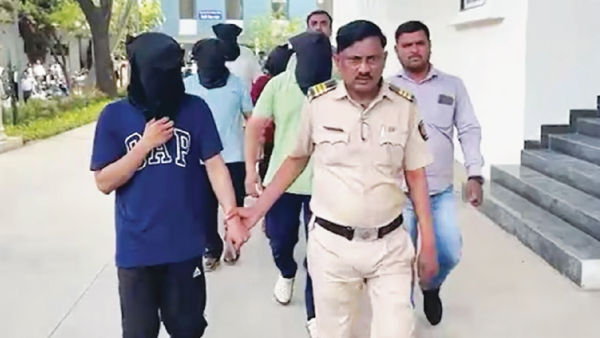
Police subsequently arrested seven people, with one woman employee reportedly still at large. The Nashik City Police have filed nine first information reports (FIR) covering charges of sexual abuse and religious conversion, with Danish Shaikh facing the most serious charge of rape.
On April 13, Chandrasekaran described the allegations as “gravely concerning and anguishing” and announced that TCS Chief Operating Officer (COO) Arathi Subramanian would lead an internal investigation to establish facts and identify those responsible.
The wife of one of the accused men told The Indian Express that the relationship between Danish Shaikh and the primary complainant was an open secret at the workplace.
“Everyone in the office knew about Danish and the woman being in a relationship. My husband told me she would wait hours for him to finish work,” she said. “She was in awe of him and had started observing fasts and dressing in a way that upset her parents.”
According to her account, the relationship unravelled in February, a month before the FIR was filed, when Danish’s wife informed the complainant that he was already married with two children. Police have since confirmed this sequence of events in their own version of the case.
The rape charge, they told IE, was added because Danish had allegedly entered into a sexual relationship with the complainant on the false promise of marriage. The charge of hurting religious sentiments was appended because he had, according to the police, “influenced” her to follow his religion.
The wife said the complainant’s parents, shaken by what had happened, “approached some politicians,” who then encouraged her to file a complaint. “It was in all of this that other men, including my husband, were caught, in spite of having nothing to do with the case,” she alleged.
An uncle of another accused echoed this. He told IE that his nephew had informed him that a colleague was “in trouble with police over a complaint by a woman employee,” and that the matter had nothing to do with anyone else. “I told him to cooperate with police,” the uncle said.
The wife described the night of her husband’s arrest in detail. On April 1, police summoned him to the station, telling him the investigation was wrapping up and a signature was needed. Given his seniority, he assumed his presence was routine.
“We had a family function at home, but he still went to the office around 6:30 pm,” she told IE. An hour later, he called to say several colleagues had been taken to the Mumbai Naka Police Station to sign documents. By 11:30 pm, however, he called again saying he was being arrested.
She rushed to the station and demanded to know the grounds for his detention. It was only at 2:30 am, she said, that officers told her he was not being held in connection with the Danish FIR, but that other women had filed fresh complaints against him.
“I said they should tell me on what grounds my husband was being arrested,” she recounted. The new FIRs were a shock because she personally knew the complainants and, to her knowledge, none of them had raised concerns earlier.
She also pushed back on the charge of hurting religious sentiments. “My husband took vegetarian food in his tiffin. He told me some of his colleagues may be uncomfortable with him eating non-vegetarian food. Why would such a person talk down another religion?”
Police told IE that the initial FIR against Danish led investigators to uncover “a pattern of harassment” involving the other accused. The Special Investigation Team (SIT) probing the case stated that they spoke to women complainants, assured them they could speak without fear and registered FIRs based solely on their statements, which were recorded before a magistrate.
“Since these were serious offences, we spoke to the women and assured them to speak without fear. It was based on their complaints that FIRs were registered against those named by them,” an officer said.
The lawyers representing the arrested men, however, told IE that offhand remarks and individuals’ “voluntary choices” were being criminalised.
One figure at the centre of the case is Ashwini Chainani, a Pune-based operations manager now in police custody, with her remand extended till April 15. The wife of one of the accused described Chainani as someone who was “fair” and “supported the arrested men,” and suggested her arrest would deter others from speaking up.
Police, however, offered a different reading. One complainant told investigators she had approached Chainani and verbally described the alleged harassment, but Chainani had discouraged her from pursuing it further. As a member of the office’s Prevention of Sexual Harassment (POSH) committee, Chainani was legally obligated to act on any such disclosure, whether written or oral, the Nashik Police said.
All the accused were engineers. Among them was one who had joined through a college recruitment drive and had been with the company for barely three months at the time of his arrest, a detail the wife cited as evidence of how peripheral some of the accused were to the original complaint.
Six of the accused remain in judicial custody.
Adding another layer to the case, a recent NDTV report, citing police sources, claimed the accused were part of a coordinated network that used WhatsApp groups to allegedly target women who were financially vulnerable, dealing with family problems or in need of money.
The accused’s families and their lawyers have so far offered no response to this specific claim.