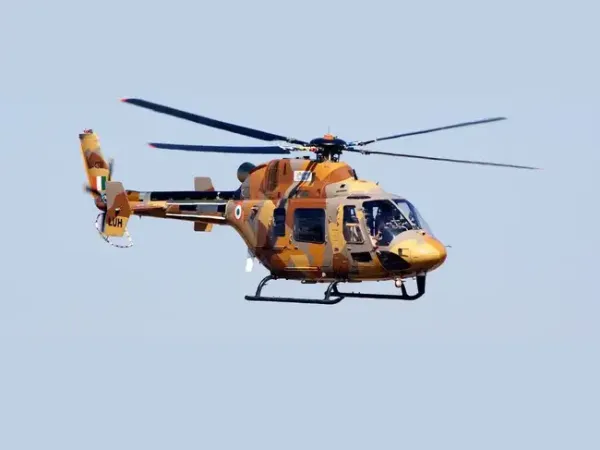
India is set to phase in its indigenously developed Light Utility Helicopter (LUH) to replace the ageing Cheetah and Chetak fleet that has long served as a lifeline across the high-altitude Himalayan frontiers, including the Siachen Glacier, reports TOI.
Developed by Hindustan Aeronautics Ltd (HAL), the LUH is tailored for extreme high-altitude operations, where legacy helicopters have routinely operated beyond their original design limits. The new platform is expected to significantly enhance India’s operational capabilities in some of the world’s most challenging terrains.
Also Read: HAL GE engine deal: F-414 engine to power three indigenous IAF jets Tejas Mk-2 TEDBF and AMCA
For decades, the Chetak and Cheetah helicopters have operated across the Himalayas, landing on narrow ridge-top helipads at altitudes exceeding 20,000 feet. These aircraft, based on older French designs, have been critical for logistics, reconnaissance and evacuation in remote posts such as Bana Top, Ashok and Sonam, many of which depend entirely on helicopter connectivity.
Operating in such environments presents severe challenges. Thin air reduces rotor lift and engine performance, limiting payload capacity and often requiring multiple sorties to complete tasks. Despite these constraints, Indian pilots have consistently operated in conditions that push the limits of helicopter performance.
Deliveries are expected to begin from HAL’s Tumakuru facility in Karnataka once certification is complete, marking a significant step in strengthening India’s self-reliance in defence aviation and replacing ageing high-altitude workhorses.
(With inputs from TOI)
Developed by Hindustan Aeronautics Ltd (HAL), the LUH is tailored for extreme high-altitude operations, where legacy helicopters have routinely operated beyond their original design limits. The new platform is expected to significantly enhance India’s operational capabilities in some of the world’s most challenging terrains.
HAL’s light utility helicopter to boost high-altitude operations
- Designed for operations in extreme high-altitude regions like the Himalayas and Siachen
- Capable of flying up to around 21,300 feet
- Powered by HAL–Turbomeca Shakti-1U turboshaft engine
- Can carry six soldiers along with a crew of two
- Maximum speed of about 235 km/h
- Equipped with a digital glass cockpit for better situational awareness
- Compatible with night vision devices for night operations
- Built for roles such as medical evacuation, troop transport and reconnaissance
- Suitable for search and rescue, surveillance and utility missions
- Developed as a replacement for ageing Cheetah and Chetak helicopters
Also Read: HAL GE engine deal: F-414 engine to power three indigenous IAF jets Tejas Mk-2 TEDBF and AMCA
For decades, the Chetak and Cheetah helicopters have operated across the Himalayas, landing on narrow ridge-top helipads at altitudes exceeding 20,000 feet. These aircraft, based on older French designs, have been critical for logistics, reconnaissance and evacuation in remote posts such as Bana Top, Ashok and Sonam, many of which depend entirely on helicopter connectivity.
Operating in such environments presents severe challenges. Thin air reduces rotor lift and engine performance, limiting payload capacity and often requiring multiple sorties to complete tasks. Despite these constraints, Indian pilots have consistently operated in conditions that push the limits of helicopter performance.
Efforts to replace legacy fleet
The armed forces have been seeking a replacement for these helicopters since 2008. A global competition between the Russian Kamov-226 and the Eurocopter Fennec did not result in a contract, paving the way for an indigenous solution.Development and testing
The LUH project received approval in 2009 and prototypes have been flying since September 2016. The helicopter has undergone extensive trials, including high-altitude testing in Ladakh, with successful landings at forward locations such as Amar and Sonam posts in 2020. Earlier concerns related to the autopilot system are reported to be nearing resolution.Orders and induction plans
A total of 171 helicopters are planned for induction, with 61 for the Indian Air Force and 110 for the Army. Both services have already placed initial orders for six units each. Recent visuals released by HAL indicate that around 10 helicopters are ready, pending final certification.Deliveries are expected to begin from HAL’s Tumakuru facility in Karnataka once certification is complete, marking a significant step in strengthening India’s self-reliance in defence aviation and replacing ageing high-altitude workhorses.
(With inputs from TOI)