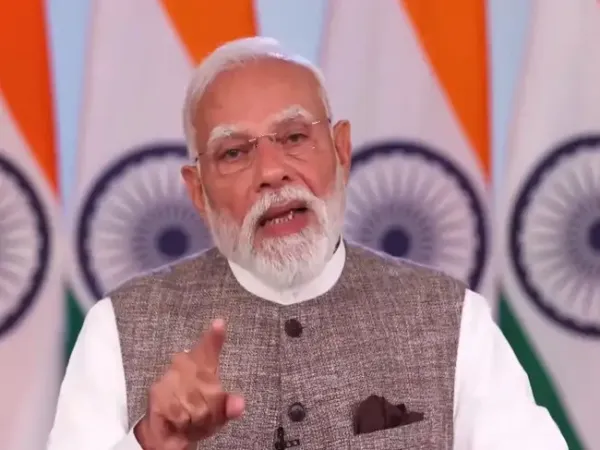
New Delhi: The Cabinet Committee on Economic Affairs (CCEA) chaired by Prime Minister Narendra Modi Saturday approved a 2% increase in dearness allowance (DA) and dearness relief (DR) for central government employees and pensioners, seeking to partly cushion them from inflationary pressures.
The increase, expected to come into effect January 1, will entail an additional financial outgo of ₹6,791 crore for the government.
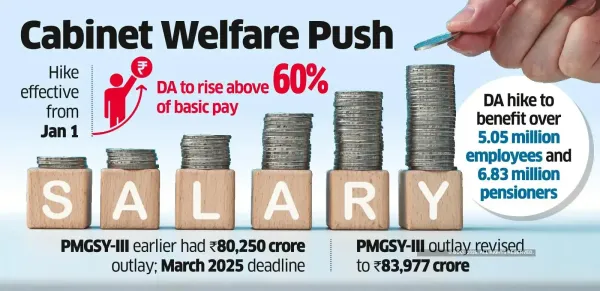
With the latest revision, DA will rise from 60% of basic pay, benefiting more than 5.05 million employees and 6.83 million pensioners, union minister of information and broadcasting Ashwini Vaishnaw told reporters after the cabinet meeting.
DA and DR for central government employees and pensioners was last revised in October 2025, when it was raised to 58% from 55%, with effect from July 1, 2025.
"This increase is in accordance with the accepted formula, which is based on the recommendations of the 7th Central Pay Commission," according to an official statement.
The deadline to complete roads and bridges in plain areas and roads in hilly areas under the Pradhan Mantri Gram Sadak Yojana-III (PMGSY-III) has been extended to March 2028, while bridges in mountainous areas have to be built by March 2029, according to an official statement.
PMGSY-III, with an initial outlay of Rs 80,250 crore, was to be completed by March 2025.
The extension of the timeline, the government said, will "significantly boost the rural economy and trade by enhancing market access for agricultural and non-farm products, reducing transportation time and costs, and thereby improving rural incomes".
Of the revised outlay Rs 83,977 crore, the Centre's share would be Rs 54,848 crore and states' Rs 29,129 crore. The Centre typically bears 60% of the cost in most states and 90% in north-eastern and hilly states.
Improved connectivity will facilitate better access to education and healthcare institutions, ensuring timely delivery of essential services, particularly in remote and underserved areas, it said.
The increase, expected to come into effect January 1, will entail an additional financial outgo of ₹6,791 crore for the government.
With the latest revision, DA will rise from 60% of basic pay, benefiting more than 5.05 million employees and 6.83 million pensioners, union minister of information and broadcasting Ashwini Vaishnaw told reporters after the cabinet meeting.
DA and DR for central government employees and pensioners was last revised in October 2025, when it was raised to 58% from 55%, with effect from July 1, 2025.
DA & DR rise to come into effect Jan 1, 2026
"This increase is in accordance with the accepted formula, which is based on the recommendations of the 7th Central Pay Commission," according to an official statement.
PMGSY III revised outlay at ₹83k cr
The Cabinet also approved extension of the validity of the third phase of the rural roads scheme, with an increased outlay of ₹83,977 crore. This is aimed at helping achieve consolidation of rural roads through routes and major rural links connecting habitations to farm markets, schools, and hospitals.The deadline to complete roads and bridges in plain areas and roads in hilly areas under the Pradhan Mantri Gram Sadak Yojana-III (PMGSY-III) has been extended to March 2028, while bridges in mountainous areas have to be built by March 2029, according to an official statement.
PMGSY-III, with an initial outlay of Rs 80,250 crore, was to be completed by March 2025.
The extension of the timeline, the government said, will "significantly boost the rural economy and trade by enhancing market access for agricultural and non-farm products, reducing transportation time and costs, and thereby improving rural incomes".
Of the revised outlay Rs 83,977 crore, the Centre's share would be Rs 54,848 crore and states' Rs 29,129 crore. The Centre typically bears 60% of the cost in most states and 90% in north-eastern and hilly states.
Improved connectivity will facilitate better access to education and healthcare institutions, ensuring timely delivery of essential services, particularly in remote and underserved areas, it said.