



Listen to this article in summarized format
Loading...
××
Subscribe to

Unlock AI Briefing and Premium Content
New Year Offer 24 Hours Left
Subscribe NowAlready a member? Sign In
What's Included
- Exclusive Stories
- Daily ePaper Access
- Smart Market Tools
- Curated Investment Ideas
- Ad-lite Experience
Subscription

On the same day that Trump promised to obliterate Iran, I found myself walking through Hiroshima, guided by a 70-year-old who told us how the city council, after the bombing by the US 81 years ago, had decided that one must 'never repeat evil'. Of course, no one has told the Orange Man of Mar-a-Lagoland this.
Hiroshima is a shining example of what forgiveness looks like. And of the wonder that is Japan.
Walking through Hiroshima Peace Memorial Park and past the Atomic Dome, you feel a strange mix of heartbreak and awe at what Japan endured, and how it rebuilt this city from rubble, keeping the memento mori, Atomic Dome, surrounded by cherry blossoms as a remembrance of what can rise out of pure evil.
Earlier this month, I spent 9 days in Japan, swimming in sakura blossoms and marvelling at the way the country functions. Visiting this country is a little like visiting a perfect country on the top of Enid Blyton's Faraway Tree.
I don't remember the last time I saw a country where footpaths are as wide as main roads. This is a country built for walking. And walk you must, given that you will be taking your tastebuds on a jamboree with every meal. It is impossible to have an average meal in Japan.
From beautifully plated food at the tiniest izakaya (bars), serving up delicious wagyu and yakitori (grilled chicken skewers) - a meal will set you back by ₹500 - to eating shabu-shabu (hotpot) at an upmarket restaurant for ₹1,000, you are spoilt for choice. And don't tip anyone unless they specifically ask - it's taken as an insult, as residents believe they earn enough.
Certain aspects of Japan stayed with me: unending pitchers of iced water in food outlets, the quiet, whether in a bustling city like Tokyo, or tourist towns like Nara. Everyone speaks softly. Residents are so trusting that if you do not have cash on you at a restaurant, they insist you finish your meal and then go to the ATM to pay them.
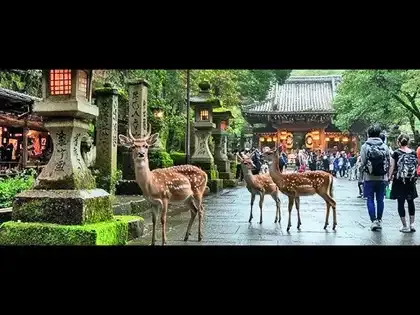
The only ones who weren't well-mannered were the deer at Nara Park. But even they were quiet. Unlike some Indians whom I encountered shouting at each other to take a selfie at the Miyajima shrine.
Every morning, across parks in Tokyo, people would roll out the same blue tarpaulin sheets and use them to picnic on. Dogs - I've never seen so many teacup poodles and Pekingese! - were everywhere. They were far more disciplined than Indians on a bus on their way to any resort.
There are no trash cans in Japan. You carry your trash home. Even the homeless had their belongings neatly arranged and slept under clean blankets.
Japan is like Singapore, but with a heavy serving of culture, history, and tradition. People follow rules not out of fear or duty, but because they are proud of their cities. Nozomi, the fastest Shinkansen (bullet train), is astounding - for its speed of up to 300 km/hr, and because its interiors look like a fancy aircraft that allows you to fit massive suitcases behind seats. It's all too civilised.
TOTO toilets here are sentient beings. But alongside the tech, there are homes that date back from the Edo period (c. 1601-1868) and bars from the Showa Era, the reign of emperor Hirohito from 1926 to 1989. You can soak yourself in mineral-rich hot spring water after a long day in an onsen bath, which seems to automatically empty out the water when you step out and fill it with fresh hot water.
The Japanese are incredibly hospitable, even though most locals speak just a smattering of English. There is a palpable pride in their country, which explains why the people are so civil and pleasant. Although the pressure to conform and be perfect must be trying. But that could just be the Jungian in me speaking.
The only problem is that now after my Japan sojourn, I walk around Gurgaon expecting people here not to speak loudly, cut queues, or litter - generally, to be civilised. Arigato gozaimasu, Japan. You have set me up for constant disappointment.
Hiroshima is a shining example of what forgiveness looks like. And of the wonder that is Japan.
Walking through Hiroshima Peace Memorial Park and past the Atomic Dome, you feel a strange mix of heartbreak and awe at what Japan endured, and how it rebuilt this city from rubble, keeping the memento mori, Atomic Dome, surrounded by cherry blossoms as a remembrance of what can rise out of pure evil.
Earlier this month, I spent 9 days in Japan, swimming in sakura blossoms and marvelling at the way the country functions. Visiting this country is a little like visiting a perfect country on the top of Enid Blyton's Faraway Tree.
I don't remember the last time I saw a country where footpaths are as wide as main roads. This is a country built for walking. And walk you must, given that you will be taking your tastebuds on a jamboree with every meal. It is impossible to have an average meal in Japan.
From beautifully plated food at the tiniest izakaya (bars), serving up delicious wagyu and yakitori (grilled chicken skewers) - a meal will set you back by ₹500 - to eating shabu-shabu (hotpot) at an upmarket restaurant for ₹1,000, you are spoilt for choice. And don't tip anyone unless they specifically ask - it's taken as an insult, as residents believe they earn enough.
Certain aspects of Japan stayed with me: unending pitchers of iced water in food outlets, the quiet, whether in a bustling city like Tokyo, or tourist towns like Nara. Everyone speaks softly. Residents are so trusting that if you do not have cash on you at a restaurant, they insist you finish your meal and then go to the ATM to pay them.
The only ones who weren't well-mannered were the deer at Nara Park. But even they were quiet. Unlike some Indians whom I encountered shouting at each other to take a selfie at the Miyajima shrine.
Every morning, across parks in Tokyo, people would roll out the same blue tarpaulin sheets and use them to picnic on. Dogs - I've never seen so many teacup poodles and Pekingese! - were everywhere. They were far more disciplined than Indians on a bus on their way to any resort.
There are no trash cans in Japan. You carry your trash home. Even the homeless had their belongings neatly arranged and slept under clean blankets.
Japan is like Singapore, but with a heavy serving of culture, history, and tradition. People follow rules not out of fear or duty, but because they are proud of their cities. Nozomi, the fastest Shinkansen (bullet train), is astounding - for its speed of up to 300 km/hr, and because its interiors look like a fancy aircraft that allows you to fit massive suitcases behind seats. It's all too civilised.
TOTO toilets here are sentient beings. But alongside the tech, there are homes that date back from the Edo period (c. 1601-1868) and bars from the Showa Era, the reign of emperor Hirohito from 1926 to 1989. You can soak yourself in mineral-rich hot spring water after a long day in an onsen bath, which seems to automatically empty out the water when you step out and fill it with fresh hot water.
The Japanese are incredibly hospitable, even though most locals speak just a smattering of English. There is a palpable pride in their country, which explains why the people are so civil and pleasant. Although the pressure to conform and be perfect must be trying. But that could just be the Jungian in me speaking.
The only problem is that now after my Japan sojourn, I walk around Gurgaon expecting people here not to speak loudly, cut queues, or litter - generally, to be civilised. Arigato gozaimasu, Japan. You have set me up for constant disappointment.
(Disclaimer: The opinions expressed in this column are that of the writer. The facts and opinions expressed here do not reflect the views of www.economictimes.com.)




Rajyasree Sen
The writer runs the Delhi-NCR catering service, Food For Thought