


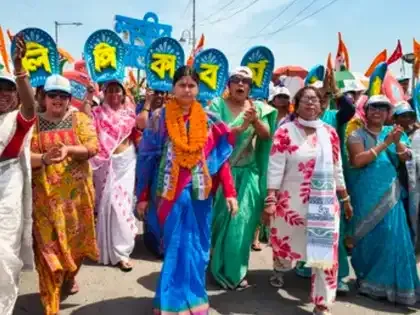
Nothing could be further from the truth than the inference that 'women have lost' because amendments to Nari Shakti Vandan Adhiniyam Bill to implement reservation for women in legislatures in 2029 and increase the number of Lok Sabha seats was defeated on April 17.
The larger transformational prospect - a Lok Sabha that looks different from what it has been for the past 75 yrs - remains firmly in place.
This is not contingent on any initiative or political consensus, but on a deeper reality: India's women won't allow it to be otherwise.
Women have already moved into a strategic position to shape outcomes in electoral politics. Over the past 15-odd yrs, they have staged a quiet revolution through EVMs, decisively altering political landscapes. They are now poised not only to secure legislative reservation but also to claim a far larger role in determining direction of governance.
This electoral assertion is evident in voter turnout trends across the last 4 Lok Sabha elections. The gender gap in turnout stood at 4.42% in 2009, but narrowed sharply to 1.42% in 2014. In 2019, female voters surpassed male voters for the first time, with 23 states and UTs recording higher female turnout. In 2024, women again outpaced men, with a turnout of 65.78%.
In 2025 Bihar assembly elections, women recorded a historic turnout of 71.78%, exceeding men by 9% and influencing outcomes. Similar trends were visible in Kerala, Assam and Puducherry, where women's turnout remained higher. In 2023, Rajasthan, Telangana, Chhattisgarh and Mizoram also saw women outvote men.
This marks a striking shift from the past, when women's participation trailed men by 17% in the 1962 general elections. Since 1971, number of female electors has risen by 240%, outpacing the increase among men. The gender ratio in the electorate has steadily improved from 910 in 1971 to 946 in 2024. Women now account for nearly half the electorate. EC's targeted facilitation and outreach over the past 15 yrs have played an important role.
Parties have taken note. In recent elections in Maharashtra and MP, women voters strongly endorsed welfare measures targeted at them. In Chhattisgarh, promises of financial assistance to married women were seen as a decisive electoral factor. Across states, government-supported self-help groups (SHGs) have evolved into influential socio-political networks. DBTs to women have become a central feature of governance, often intensifying ahead of elections. Targeted welfare and rising female turnout have reinforced each other.
Despite this, women remain underrepresented in legislatures. Their share in Parliament is about 15%, well below both the Asian average and global benchmark of around 30%. Nepal, Bangladesh, Pakistan and Bhutan have higher representation. State assemblies fare worse, with women comprising less than 10% of members. In contrast, reservations in local bodies have enabled around 1.5 mn elected female representatives in panchayats and municipalities, fostering grassroots leadership and advancing gender-sensitive governance.
Parties continue to reflect a contradiction. While they celebrate women's roles in history, culture and development, they remain reluctant to field women candidates, or include them in decision-making structures.
After unanimously passing Nari Shakti Vandan Adhiniyam in 2023, parties fielded fewer than 800 women candidates in the 2024 elections out of 8,360 contestants. In 152 constituencies, not a single woman candidate was present. Women are often still viewed as less 'winnable' than men representing caste or community blocs, though rising female turnout is beginning to challenge this perception.
But they have emerged as perhaps the most decisive constituency in electoral democracy, often cutting across caste and class divides. Their voting behaviour reflects a growing awareness of interests and bargaining power. Election outcomes increasingly bear the imprint of this shift, one that political actors cannot ignore.
Reservation in Parliament and assemblies is a natural extension of this broader empowerment. Guaranteed representation in legislatures is unlikely to be granted passively. It will be claimed, backed by the force of electoral participation. It's no longer if but when.
The writer is former DG,Election Commission.
The larger transformational prospect - a Lok Sabha that looks different from what it has been for the past 75 yrs - remains firmly in place.
This is not contingent on any initiative or political consensus, but on a deeper reality: India's women won't allow it to be otherwise.
Women have already moved into a strategic position to shape outcomes in electoral politics. Over the past 15-odd yrs, they have staged a quiet revolution through EVMs, decisively altering political landscapes. They are now poised not only to secure legislative reservation but also to claim a far larger role in determining direction of governance.
This electoral assertion is evident in voter turnout trends across the last 4 Lok Sabha elections. The gender gap in turnout stood at 4.42% in 2009, but narrowed sharply to 1.42% in 2014. In 2019, female voters surpassed male voters for the first time, with 23 states and UTs recording higher female turnout. In 2024, women again outpaced men, with a turnout of 65.78%.
In 2025 Bihar assembly elections, women recorded a historic turnout of 71.78%, exceeding men by 9% and influencing outcomes. Similar trends were visible in Kerala, Assam and Puducherry, where women's turnout remained higher. In 2023, Rajasthan, Telangana, Chhattisgarh and Mizoram also saw women outvote men.
This marks a striking shift from the past, when women's participation trailed men by 17% in the 1962 general elections. Since 1971, number of female electors has risen by 240%, outpacing the increase among men. The gender ratio in the electorate has steadily improved from 910 in 1971 to 946 in 2024. Women now account for nearly half the electorate. EC's targeted facilitation and outreach over the past 15 yrs have played an important role.
Parties have taken note. In recent elections in Maharashtra and MP, women voters strongly endorsed welfare measures targeted at them. In Chhattisgarh, promises of financial assistance to married women were seen as a decisive electoral factor. Across states, government-supported self-help groups (SHGs) have evolved into influential socio-political networks. DBTs to women have become a central feature of governance, often intensifying ahead of elections. Targeted welfare and rising female turnout have reinforced each other.
Despite this, women remain underrepresented in legislatures. Their share in Parliament is about 15%, well below both the Asian average and global benchmark of around 30%. Nepal, Bangladesh, Pakistan and Bhutan have higher representation. State assemblies fare worse, with women comprising less than 10% of members. In contrast, reservations in local bodies have enabled around 1.5 mn elected female representatives in panchayats and municipalities, fostering grassroots leadership and advancing gender-sensitive governance.
Parties continue to reflect a contradiction. While they celebrate women's roles in history, culture and development, they remain reluctant to field women candidates, or include them in decision-making structures.
After unanimously passing Nari Shakti Vandan Adhiniyam in 2023, parties fielded fewer than 800 women candidates in the 2024 elections out of 8,360 contestants. In 152 constituencies, not a single woman candidate was present. Women are often still viewed as less 'winnable' than men representing caste or community blocs, though rising female turnout is beginning to challenge this perception.
But they have emerged as perhaps the most decisive constituency in electoral democracy, often cutting across caste and class divides. Their voting behaviour reflects a growing awareness of interests and bargaining power. Election outcomes increasingly bear the imprint of this shift, one that political actors cannot ignore.
Reservation in Parliament and assemblies is a natural extension of this broader empowerment. Guaranteed representation in legislatures is unlikely to be granted passively. It will be claimed, backed by the force of electoral participation. It's no longer if but when.
The writer is former DG,Election Commission.
(Disclaimer: The opinions expressed in this column are that of the writer. The facts and opinions expressed here do not reflect the views of www.economictimes.com.)




Akshay Rout
The writer is former director general, Election Commission of India