The ongoing war, spilling across maps, headlines, and borders between Iran and Israel, has once again turned the world’s attention to conflict, strategy, and survival. Yet even as missiles redraw political geographies and tensions harden across the Middle East, there remains one force that refuses to be reduced by violence: food. Civilizations may collide, governments may fracture, and alliances may shift, but Persian cuisine continues to move through history like something untouched by urgency - slow and aromatic. When Donald Trump talks about wiping off an entire civilization, he forgets bombs can’t destroy what is still in making from thousands of years – a civilization, its people, art, culture and its food that keeps it thriving.
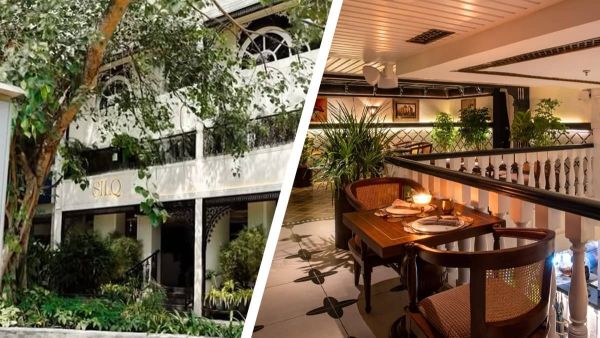
I got the chance to visit – SILQ – one-of-a-kind place in Delhi’s Malcha Marg. In moments of geopolitical instability, Persian food feels almost defiant. The current Iran–Israel conflict, marked by escalating regional hostility and global anxiety, is a reminder of how fragile political order can be. But Persian cuisine does not behave like politics. It does not react, it preserves. While war is loud, Persian food is layered silence, saffron steeped over time, rice delicately jeweled with dried fruits and nuts, kebabs grilled with patience rather than haste. Even in the shadow of conflict, its identity remains intact, as though centuries of empire, migration, and cultural exchange have trained it to outlive disruption.
At SILQ (Silq), this philosophy becomes tangible. The restaurant does not merely serve Persian-inspired dishes; it stages them within a larger Mediterranean, Mughlai, and Modern Indian dialogue. But it is Persian influence that quietly dominates the conversation. The kebabs arrive tender, restrained, almost meditative in their execution. The rice dishes feel ceremonial, carrying saffron not as an ingredient but as memory. Compared to the sharper contrasts of Mediterranean acidity or Mughlai heaviness, Persian food feels balanced in a way that does not compete—it resolves. It is as if every plate understands that excess is not power; control is.
The ambience of the place mirrors this same philosophy. The lighting is low and intentional, the interiors polished yet understated, creating a space that feels suspended between past and present. It is not loud luxury; it is composed stillness. Conversations soften naturally, and time seems to lose its urgency. In such a setting, food becomes more than consumption, it becomes atmosphere, almost like a diplomatic language between emotion and restraint. Persian cuisine, in particular, fits seamlessly into this environment, as though it was always meant to be served in rooms where silence carries as much meaning as speech.
This experience deepens further when Persian music begins to weave through the space. The melodies are often melancholic yet controlled, built on repetition and longing rather than spectacle. Traditional instruments carry a sense of distance, of deserts, courtyards, and lost empires, but also intimacy, as if every note is recalling something once held dear. In a place like SILQ, such music does not merely play in the background; it completes the atmosphere. It turns dining into memory-making, where each bite aligns with rhythm and nostalgia.
And yet, even after leaving such curated interiors, the world outside remains grounded in its own quiet poetry. A walk along Malcha Marg, shaded by old, towering trees, feels like an antidote to intensity. The trees stand unbothered by human conflict, their branches filtering sunlight into soft fragments that fall across the road like scattered thoughts. They have witnessed decades of change, political, social, architectural, yet they remain rooted, indifferent to the urgency of the present. In their presence, one understands that continuity often belongs not to nations or headlines, but to nature itself.
In the end, Persian food at SILQ is more than just a dining experience, it feels like a reminder that even in times of conflict, refinement and culture continue to survive. Wars may shape the present, but food carries history forward. Among all cuisines, Persian food stands apart, not because it tries to dominate, but because it stays with you quietly, long after everything else has faded.
They say, in Iran, food is never just a food – it is an invitation to belong. The stews feed your heart, the taste you get here makes you think why is there so much fuss.
Why people can’t just respect each other’s faith, culture and celebrate art and food together. In Farsi, there’s a word called “Shekam Doost” which when translated in English, roughly means a food lover. If you are a Shekam Doost in Delhi – this Persian themed restaurant in Delhi is a must visit.