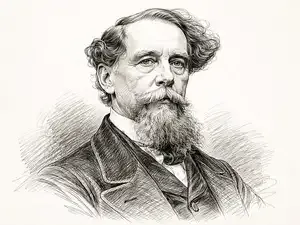
There are moments when effort feels useless, when problems seem larger than our ability to fix them. We try, fail, and try again, holding on to the faint belief that time and persistence may still bring change. Today’s quote captures that quiet endurance: the decision to keep hoping even when control feels limited.
Charles Dickens (1812–1870) was a towering English novelist whose works exposed social injustice while creating some of literature’s most memorable characters. Born in Portsmouth, he experienced childhood hardship when his father was imprisoned for debt, forcing young Dickens to work in a factory. These early struggles shaped his lifelong concern for the poor and vulnerable.
His serialized novels, including Oliver Twist, David Copperfield, Bleak House, and A Tale of Two Cities, combined vivid storytelling with sharp social criticism. Dickens mastered humor, suspense, and pathos, captivating Victorian readers and influencing public opinion on poverty, child labor, and education.
A prolific writer and public reader, he became an international celebrity. Dickens wrote today’s widely quoted line in his late novel Our Mutual Friend, where characters grapple with social inequality and personal hardship while clinging to hope.
“I cannot stop some dreadful things I try to stop, but I go on in the hope and trust that the time will come.”
Dickens’ words explore a painful truth: there are injustices, losses, and hardships that an individual cannot immediately prevent, no matter how sincere the effort. The quote recognizes human limitation without surrendering to helplessness. It reflects the emotional burden of caring deeply in a world where outcomes are often beyond personal control.
At a deeper level, the line speaks to moral perseverance. Dickens suggests that hope is not naïve optimism but a conscious decision to continue believing in eventual change. “Hope and trust” become acts of quiet resistance against despair. This is especially powerful in the context of his work, where characters endure poverty, cruelty, and neglect yet cling to the possibility of a better future.
Who was Charles Dickens
Charles Dickens (1812–1870) was a towering English novelist whose works exposed social injustice while creating some of literature’s most memorable characters. Born in Portsmouth, he experienced childhood hardship when his father was imprisoned for debt, forcing young Dickens to work in a factory. These early struggles shaped his lifelong concern for the poor and vulnerable.
His serialized novels, including Oliver Twist, David Copperfield, Bleak House, and A Tale of Two Cities, combined vivid storytelling with sharp social criticism. Dickens mastered humor, suspense, and pathos, captivating Victorian readers and influencing public opinion on poverty, child labor, and education.
A prolific writer and public reader, he became an international celebrity. Dickens wrote today’s widely quoted line in his late novel Our Mutual Friend, where characters grapple with social inequality and personal hardship while clinging to hope.
Quote of the day
“I cannot stop some dreadful things I try to stop, but I go on in the hope and trust that the time will come.”
Meaning of the quote
Dickens’ words explore a painful truth: there are injustices, losses, and hardships that an individual cannot immediately prevent, no matter how sincere the effort. The quote recognizes human limitation without surrendering to helplessness. It reflects the emotional burden of caring deeply in a world where outcomes are often beyond personal control.
At a deeper level, the line speaks to moral perseverance. Dickens suggests that hope is not naïve optimism but a conscious decision to continue believing in eventual change. “Hope and trust” become acts of quiet resistance against despair. This is especially powerful in the context of his work, where characters endure poverty, cruelty, and neglect yet cling to the possibility of a better future.
More quotes by Charles Dickens
- “No one is useless in this world who lightens the burden of another.”
- “Have a heart that never hardens, and a temper that never tires.”
- “It was the best of times, it was the worst of times.”
- “We forge the chains we wear in life.”
- “There is nothing in the world so irresistibly contagious as laughter and good humor.”