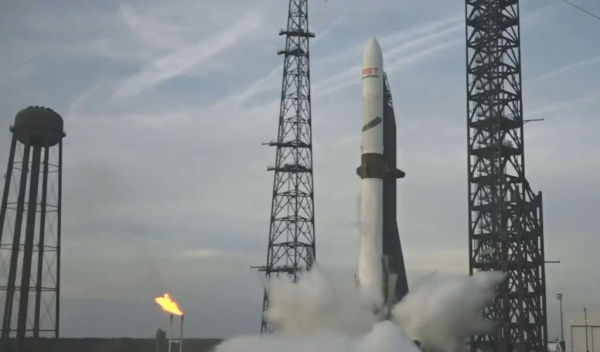
Blue Origin’s New Glenn rocket failed to place AST SpaceMobile’s BlueBird 7 satellite in its designated low-Earth orbit, rendering it unusable. The Federal Aviation Administration has grounded the rocket and ordered a mishap investigation.
Published Date – 21 April 2026, 11:55 PM
Washington: US space transporter Blue Origin placed AST Mobile’s BlueBird 7 communications satellite in the wrong orbit, making its direct-to-device operation unviable and forcing the firm to junk the spacecraft.
Blue Origin’s New Glenn reusable rocket took off majestically from Cape Canaveral in Florida on Sunday morning, and its first stage booster rocket landed on a drone ship hundreds of miles off the coast in the Atlantic.
However, the rocket failed to deliver on its primary task of placing the communications satellite in the designated low Earth orbit.
“While the satellite separated from the launch vehicle and powered on, the altitude is too low to sustain operations with its onboard thruster technology and will be de-orbited,” an AST SpaceMobile post-launch press release said.
India’s Launch Vehicle Mark-3 launched AST SpaceMobile’s BlueBird 6 satellite from ISRO’s spaceport at Sriharikota on December 23 last year.
Sunday’s launch of the New Glenn rocket was its third mission, and the vehicle now remains grounded pending an investigation into the reasons for failure.
Blue Origin is one of two companies that NASA has hired to provide landers that are to take astronauts from lunar orbit to the surface of the moon as soon as 2028. SpaceX is the other company hired by NASA for its lunar missions.
BlueBird 7 would have been AST SpaceMobile’s eighth deployed into low Earth orbit and is one of many planned for its space-based cellular broadband network. The company is currently in production through BlueBird 32, with BlueBird 8 to 10 expected to be ready to ship in approximately 30 days, the company statement said.
ASTSpace Mobile said the cost of the satellite is expected to be recovered under the company’s insurance policy.
Now, the Federal Aviation Administration is requiring Blue Origin to conduct a mishap investigation. Return to flight of New Glenn rockets is based on the FAA determining that “any system, process, or procedure to the mishap does not affect public safety.”
“The FAA will oversee the Blue Origin-led investigation, be involved in every step of the process, and approve Blue Origin’s final report, including any corrective actions,” per an FAA statement.
In a Monday afternoon tweet, Blue Origin CEO Dave Limp provided more details about the failed satellite deployment.
“Early data suggest that on our second GS2 burn, one of the BE-3U engines didn’t produce sufficient thrust to reach our target orbit,” Limp said.
Blue Origin is leading the anomaly investigation with FAA oversight to learn from the data and implement the improvements needed to quickly return to flight operations, he said.
“We have been in steady communication with the team at AST SpaceMobile. We appreciate their partnership, and we’re looking forward to many flights together,” Limp said.