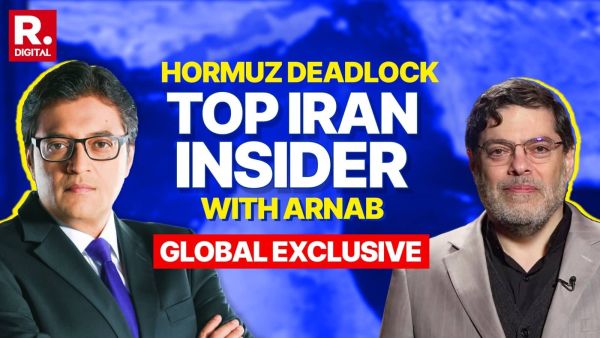
New Delhi: As the April 22 deadline for the current U.S.-Iran ceasefire looms, the prospects for a diplomatic breakthrough have dimmed significantly. In an in-depth interview with Republic Editor-In-Chief Arnab Goswami, Iranian professor Mohammad Marandi revealed that the Iranian delegation currently has "no plans" to return to the negotiating table in Pakistan, citing a fundamental lack of seriousness from the Trump administration.
Here is the full interaction.
Will the talks happen, or will the ceasefire end tomorrow? What do you think will happen? Will the Iranian delegation travel to Islamabad? Will they meet Vance and others?
As things stand, the Iranians have no plans to go. If the United States suddenly decided to change its position, to end the siege on the Persian Gulf and hostile acts against Iranian ships, then it may change. Although I don’t think there is any chance of travelling to Islamabad.
#NoSecondRound | ‘I don’t think there is any chance there will be any move to travel to Islamabad’: Seyed Mohd Marandi (@s_m_marandi), Member of Iranian Delegation
— Republic (@republic) April 21, 2026
Watch #ArnabLiveWithSeyedMarandi now, on-air, and online. Tune in and fire in your comments:… pic.twitter.com/m57EyldvPu
Is there coordination going on with the American side, or is the back channel on?
As you know, the Iranians and the Americans have always been sending messages back and forth over the years. We did have one day of direct negotiation in Islamabad. Before that and after that, the messages have been indirect. So I assume, messages continue to go back and forth. But unless there is a change on the ground, then I don’t see any reason for the Iranians to contemplate traveling to Islamabad.
When you were there last time, what was the gut feeling you got? Was it that after some time, the second round would be the final round? In the sense that you or the Iranian delegation were also working toward a timeline? Because there were some people who believed that, despite all the ups and downs and sharp statements, there was a feeling that we have come 50% of the way this time. We are going to seal it the next time. Was it the feeling that you had as well?
#NoSecondRound | ‘They were most probably buying time. They lost the war’: Seyed Mohd Marandi (@s_m_marandi), Member of Iranian Delegation
— Republic (@republic) April 21, 2026
Watch #ArnabLiveWithSeyedMarandi now, on-air, and online. Tune in and fire in your comments: https://t.co/xt98LtF8A8#RepublicWorld… pic.twitter.com/JzWjDAv8kh
No, that wasn’t the feeling that was in the Iranian delegation. When Iranians were going there, the Washington Post put up an opinion piece, and you know how close the Washington Post is to the US Intelligence, in that opinion piece it said that the Americans should assassinate the Iranian negotiators. So, we were actually thinking that probably on the way back to Iran, our plane would be targeted and we will all be killed. And, to the credit of everyone who was on the delegation, all the men and women, including journalists, every single one, on the way back, they got on the plane. No one decided to stay in Pakistan or take a land route or anything like that. We all boarded the plane and came back to Iran.
But that is the sort of mood that the Americans had created, and in Islamabad it was clear that, unlike the Iranian side, which had a mandate. Dr. Ghalibaf, before traveling, had an extensive dialogue with Ayatollah Khamenei; the framework on the Iranian side was all clear. But it was clear that Vance did not have a mandate. He was constantly making phone calls, and one of the people he was calling was Netanyahu. Netanyahu himself said that Vance reported to him, which is very strange to hear that a tiny regime like the Israeli regime’s Prime Minister would be receiving reports from the vice-president of the United States. Of course, Netanyahu also said other American leaders report to him every day, but I digress. The Iranians felt that the Americans did not have a mandate to talk, and basically, what they were doing was that they were, most probably, buying time, or they were hoping for something beyond hope to get something on the negotiating table or the battlefield. They did not win the war; they lost the war, and they were hoping that perhaps, somehow, the Iranians would be willing to give concessions, which I find quite extraordinary.
You don’t think that there is pressure on the American side to get a deal? I feel there is a lot of pressure; even the American media has begun to think that there is a lot of pressure on Trump. You don’t think so? Didn’t you feel the pressure on the American delegation in Islamabad?
No, I was talking about the Iranian delegation. On the Iranian side, they were in no rush, and they went there to see if the Americans were serious. When the Americans turned out not to be serious, the Iranians returned home. Right now, as we see, the Americans are insisting Iranians go to Islamabad, but the Iranians are saying no, we are not going unless something changes. Americans are violating the ceasefire, and when you violate a ceasefire, that means you don’t carry out your commitments, and when you stop carrying out commitments, why should we believe that you will carry out further commitments? But, I cannot say anything personally about the US delegation because I did not meet anyone linked to the American delegation in Islamabad. But from what we are seeing, in the western media, what we are seeing from people bringing messages back and forth, not necessarily from Pakistan but the rest of the world too, who have connections in the United States, there is indeed, as you rightly pointed out, an enormous amount of pressure on Trump to come to terms with Iran. On the other hand, there is a great deal of pressure from the Zionist lobby, from the Israeli regime, to continue, and basically to destroy the global economy.
#NoSecondRound | ‘The Americans are violating the ceasefire. If you don’t carry out your commitments, why should we believe that you will carry out your further commitments’: Seyed Mohd Marandi (@s_m_marandi), Member of Iranian Delegation
— Republic (@republic) April 21, 2026
Watch #ArnabLiveWithSeyedMarandi now,… pic.twitter.com/G4ciMQdfjr
There is also further evidence that supports this. When Joe Kent resigned, and he was, of course, the counter-intelligence chief who was installed by Trump himself, when he resigned, he said Iran was not building a nuclear weapon, Iran was no threat to the United States, but more importantly, he said that the war was imposed because of the Zionist lobby in the United States and the Israeli regime. So one can assume that a couple of months after he resigned, the status and the position of the Zionist lobby in the United States have not changed. So it is fair to say that the Zionist lobby and the Israeli regime want the war to continue, and the continuation of this war will make it inevitable that we will have a global economic depression, not recession. As things stand, we are heading towards a major economic crisis and things are bad as it, we are seeing the tip of the iceberg, but if the war is renewed then I think the ships in the Persian Gulf, many will be destroyed, if not all and if critical Iranian infrastructure is targeted, as Trump threatens, thy family regimes in the Persian Gulf, since they are all a part of this aggression, US uses their land, aerospace, and sea to attack Iran, their critical infrastructure would be destroyed. Iran will target the Israeli regime’s critical infrastructure as well. But when the critical infrastructure of these countries in the Persian Gulf is destroyed, that will mean no oil or gas for years to come. Also, if they target Iran’s electricity, their electricity will be targeted, and in a few weeks from now, the heat in the Persian Gulf and the humidity will force everyone to leave. These countries, alongside the Persian Gulf, I think, will be emptied. They will probably not exist any longer in the current form. These regimes are deserts; they are not like Iran. Right now in Tehran, we have mountains, and on the mountains, we have snow; we produce almost all of our agricultural goods. These countries are completely dependent; the changes will be extraordinary.
Is there a fight within the Iranian leadership? You mentioned the Western media, the Washington Post, and certain sections of the American media are indicating of late that there is a moderate vs hardliner within Tehran’s leadership. They are saying Ghalibaf, Araghchi, they are all moderates, the IRGC is more hardline. Araghchi wants the talks to happen, and the IRGC is stopping him - there is an internal power tussle. How accurate is this portrayal?
No, that’s nonsense. I think it is quite clear that the posturing of Trump and Netanyahu is such that everyone recognises in Iran that the negotiations are not serious. The sense in Iran is as such that when the United States is violating the agreement that we have and imposing an embargo on our ports and ships, that means they are not serious.
#NoSecondRound | ‘Is there a fight within the Iranian leadership?’: Seyed Mohd Marandi (@s_m_marandi), Member of Iranian Delegation Answers | Watch
— Republic (@republic) April 21, 2026
Watch #ArnabLiveWithSeyedMarandi now, on-air, and online. Tune in and fire in your comments: https://t.co/xt98LtF8A8… pic.twitter.com/kA2CTtyJOi
Nothing we talk about in future or potentially agree up on in future will be taken seriously by the United States. In order for two entities, whether that is two governments, individuals, or organisations, to cooperate, they must be assured that the counterpart will abide by their commitments. If that is not the case, then there is no point in negotiating. So, this is basically propaganda from Israeli outlets like Israeli International or Reuters, which constantly uses unnamed Iranian sources. But I think it is very clear that anyone in the world will recognise the posturing of Trump, especially today and during the past few days, make it really clear that negotiating is not a solution unless facts on the ground change. Trump’s signature is not important to us; it is worthless, but the facts on the ground are what interest us.
What about the role of the Pakistani army? Pakistan is looking for an opportunity to be relevant, but the Pakistani army head spent three days in Tehran, and now the Pakistanis have released a statement effectively blaming Iran. They are saying they are trying their best to make you understand to be reasonable, but you are not. They are making sincere efforts to convince you, but you are not listening. How neutral is Pakistan? Isn’t Asim Munir known to be Trump’s puppet?
Well, I have not seen the statements, so I cannot comment on that. But for Iran, the only thing that is important is the actions of the United States. The mediator can be Pakistan; it can be Oman, it can be anyone, but as long as the United States does not abide by its commitment, nothing is going to happen. Remember, before the 12-day war, we were negotiating with the United States. We have 5 rounds of negotiations, and it turned out that as the US was negotiating with us, which was last year, they were secretly conspiring to attack us with the Israeli regime. Of course, the Israeli regime lost that war. After 12 days, the Israelis were begging for a ceasefire, not Iran. This time around, the US put its entire force and the proxies with them, and the Israelis, with all the European weapons at their disposal, collectively attacked Iran. But before they attacked the Omani, 12 days before that, they were mediating, and the Omani foreign minister said there was enormous progress; he went to Washington, yet the Americans still attacked.
#NoSecondRound | ‘We are dealing with Trump who has no moral compass, no sense of morality, no friends’: Seyed Mohd Marandi (@s_m_marandi), Member of Iranian Delegation
— Republic (@republic) April 21, 2026
Watch #ArnabLiveWithSeyedMarandi now, on-air, and online. Tune in and fire in your comments:… pic.twitter.com/xRumVj1TPi
So the problem ultimately lies in the White House, and as long as the White House cannot abide by its commitment and constantly attacks and kills Iranians. Remember the first day of the attack, they murdered 168 little girls in the elementary school - in the first strike. And, you know why – the first strike is pre-planned. They had weeks and months to vet their targets, so they knew exactly what they were bombing. This school was there for many years, and it was on all Iranian apps, on all American apps and maps. But since a lot of children in this school had their fathers in the military, Americans wanted to teach the Iranians a lesson. This is who we are dealing with. Trump has no moral compass, no sense of morality, at all, whatsoever. He has no friends, he pretends to be India’s friend then threatens India with tariffs, he threatens to take Greenland, the threatens to take Panama – this is the sort of person we are dealing with. So mediation is not the issue, the issue is how can we deal with such a person.