Edge AI Chips: Artificial intelligence has always required strong cloud computing networks as its essential infrastructure. The system operates by having devices acquire information, which they transmit to main data centers, where machine learning models analyze the data and produce results. The deployment of artificial intelligence applications maintained this cloud-based system as its standard operating procedure for several years.
This method presents various challenges which need to be addressed. The process of transferring extensive data sets to distant servers leads to two main problems, which include introducing delays and needing extra bandwidth while creating protection issues for users’ financial data. The technology sector is now moving to adopt edge computing, which processes data on local devices instead of relying on remote data storage facilities.
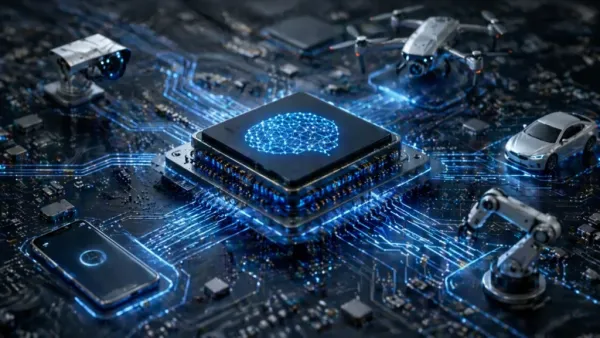
Edge AI refers to running artificial-intelligence algorithms on devices located at the “edge” of a network—such as smartphones, cameras, drones, vehicles, sensors, and industrial machines. The devices process data on-site to create real-time insights, which eliminate the need for sending all information to the cloud.
The development of semiconductor design has enabled this technological transformation. The latest processors use special AI components that enable them to execute complex neural network models while consuming minimal energy. Edge AI chips enable intelligent systems to operate through their ability to make decisions at the device level.
Edge AI chips function as dedicated processors that execute machine learning tasks on users’ local devices. The chips perform artificial intelligence tasks more efficiently than standard processors, which handle general computing needs, because they are built to execute matrix multiplications and neural-network inference operations.
Most edge AI systems combine several types of processors working together:
The specialized components enable devices to run AI models without needing to connect to outside server systems. For example, modern smartphone processors include integrated neural engines capable of performing tens of trillions of operations per second. The device’s processing power supports advanced functionalities, which include real-time photo enhancement, voice recognition, and augmented-reality applications.
One of the most important advantages of edge AI is speed. When devices depend on cloud servers for data processing, information needs to move through network systems before receiving the results. The performance of time-sensitive applications experiences severe impacts from even minor delays.
Edge AI processing operates without any waiting period because it handles data within local systems. The technology enables immediate decision-making, which supports real-time operations in robotics, industrial automation, and autonomous vehicle systems.
A self-driving car needs to identify pedestrians and understand road signs while responding to dynamic traffic conditions within a time frame of milliseconds. The use of remote servers for sensor data transmission creates unacceptable delays because onboard AI chips can process data instantaneously.
The digital era has turned privacy issues into a significant concern that people have to handle. AI systems process sensitive information, which includes voice recordings, images, and personal data. The process of sending this data to cloud servers creates two major risks, which include security breaches and data misuse.
Edge AI resolves this problem by performing data processing directly on the device. Devices perform local data analysis without sending complete data sets to remote servers, and they transmit only required information.

This method proves essential for healthcare monitoring systems, biometric authentication technologies, and personal voice assistant applications. Devices that handle sensitive data processing safeguard user privacy while they maintain confidential information security.
The quantity of data produced by sensors, cameras, and smart devices has increased as there are more connected devices. The process of sending all this information to the cloud creates substantial demands on network systems.
Edge AI decreases network consumption by handling data processing at local sites and transferring only essential findings to the cloud. A security camera that uses edge AI technology can identify movement and abnormal behavior while sending critical events to the user instead of transmitting ongoing video footage.
Internet-of-Things systems can achieve better performance and lower expenses through this method of deployment.
The majority of locations provide either partial internet access or experience internet connectivity problems. The systems that rely exclusively on cloud connections will experience operational difficulties when they encounter these conditions. Edge AI chips enable devices to function properly when their connection to the network is either weak or completely lost.
The system can perform data analysis and decision-making tasks because AI models operate directly on the device without needing remote server access. The capability serves essential functions in remote industrial sites, agricultural monitoring systems, disaster response operations, and autonomous drone missions.
Neural Processing Units serve as dedicated hardware components that support neural network computational tasks. The system speeds up deep learning operations through its ability to process matrix multiplication, convolution, and tensor processing tasks.
NPUs use energy-efficient processing to enable devices to execute advanced artificial intelligence functions with low power consumption. Battery-operated devices, including smartphones, wearables, and portable sensors, depend on this efficiency.
The edge AI chips use NPUs together with specialized accelerators, which handle exceptional functions. The components boost system performance by optimizing it for particular AI workload types.

Examples include:
Edge AI chips achieve efficient workload management through their design, which enables them to process multiple processing units while operating at minimal power requirements.
Running AI models on compact devices requires efficient use of hardware resources. Developers use various optimization techniques to reduce the size and computational requirements of machine-learning models. The following methods represent standard techniques that practitioners commonly use:
These techniques enable AI systems to run effectively on edge hardware without significantly compromising accuracy.
Smartphones serve as one of the most common examples of edge artificial intelligence deployment. The current devices utilize on-device artificial intelligence chips to enable facial recognition and photography improvements, language translation, and voice assistant functions. The local execution of these processes enables users to experience quicker performance and enhanced protection of their personal information.
Developing autonomous vehicles requires heavy reliance on edge AI technology. Cars produce extensive sensor data through their camera systems, radar systems, and lidar systems. The edge AI chips use real-time data processing to identify obstacles and assess road conditions while making driving decisions. Autonomous driving systems require rapid local processing capabilities because they need to react to safeguard operations.
Edge AI is changing how cities build their infrastructure. The AI chip-based intelligent cameras can identify traffic congestion, track public area usage, and detect abnormal behavior patterns. The systems work by processing video at local sites while they send out only critical alerts and important information. This method decreases network usage while improving system response speed.
Manufacturing sectors are implementing edge AI technologies to enhance operational efficiency and system reliability. Production lines equipped with sensors and cameras enable real-time monitoring of equipment performance while simultaneously identifying defects.
Edge AI systems enable businesses to forecast equipment failures before they happen, which allows companies to conduct preemptive maintenance and prevent expensive operational interruptions.
The demand for edge AI capabilities is expected to grow rapidly as more devices become connected and intelligent. The development of powerful AI processors with energy-efficient capabilities is being driven by advancements in semiconductor technology.
The combined power of neuromorphic computing, advanced chip architectures, and integrated AI accelerators will enable edge devices to reach their full potential. The combination of 5G connectivity and Internet of Things technologies is creating more devices that can perform local AI processing. The two trends will create a computing system where edge devices handle real-time tasks and cloud systems manage extensive data analysis and model development.
Edge AI chips are changing artificial intelligence because they bring processing capabilities to edge devices. Modern systems have the ability to process data on-site, which enables them to deliver quicker results while maintaining better privacy and operational consistency compared to traditional systems that depend on centralized cloud services.
The deployment of connected devices and intelligent systems by industries will lead to rising demands for intelligence functions that operate directly on their devices. Edge AI chips will enable real-time decision-making for applications that include smartphones, autonomous vehicles, industrial automation systems, and smart city networks.
The development of edge hardware and AI software will bring about continuous progress that will establish device-level intelligence as a vital element of the worldwide technology ecosystem.