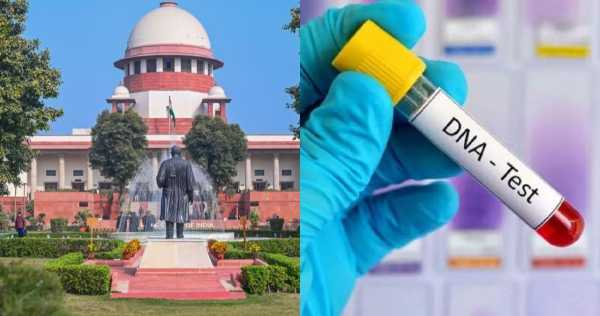
The Supreme Court has given a big verdict on the father not being proved in the DNA test. The Supreme Court, while giving relief to the defendant in the case, said that if the person is not the biological father of the child, then he cannot be directed to provide maintenance. Even if the child is born out of wedlock. After this, the court rejected the petition filed by the woman demanding maintenance of the child.
The Supreme Court bench comprising Justice Sanjay Karol and Justice Nongmeikapam Kotishwar Singh rejected the mother's appeal challenging the denial of maintenance to her daughter. SC upheld the decision given by Delhi High Court in this case. It was told that both the parties got married in 2016. Later, marital disputes arose and the mother filed a petition in the court for interim maintenance for herself and the child under the Protection of Women from Domestic Violence Act, 2005. During the proceedings, the defendant sought a DNA test to determine paternity.
On the demand of the defendant, the magistrate gave permission for the DNA test. The test report revealed that the defendant is not the biological father of the child. The father of the child is someone else. On this basis the Delhi High Court rejected the claim for interim maintenance for the child, and this decision was upheld by the appeal and the High Court. However, the court expressed concern that this entire controversy has affected the child and it is important to give priority to his well-being.
The Supreme Court directed that the Women and Child Development Department of the Delhi Government should investigate the condition of the child. For this, an officer was sent to the child's home and asked to assess his living situation, which included availability of his education, food, health and basic needs of life. The court also said that if the investigation finds any deficiency in the condition of the child, then the department should immediately take necessary corrective steps. The Supreme Court also clarified that the Delhi High Court has already sent the issue of maintenance to the woman to the lower court for reconsideration, hence this appeal was rejected.
The Court considered Section 112 of the Indian Evidence Act, 1872 (now Section 116 of the Indian Evidence Act). Under this section, it is believed that a child born during marriage is legitimate, unless it is proved that there was non-access between the husband and wife.