It has been nearly 18 months since Sunil Gavaskar’s Boxing Day outburst at the MCG, yet on Wednesday night in Lucknow, those words resurfaced with uncomfortable relevance. This time, they were not commentaries. Questions were hanging over Rishabh Pant.
Because this was not just another dismissal. It felt like a familiar fault line in a career that has scaled the highest peaks in Test cricket, yet continues to drift when the white ball demands a different kind of discipline.
The tension was evident even before the post-match press conference began. The room fell into a hush as the microphones flickered on.
“Three consecutive losses at home. What’s your honest assessment of why LSG can’t win in Lucknow?”
The question to Justin Langer landed without preamble. He paused, choosing his words carefully, before conceding that his batters had not adapted to the Ekana surface. There was enough pace and bounce for a compelling contest, but not enough awareness from LSG on a night when two points slipped away far too easily.
Three defeats in a row at home. Seven on the bounce at the venue. And now, a chase of 160 that never truly gathered shape.
Lucknow Super Giants find themselves trapped in what feels like an Ekana Bhool Bhulaiya. Combinations have been shuffled, roles reassigned, surfaces tweaked, yet the outcome remains unchanged.
THREE BALLS, THREE POOR SHOTS
Even in the press box, there was a sense of unease after the Rajasthan Royals were restricted. The plan to contain Vaibhav Suryavanshi had worked, but confidence in LSG’s chase was fragile at best. Their struggles with the bat this season have rarely allowed for optimism.
That unease proved justified.
LSG never came close to 160. It was a collective failure, but as so often, the early moments set the tone. The “Play of the Day” was not an act of brilliance, but a snapshot of disorder: Pant’s dismissal.
The chase began poorly, with Ayush Badoni run out in the opening over after a mix-up with Mitchell Marsh. It left the innings unsettled before it had even begun.
Then came Pant.
There had been warning signs from the outset. He seemed unwilling to grant himself time, instead looking to impose himself immediately on Nandre Burger, who was operating at a high pace. It is an approach that has served him well in the past. He has taken down fast bowlers of far higher calibre, but here it felt out of sync with the demands of the surface.
He charged at his first delivery, aiming to launch it over the infield. He missed.
He tried again soon after, advancing once more, only to miscue a pull as Burger adjusted his length.
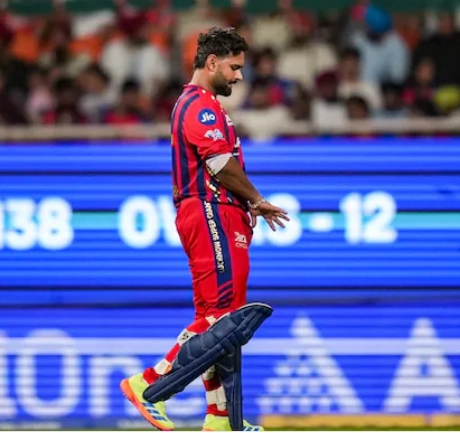
And then came the decisive moment. Abandoning the charge, Pant dropped to one knee and attempted a cross-batted swipe towards mid-wicket. The execution did not match the intent. A faint outside edge carried safely to Dhruv Jurel behind the stumps.
Three balls. Three misreads.
Pant batted as though the chase demanded urgency, as though 260 was on the board rather than 160. The intent was clear, but the judgment was not. Shot selection, balance, and awareness all deserted him in a passage that summed up LSG’s broader struggles.
WHAT LANGER SAID
“I haven’t spoken to him (Rishabh) yet, but he wants to play with freedom. That’s how he plays all his cricket — he’s very instinctive,” Langer said after LSG were bowled out for just 119 in 18 overs. Mitchell Marsh waged a lone battle with a fifty, but the hara-kiri at the top of the order meant they never recovered from 11 for 3 on a pitch that required common sense and patience. Aiden Markram failed, Nicholas Pooran failed, but none threw it away quite like Pant.
“He’s probably feeling the pinch as much as everyone, and he’s in that pivotal position at number three. He came out very aggressively against Punjab — he needed to, because we were chasing 250 — but I think that’s the style of cricket he wants to play. He’ll be as frustrated as anyone that it didn’t come off today.”
Instinctive, then. Or instinctive to a fault?
After all, Justin Langer is not an unfamiliar observer of Rishabh Pant at his most audacious. He watched from the opposition dressing room when Pant became the embodiment of modern fearlessness, dismantling Australia’s fortress at the Gabba. That unbeaten 89 remains one of the defining knocks of the 2021 Border-Gavaskar Trophy, a performance that cemented his reputation as a cricketer unafraid of moments or consequences.
That version of Pant won admiration across dressing rooms, including Langer’s.
TOO MUCH PRESSURE ON PANT?
But in the years since, particularly in white-ball cricket, the returns have not matched the reputation. Which raises a more uncomfortable question: is it the instinct that defines him, or the same instinct that now undermines him?
The swipe on Wednesday did not reflect calculated aggression. It was a shot played without alignment to the situation or surface, and it sat awkwardly with Langer’s defence of ‘backing instincts’. This was not instinct refined by awareness; it was impulse unchecked.
Riyan Parag had, in fact, offered a clue much earlier. At the toss, he spoke about the Ekana surface slowing down in the second innings, an insight drawn from his recent experience here during the Syed Mushtaq Ali Trophy with Assam. It was a small detail, but an important one.
This was never a typical T20 surface. As Langer later suggested, it resembled an Indian version of the WACA: pace and bounce on offer, but not a pitch that allowed batters to dominate without discretion.