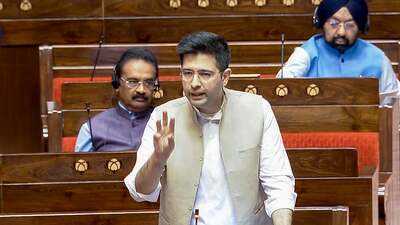
The Aam Aadmi Party (AAP) was rocked by a major political rupture on Friday, 24 April as a group of its Rajya Sabha MPs led by Raghav Chadha announced their decision to merge with the BJP, prompting sharp accusations from the party that the move was orchestrated under the BJP’s controversial ‘Operation Lotus’.
At a press conference in the capital, Chadha said seven of AAP’s 10 Rajya Sabha MPs — meeting the two-thirds requirement under anti-defection provisions — had submitted documents to Rajya Sabha chairman C P Radhakrishnan to formalise their merger with the BJP. Those joining him include Sandeep Pathak, Harbhajan Singh, Swati Maliwal, Ashok Mittal, Rajendra Gupta and Vikram Sahni. Pathak and Mittal stood alongside Chadha at the briefing, underscoring the coordinated nature of the breakaway.
While the scale of the defection is striking, Chadha’s exit itself has been widely anticipated. Once among AAP’s most prominent national figures and a close confidant of party chief Arvind Kejriwal, Chadha had, over recent months, appeared increasingly estranged from the leadership.
His diminished role in key decisions, alongside reported disagreements over electoral strategy and the party’s positioning against the BJP, had signalled a deepening internal divide. Observers had also pointed to his increasingly tempered public criticism of the BJP — a shift that, in retrospect, foreshadowed Friday’s move.
AAP moved quickly to frame the defections as externally engineered rather than internally driven. Senior leader and fellow Rajya Sabha MP Sanjay Singh, addressing a separate press conference, alleged that the BJP had actively orchestrated the split to weaken the party, particularly in Punjab. “This is the work of the BJP under ‘Operation Lotus’,” Singh said, accusing it of attempting to derail the functioning of the Bhagwant Mann government. “The people of Punjab will never forgive the MPs who deserted the Aam Aadmi Party,” he added.
The reference to ‘Operation Lotus’ — a term frequently used by Opposition parties to describe alleged BJP efforts to engineer defections from political rivals — underscores AAP’s attempt to cast the episode as part of a broader political pattern rather than a reflection of internal dissent. However, the months-long tensions surrounding Chadha’s position within the party complicate that narrative, suggesting that both internal fissures and external political pulls may have converged.
For AAP, the immediate impact is a sharp reduction in its strength in the Rajya Sabha and a blow to its claims of organisational cohesion at a time when it is seeking to expand beyond Delhi and Punjab. For the BJP, the induction of a substantial bloc of opposition MPs not only strengthens its numbers in the Upper House but also delivers a symbolic and strategic gain against a rival that has positioned itself as a national challenger.
As both parties brace for the political fallout, the episode marks a decisive turning point for AAP — and the culmination of a rupture that had long been visible beneath the surface.
With PTI inputs