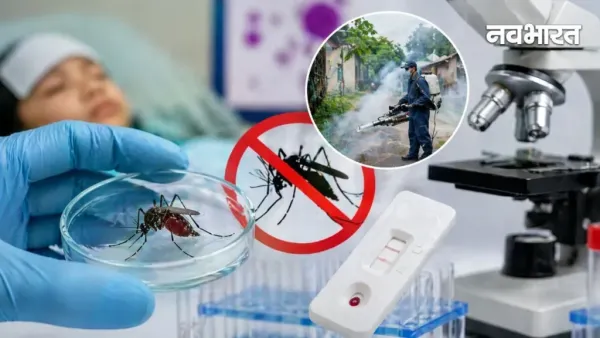
World Malaria Day: The global war against malaria, which has been going on for decades, has now reached a very decisive and historic juncture. World Malaria Day, celebrated every year on 25 April, is not just a means of spreading awareness this year, but is also a demonstration of the scientific progress and global will that has the potential to eradicate this deadly disease. Experts believe that with a combination of modern science and precise strategies, it seems possible to completely eradicate malaria within our lifetime.
The World Health Organization, together with its global partners, has issued a powerful call to action this year to commit to eradicating malaria: We can do it now. Now we have to do it. This slogan reflects the belief that the time has come to take to the end what we have achieved in the last two decades. Statistics from the year 2000 till now show that millions of cases and millions of possible deaths have been averted in time around the world.
Many bright sides of success have also emerged in this fight against malaria. So far, 47 countries of the world have been officially declared ‘malaria-free’ Has been declared. In particular, areas such as the Greater Mekong subregion have proven that cases can be reduced by up to 90 percent, despite difficult circumstances such as drug resistance, if concrete strategies are adopted. However, the figures for 2024 also raise some concerns where an estimated 282 million cases and 6 lakh 10 thousand deaths have been recorded.
Mosquito photo (Ms. Freepik)
Today we have more advanced weapons to fight malaria than ever before. The new generation mosquito nets now account for 84 percent of the total distribution. Along with this, new malaria vaccines are proving to be a game-changer. At present, 25 countries are already providing protective cover to about one crore children through vaccines. Apart from this, genetic modification of mosquitoes and modern injections present in the development stage can bring revolutionary changes in this direction.
Despite progress, the World Malaria Report 2025 points to some serious challenges. Resistance to malaria drugs is being seen in many parts of Africa, which is a major threat. At the same time, conditions like increasing resistance of mosquitoes to pesticides, lack of financial resources and climate change are making this fight more complex.
Ending malaria now requires strong leadership at the national level and strategies tailored to local needs. Scientists say that when we have technology, knowledge and resources, it should not be acceptable for anyone to die due to malaria. World Malaria Day 2026 is dedicated to the belief that if we move forward by uniting and increasing investment in innovation, the end of malaria will no longer be just a dream.