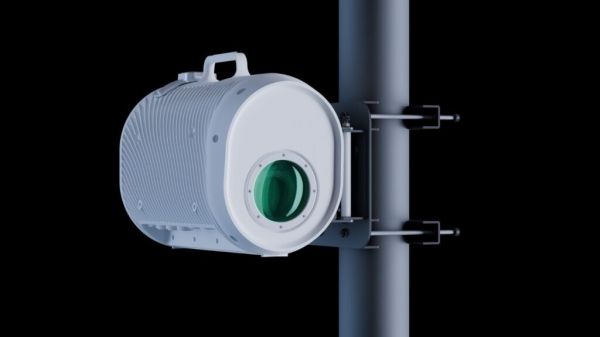
In the United States, cable and fiber-optic internet have been the go-to methods for internet access for most households. More recently, satellites whizzing overhead became a new option. But now, a company called Taara has come up with a third option, and it involves shooting invisible beams of light across the city. And this isn’t some random startup either. It actually broke away from Alphabet’s moonshot factory, known as X, last year. Now, it’s its own thing, though Alphabet still holds onto a minority stake. It’s also backed by outside investors like Series X Capital, who are helping it scale.
But big names aren’t the only thing the company has working in its favor. It has the technology too. Taara’s new product is the Taara Beam, a projector-sized box weighing roughly 17 pounds. It can literally beam internet through the air at speeds of up to 25 Gbps. It does this using near-infrared light, which is the same technology your TV remote uses to talk to your TV.
Unlike fiber-optic cables that require installers to dig up streets, this box doesn’t need an elaborate setup to work either. These boxes can be set up on rooftops, lampposts, or cell towers in a matter of hours. All Taara needs to ensure is that one of these boxes points to another one about 10 kilometers (6.2 miles) away. And as long as nothing blocks the line of sight between the two, you get fiber-level speeds. Moreover, because of that simple installation, Taara doesn’t have to deal with things like spectrum licensing and right-of-way paperwork, which saves money and time.
So how does this stack up against Starlink?
Despite how differently they work, Taara and Starlink ultimately have similar goals, which is getting fast internet to places where digging to lay cables is impossible. For context, Starlink is the next frontier in internet technology, and the way it works involves using a large constellation of low Earth orbit satellites beaming connections down to a dish on your roof.
That’s very different from Taara’s method, which keeps everything on the ground and fires light between towers. One major advantage this approach offers is latency. For Taara, it clocks in at just around 100 microseconds. That blows past anything a space-based network can realistically offer, simply because satellites orbit so far up. Speed is another major advantage. The company’s founder, Mahesh Krishnaswamy, has previously said the tech can deliver 10 to even 100 times the bandwidth of a typical Starlink antenna, at a much lower price, too.
That said, there’s a catch. Taara isn’t designed for you or your neighbor. The primary customers instead are businesses like internet service providers, mobile carriers, data center operators, and even college campuses. That means you can’t outright buy a Taara Beam for your home. Of course, Taara’s customers will pass connectivity along to regular folks.
Can Taara actually pull this off?
Taara has a good chance of pulling it all off. The Beam isn’t even the company’s first product. Lightbridge, the first iteration of the technology, was rolled out back in 2020 when Taara was still a Google subsidiary. The device is the size of a traffic light, works similarly to Beam, and already has a presence in more than 20 countries. The company has partnered with T-Mobile, SoftBank, Airtel, and Digicel. T-Mobile in particular has used the technology at music and balloon festivals to take pressure off nearby 5G networks.
The new Beam isn’t meant to replace Lightbridge, though. It’s meant to complement it by offering a smaller and more flexible option, which it does by trading some of the range. Where Lightbridge’s range stands at roughly 12.4 miles (20 kilometers), Beam tops out at 6.2 miles (10 kilometers). The two can also be used together to cover a whole city.
One major problem Taara faces is the weather. Fog, dust storms, and rain can still mess with optical links. To be fair, weather is one of a few reasons Starlink may not be the best internet service for some people, so it’s hardly a Taara-only problem. Taara’s solution to the weather problem is a companion system called Lightbridge Pro, released in February 2026. It promises 99.999% uptime even in bad weather.