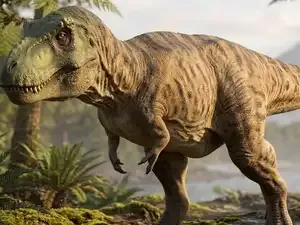
For years the popular media has depicted Tyrannosaurus reptiles as massive, flat-footed, lumbering beast, each step rumbling like an exploding wrecking ball. The iconic chase scene from the 1993 movie Jurassic Park cemented this image into the popular imagination. New research in science challenges the long-held image, and presenting the most nuanced and stunning depiction of how the creature actually was moving.
The most recent research study, An analysis of biomechanical parameters of the foot strike during Tyrannosaurus Rex movement shows that T. reptiles did not move across the floor like the reptilian heavyweight. It likely was walking with a birdlike motion that threw the ground with the soles of its feet instead of the entire foot. This revelation changes the way scientists view dinosaur movements as well as how we think about one of the world's most revered predators.
An evolution from toe-first to flat footed movement
The principle concept that lies at the core of this research is called the concept of digitigrade locomotion which is also known as "toe walking." This is the same pattern found in running birds of today like ostriches. They have the heel stays elevated and the majority of body weight is carried by the front part of the foot. Humans, however, are considered to be plantigrade, meaning the weight is distributed across all of the foot from toe to heel.
Researchers believe that T. Rex was further to the birdside of the spectrum. Instead of putting its entire foot directly to the floor, its had a more sprung and toe-first step. The subtle distinction has major consequences. Digitigrade stances allow more efficiency, enhanced equilibrium, and could lead to more rapid movement in big animals.
Within the research
The study was conducted by Adrian Tussel Boeye, along with co-authors Kyle Logan Atkins Weltman, J. Logan King and deceased Scott Swann. The research brought together knowledge of colleges like the College of the Atlantic in the United States, Oklahoma State University College of Osteopathic Medicine in the United States, and Colorado Northwestern Community College in the United States.
The study was described as the first biomechanical study of the foot strike during Tyrannosaurus movement, the research utilized physics to address a seemingly easy question: what happened when the foot of the dinosaur actually touch the ground?
In order to answer this question researchers measured the fossilized bones of foot and leg as well as applied speed-based models that increase according to body size. They then created three forms of foot strikes, back-foot, mid-foot and toe-first, in order to understand what effect each could have on movements. Results consistently indicated the toe dominance landing pattern.
What are the footprints that reveal
Fossilized footprints that were studied within the field of ichnology provide a further source of evidence. For many of theropod tracks The deepest footprints can be found below the toes rather than throughout the feet. This suggests that animal's mass was placed in the front and supports the concept of digitigrade movements.
But, they took care not to exaggerate this proof. Tracks may vary based upon the conditions of the ground, like sand or mud. Also, elements like shifting or turning may alter the appearance of tracks. This is why studies of fossil tracks are viewed as clues to support the hypothesis as opposed to a conclusive evidence.
Thinking about T. Rex speed
Perhaps one of the more fascinating results of this study is the impact it has on the estimates of T. T. rex's speed. It is predicted that adults could achieve the speed of 11 to 25 miles per hour which is roughly 5-11 meters per second.
It is important to note that adopting a toe-first step can increase estimates of speed approximately 20 percent in comparison with a softer foot strike. However, this doesn't mean T. Rex was an extremely fast speed runner capable of taking cars down However, it is a sign of an improved and more efficient athlete than we had previously believed.
This study also reveals how speed varies in relation to age. Young T. Rex species who are smaller and more agile, could achieve speeds as high as 25 miles an hour. However, the massive adult which included famous animals such as Sue was likely to be limited to 11 miles per hour. The same pattern can be seen in a variety of large animals present day, where growing body mass decreases the the speed at which they can travel.
A long-standing debate
The speed at which T. rex could run has been a subject of debate for a long time. An important study from 2002 by John R. Hutchinson and Mariano Garcia argued that extremely fast speeds will require huge leg muscles, thereby restricting the speed at which these creatures could run.
The research that has been conducted doesn't change the limits but rather refines them, by introducing the foot strike as an important factor. It demonstrates that the way animals move could be as significant as its weight and mass in assessing its performance.
What's the point?
From a first impression it may seem like something minor in terms of technical details however, it's got far-reaching consequences. Knowing how foot strike affects the human body helps researchers interpret the fossil tracks better, create more realistic biomechanical models and can even help improve the way dinosaurs are depicted in films as well as documentaries.
In general, this study is a sign of a rising movement in paleontology towards integrating several evidence sources. Combining skeletal measurements with analyses of footprints and comparing them to living animals, scientists have created a complete understanding of how species that died used to move and walked.
However being cautious is essential. Recent research has also shown that speed estimations based on track data could be inaccurate, especially in areas with uneven or soft surfaces. It is a reminder that there is no one method to give all the information needed.
A larger and more elegant monster
The stereotype of T. T. rex being the flimsy, flat-footed tiger has been gradually changing to an image that is more sophisticated. Although it's still an impressive predator the animal could have walked at a breakneck speed with astonishing grace, with its large frame on its strong feet and bird-like limbs, while stepping at a brisk pace on its heels.
By saying goodbye to Jurassic Park version of T. rex, we are not losing the creature's amazing appearance. Instead, we're getting a more precise understanding of the creature which brings it into the real world, and shows a species which was not only powerful yet also exceptionally capable of adapting to the environment in which it lived.
The most recent research study, An analysis of biomechanical parameters of the foot strike during Tyrannosaurus Rex movement shows that T. reptiles did not move across the floor like the reptilian heavyweight. It likely was walking with a birdlike motion that threw the ground with the soles of its feet instead of the entire foot. This revelation changes the way scientists view dinosaur movements as well as how we think about one of the world's most revered predators.
An evolution from toe-first to flat footed movement
The principle concept that lies at the core of this research is called the concept of digitigrade locomotion which is also known as "toe walking." This is the same pattern found in running birds of today like ostriches. They have the heel stays elevated and the majority of body weight is carried by the front part of the foot. Humans, however, are considered to be plantigrade, meaning the weight is distributed across all of the foot from toe to heel.
Researchers believe that T. Rex was further to the birdside of the spectrum. Instead of putting its entire foot directly to the floor, its had a more sprung and toe-first step. The subtle distinction has major consequences. Digitigrade stances allow more efficiency, enhanced equilibrium, and could lead to more rapid movement in big animals.
Image Credit: Gemini
Within the research
The study was conducted by Adrian Tussel Boeye, along with co-authors Kyle Logan Atkins Weltman, J. Logan King and deceased Scott Swann. The research brought together knowledge of colleges like the College of the Atlantic in the United States, Oklahoma State University College of Osteopathic Medicine in the United States, and Colorado Northwestern Community College in the United States.
The study was described as the first biomechanical study of the foot strike during Tyrannosaurus movement, the research utilized physics to address a seemingly easy question: what happened when the foot of the dinosaur actually touch the ground?
In order to answer this question researchers measured the fossilized bones of foot and leg as well as applied speed-based models that increase according to body size. They then created three forms of foot strikes, back-foot, mid-foot and toe-first, in order to understand what effect each could have on movements. Results consistently indicated the toe dominance landing pattern.
What are the footprints that reveal
Fossilized footprints that were studied within the field of ichnology provide a further source of evidence. For many of theropod tracks The deepest footprints can be found below the toes rather than throughout the feet. This suggests that animal's mass was placed in the front and supports the concept of digitigrade movements.
But, they took care not to exaggerate this proof. Tracks may vary based upon the conditions of the ground, like sand or mud. Also, elements like shifting or turning may alter the appearance of tracks. This is why studies of fossil tracks are viewed as clues to support the hypothesis as opposed to a conclusive evidence.
Thinking about T. Rex speed
Perhaps one of the more fascinating results of this study is the impact it has on the estimates of T. T. rex's speed. It is predicted that adults could achieve the speed of 11 to 25 miles per hour which is roughly 5-11 meters per second.
It is important to note that adopting a toe-first step can increase estimates of speed approximately 20 percent in comparison with a softer foot strike. However, this doesn't mean T. Rex was an extremely fast speed runner capable of taking cars down However, it is a sign of an improved and more efficient athlete than we had previously believed.
This study also reveals how speed varies in relation to age. Young T. Rex species who are smaller and more agile, could achieve speeds as high as 25 miles an hour. However, the massive adult which included famous animals such as Sue was likely to be limited to 11 miles per hour. The same pattern can be seen in a variety of large animals present day, where growing body mass decreases the the speed at which they can travel.
A long-standing debate
The speed at which T. rex could run has been a subject of debate for a long time. An important study from 2002 by John R. Hutchinson and Mariano Garcia argued that extremely fast speeds will require huge leg muscles, thereby restricting the speed at which these creatures could run.
The research that has been conducted doesn't change the limits but rather refines them, by introducing the foot strike as an important factor. It demonstrates that the way animals move could be as significant as its weight and mass in assessing its performance.
What's the point?
From a first impression it may seem like something minor in terms of technical details however, it's got far-reaching consequences. Knowing how foot strike affects the human body helps researchers interpret the fossil tracks better, create more realistic biomechanical models and can even help improve the way dinosaurs are depicted in films as well as documentaries.
In general, this study is a sign of a rising movement in paleontology towards integrating several evidence sources. Combining skeletal measurements with analyses of footprints and comparing them to living animals, scientists have created a complete understanding of how species that died used to move and walked.
However being cautious is essential. Recent research has also shown that speed estimations based on track data could be inaccurate, especially in areas with uneven or soft surfaces. It is a reminder that there is no one method to give all the information needed.
A larger and more elegant monster
The stereotype of T. T. rex being the flimsy, flat-footed tiger has been gradually changing to an image that is more sophisticated. Although it's still an impressive predator the animal could have walked at a breakneck speed with astonishing grace, with its large frame on its strong feet and bird-like limbs, while stepping at a brisk pace on its heels.
By saying goodbye to Jurassic Park version of T. rex, we are not losing the creature's amazing appearance. Instead, we're getting a more precise understanding of the creature which brings it into the real world, and shows a species which was not only powerful yet also exceptionally capable of adapting to the environment in which it lived.