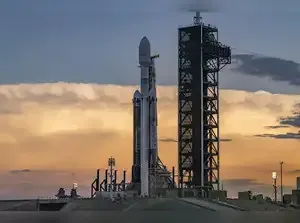
SpaceX stood down from launching its first Falcon Heavy rocket in over a half due to poor weather on Monday, April 27. The countdown was stopped with just seconds remaining, highlighting how sensitive launch operations are to atmospheric conditions.
Officials noted that scheduling could also depend on activity at the Eastern Range, including preparations connected to NASA’s Space Launch System hardware.
The launch from Kennedy Space Center will also showcase the return of the rocket’s two side boosters, which are scheduled to land at Cape Canaveral Space Force Station.
However, meteorologists cautioned of potential concerns related to cloud formations and atmospheric electrical fields. Weather officers described:
“A Carolina Low is expected to push a weak back door cold front through central Florida early Monday morning.”
They stated:
“With the primary window opening around the time the sea breeze will develop, the position of that frontal boundary will determine if clouds are enhanced over the Spaceport.”
Ultimately, these concerns forced SpaceX to scrub the launch attempt.
For this mission:
Which are the Similar Incidents Happened Before?
Launch scrubs like this aren’t rare. In fact, both SpaceX and other agencies have a long track record of delays caused by weather, technical checks, or safety concerns. Here are some notable past incidents:
Unlike delays caused by weather or rocket performance, this particular setback was largely driven by the readiness of the payload and associated spacecraft systems. Before launch approval, all satellite components had to complete final testing, integration checks, and certification processes required for a sensitive national security mission.
In another instance, Crew-10 experienced delays linked to ground-side technical readiness issues, including checks on launchpad systems and hardware validation procedures before liftoff could proceed.
The Falcon Heavy is designed to carry large and heavy payloads into space. It is commonly used for missions requiring high power and long-distance orbital placement.
Q2. Why was the recent Falcon Heavy launch delayed?
The launch was postponed due to unfavorable weather conditions near the launch site. Safety concerns always take priority in space missions.
Officials noted that scheduling could also depend on activity at the Eastern Range, including preparations connected to NASA’s Space Launch System hardware.
Mission Overview: A Major Satellite Deployment
When it lifts off, the mission will send the ViaSat-3 Flight 3 communications satellite into a geosynchronous transfer orbit. The spacecraft, weighing about six metric tons, is expected to separate from the rocket’s upper stage nearly five hours after launch.The launch from Kennedy Space Center will also showcase the return of the rocket’s two side boosters, which are scheduled to land at Cape Canaveral Space Force Station.
Weather Challenges Disrupt Liftoff
The launch was set from Launch Complex 39A with an opening window at 10:21 a.m. EDT. The 45th Weather Squadron had forecasted a 70% chance of favorable conditions.However, meteorologists cautioned of potential concerns related to cloud formations and atmospheric electrical fields. Weather officers described:
“A Carolina Low is expected to push a weak back door cold front through central Florida early Monday morning.”
They stated:
“With the primary window opening around the time the sea breeze will develop, the position of that frontal boundary will determine if clouds are enhanced over the Spaceport.”
Ultimately, these concerns forced SpaceX to scrub the launch attempt.
Falcon Heavy: Power and Reusability
The Falcon Heavy rocket remains one of the most powerful operational launch vehicles, consisting of three booster cores working together.For this mission:
- Two side boosters (tail numbers 1072 and 1075) will separate and return for landing
- The center core (B1098) will be expended in the Atlantic Ocean after completing its mission
A Rare Falcon Heavy Flight
This mission marks the 12th launch of Falcon Heavy since its launch in 2018 and its initial flight in around 18 months. Despite Falcon Heavy’s power, it is used less frequently than Falcon 9, which has conducted hundreds of launches in the same period.Which are the Similar Incidents Happened Before?
Launch scrubs like this aren’t rare. In fact, both SpaceX and other agencies have a long track record of delays caused by weather, technical checks, or safety concerns. Here are some notable past incidents:1. Falcon Heavy Demo Mission (2018)
The first-ever launch of the Falcon Heavy, which ultimately occurred on February 6, 2018, was delayed for several years beyond its originally planned timeline. Early expectations had placed the rocket’s debut around 2013, but development proved far more complex than initially anticipated. Engineers faced major design challenges in scaling up the Falcon 9 architecture into a triple-core configuration, where synchronization of engines, structural loads, and booster separation systems all had to function together flawlessly. Finally launched in 2018, the mission represented the culmination of years of engineering refinement and testing, validating one of the most powerful operational rockets ever built.2. Falcon Heavy USSF-44 Mission (2022)
The Falcon Heavy USSF-44 mission experienced a significant postponement of roughly two years, shifting from its original 2020 target window to its eventual launch on November 1, 2022.Unlike delays caused by weather or rocket performance, this particular setback was largely driven by the readiness of the payload and associated spacecraft systems. Before launch approval, all satellite components had to complete final testing, integration checks, and certification processes required for a sensitive national security mission.
3. Crew Dragon Launch Delays
In multiple cases, launches such as Crew-11 and Crew-12 were delayed because weather conditions at the launch site did not meet strict flight safety criteria. Strong upper-level winds and cloud formations raised concerns about safe ascent and potential lightning risk, prompting mission controllers to hold or scrub attempts.In another instance, Crew-10 experienced delays linked to ground-side technical readiness issues, including checks on launchpad systems and hardware validation procedures before liftoff could proceed.
FAQs:
Q1. What is the Falcon Heavy rocket used for?The Falcon Heavy is designed to carry large and heavy payloads into space. It is commonly used for missions requiring high power and long-distance orbital placement.
Q2. Why was the recent Falcon Heavy launch delayed?
The launch was postponed due to unfavorable weather conditions near the launch site. Safety concerns always take priority in space missions.