
Listen to this article in summarized format
Loading...
××
Subscribe to

Unlock AI Briefing and Premium Content
New Year Offer 24 Hours Left
Subscribe NowAlready a member? Sign In
What's Included
- Exclusive Stories
- Daily ePaper Access
- Smart Market Tools
- Curated Investment Ideas
- Ad-lite Experience
Subscription

Multiple exit polls released on Wednesday projected the Bharatiya Janata Party (BJP) ahead in the fiercely contested 2026 West Bengal Assembly elections, suggesting the party could be on course for a historic breakthrough in a state long dominated by Chief Minister Mamata Banerjee’s Trinamool Congress (TMC).
The projections came after polling for all 294 Assembly seats concluded at 6 pm, capping weeks of intense campaigning, bitter political exchanges and exceptionally high voter participation across the state.
Among the major projections, Chanakya Strategies estimated the BJP could secure between 150 and 160 seats — above the majority mark of 148 — while placing the Mamata Banerjee-led TMC at 130 to 140 seats. Other parties were projected to win between six and 10 seats.
The Matrize exit poll also gave the BJP an edge, projecting the party to win between 146 and 161 seats, while the TMC was estimated at 125 to 140 seats. Here too, other parties were projected in the six to 10 seat range.
Poll Diary projected a wider range but continued to place the BJP ahead, estimating the party’s tally between 142 and 171 seats. The TMC was projected to win between 99 and 127 seats, while other parties were estimated at five to nine seats.
Taken together, the surveys pointed towards a strong BJP surge in Bengal, where the party has spent years expanding its organisational footprint in a bid to dislodge the Trinamool Congress from power. For the TMC, the projections signal what could be its toughest electoral test since Mamata Banerjee first swept to power in 2011.
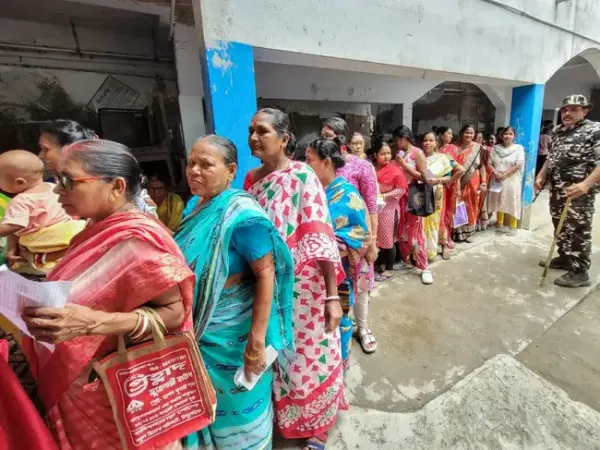
The exit poll numbers emerged after a high-turnout election that saw brisk voting across districts. Till 5 pm, Purba Bardhaman recorded the highest turnout at 92.46%, followed by Hooghly at 90.34%, Nadia at 90.28% and Howrah at 89.44%. North and South 24 Parganas also recorded heavy participation, reflecting the intensity of the contest. Overall turnout before the close of polling was estimated at around 90%.
The election was widely viewed as a direct battle between the incumbent TMC, seeking a fourth consecutive term, and a resurgent BJP hoping to script its first-ever victory in Bengal. The campaign saw aggressive outreach from both camps, with issues ranging from governance and corruption allegations to identity politics, women’s safety and welfare schemes dominating the discourse.
Several prominent political leaders cast their votes during the final phase, including Chief Minister Mamata Banerjee, Leader of Opposition Suvendu Adhikari, TMC national general secretary Abhishek Banerjee, West Bengal BJP president Samik Bhattacharya and Ratna Debnath, the BJP candidate and mother of the RG Kar Medical College rape and murder victim.
Polling day, however, was not without controversy. The final phase also witnessed allegations of violence and intimidation, with rival political parties accusing each other of voter intimidation, booth-level disruption and attempts to influence polling in several constituencies.
While exit polls often shape the political narrative ahead of counting day, West Bengal has historically produced unpredictable electoral outcomes, making the final verdict on May 4 the true test of whether the BJP’s projected surge translates into power — or whether Mamata Banerjee can once again defy the odds.
The projections came after polling for all 294 Assembly seats concluded at 6 pm, capping weeks of intense campaigning, bitter political exchanges and exceptionally high voter participation across the state.
Among the major projections, Chanakya Strategies estimated the BJP could secure between 150 and 160 seats — above the majority mark of 148 — while placing the Mamata Banerjee-led TMC at 130 to 140 seats. Other parties were projected to win between six and 10 seats.
The Matrize exit poll also gave the BJP an edge, projecting the party to win between 146 and 161 seats, while the TMC was estimated at 125 to 140 seats. Here too, other parties were projected in the six to 10 seat range.
Poll Diary projected a wider range but continued to place the BJP ahead, estimating the party’s tally between 142 and 171 seats. The TMC was projected to win between 99 and 127 seats, while other parties were estimated at five to nine seats.
Taken together, the surveys pointed towards a strong BJP surge in Bengal, where the party has spent years expanding its organisational footprint in a bid to dislodge the Trinamool Congress from power. For the TMC, the projections signal what could be its toughest electoral test since Mamata Banerjee first swept to power in 2011.
The exit poll numbers emerged after a high-turnout election that saw brisk voting across districts. Till 5 pm, Purba Bardhaman recorded the highest turnout at 92.46%, followed by Hooghly at 90.34%, Nadia at 90.28% and Howrah at 89.44%. North and South 24 Parganas also recorded heavy participation, reflecting the intensity of the contest. Overall turnout before the close of polling was estimated at around 90%.
The election was widely viewed as a direct battle between the incumbent TMC, seeking a fourth consecutive term, and a resurgent BJP hoping to script its first-ever victory in Bengal. The campaign saw aggressive outreach from both camps, with issues ranging from governance and corruption allegations to identity politics, women’s safety and welfare schemes dominating the discourse.
Several prominent political leaders cast their votes during the final phase, including Chief Minister Mamata Banerjee, Leader of Opposition Suvendu Adhikari, TMC national general secretary Abhishek Banerjee, West Bengal BJP president Samik Bhattacharya and Ratna Debnath, the BJP candidate and mother of the RG Kar Medical College rape and murder victim.
Polling day, however, was not without controversy. The final phase also witnessed allegations of violence and intimidation, with rival political parties accusing each other of voter intimidation, booth-level disruption and attempts to influence polling in several constituencies.
While exit polls often shape the political narrative ahead of counting day, West Bengal has historically produced unpredictable electoral outcomes, making the final verdict on May 4 the true test of whether the BJP’s projected surge translates into power — or whether Mamata Banerjee can once again defy the odds.