A surprise exit poll by Times Now-JVC projecting an NDA victory in Tamil Nadu has sharply diverged from the broader consensus of pollsters, most of whom continue to forecast a comfortable return for Chief Minister M. K. Stalin and the DMK-led alliance.
The JVC projection gives the AIADMK-BJP-led NDA 128-147 seats in the 234-member Assembly, while placing the DMK alliance at 75-95 seats and Others at 8-15 — making it the lone major outlier in an otherwise DMK-leaning exit poll landscape.
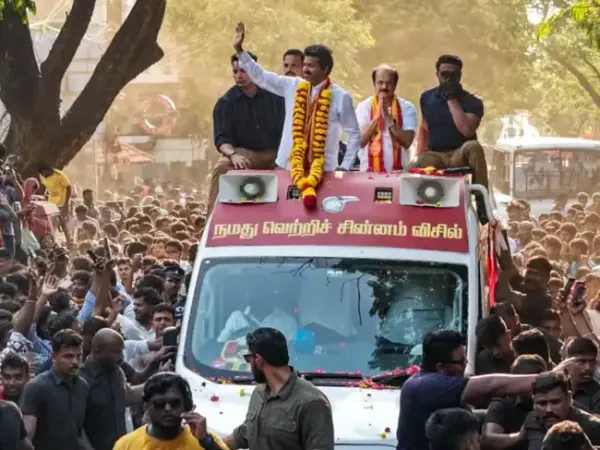
The key variable behind the divergence appears to be actor-politician Joseph Vijay and his fledgling Tamilaga Vettri Kazhagam (TVK), whose electoral impact has become the biggest unresolved question of the election.
Most agencies have worked on the assumption that TVK, despite generating massive crowds and media attention, would struggle to convert popularity into seats because of weak booth-level machinery and the absence of alliance support. But the JVC projection appears to assume a far more disruptive role for Vijay — particularly as a spoiler for the DMK’s anti-incumbency opponents.
The election has effectively become a referendum on Stalin’s five years in office, but it is also being watched as a test of whether Tamil Nadu’s entrenched Dravidian duopoly can withstand the arrival of a new-age political celebrity with a large youth following.
Unlike previous film stars who entered alliances early, Vijay has carefully positioned TVK as an independent anti-establishment force. Party leaders repeatedly stressed that he entered politics “to become chief minister”, not as a junior ally in an AIADMK-NDA arrangement — helping TVK retain ideological clarity and outsider appeal, especially among urban voters and first-time entrants to the electorate.
That positioning, however, has created a strategic dilemma for the opposition space.
TVK’s support base — younger voters, urban middle classes and politically disengaged sections — overlaps heavily with constituencies the AIADMK-led NDA has also been trying to consolidate. Rival parties, especially within the NDA, had warned throughout the campaign that a fragmented anti-DMK vote could ultimately benefit Stalin.
The JVC projection appears to reflect precisely that scenario: Vijay may not be winning large numbers of seats himself, but he could be slicing enough opposition votes away from the AIADMK-BJP combine in key constituencies to reshape the electoral arithmetic.
Most other pollsters, however, believe the impact will remain limited.
People Pulse has projected 125-145 seats for the DMK alliance and 65-80 for the NDA, while estimating TVK at just 2-6 seats. Matrize projected the DMK alliance at 122-132 seats and the NDA at 80-100, while placing TVK between 0 and 6 seats. P-MARQ similarly forecast 125-145 seats for the DMK alliance and 60-70 for the AIADMK-led bloc, with TVK at 1-6 seats.
Only People Insight assigned TVK a potentially significant breakthrough, projecting 30-40 seats for Vijay’s party, though even that survey still forecast a DMK victory overall.
Political observers say TVK’s challenge lies not in narrative-building but in electoral conversion. Vijay’s campaign, centred on anti-corruption messaging, governance reform and youth-focused economic promises, has resonated strongly with sections of urban Tamil Nadu. Proposals around employment-linked incentives, localised job creation and support for creators were designed to appeal to younger aspirational voters looking beyond traditional welfare politics.
But Tamil Nadu elections have historically been decided as much by cadre depth, caste coalitions and booth management as by charisma or messaging.
By contesting alone instead of entering an alliance, TVK preserved its independent identity but also gave up the organisational advantages of established political networks — especially in rural regions where the DMK and AIADMK retain formidable grassroots machinery.
That trade-off has made Vijay the biggest wildcard of the election: a force capable of reshaping margins across constituencies even if his party falls short of a statewide breakthrough.
Polling across all 234 Assembly constituencies concluded on April 23 with a voter turnout of 82.24% by 5 pm, according to the Election Commission. Karur recorded the highest turnout at 89.32%, followed by Salem at 88.02% and Erode at 87.59%, while Chennai registered 81.34%.
Votes will be counted on May 4.
The JVC projection gives the AIADMK-BJP-led NDA 128-147 seats in the 234-member Assembly, while placing the DMK alliance at 75-95 seats and Others at 8-15 — making it the lone major outlier in an otherwise DMK-leaning exit poll landscape.
The key variable behind the divergence appears to be actor-politician Joseph Vijay and his fledgling Tamilaga Vettri Kazhagam (TVK), whose electoral impact has become the biggest unresolved question of the election.
Most agencies have worked on the assumption that TVK, despite generating massive crowds and media attention, would struggle to convert popularity into seats because of weak booth-level machinery and the absence of alliance support. But the JVC projection appears to assume a far more disruptive role for Vijay — particularly as a spoiler for the DMK’s anti-incumbency opponents.
The election has effectively become a referendum on Stalin’s five years in office, but it is also being watched as a test of whether Tamil Nadu’s entrenched Dravidian duopoly can withstand the arrival of a new-age political celebrity with a large youth following.
Unlike previous film stars who entered alliances early, Vijay has carefully positioned TVK as an independent anti-establishment force. Party leaders repeatedly stressed that he entered politics “to become chief minister”, not as a junior ally in an AIADMK-NDA arrangement — helping TVK retain ideological clarity and outsider appeal, especially among urban voters and first-time entrants to the electorate.
That positioning, however, has created a strategic dilemma for the opposition space.
TVK’s support base — younger voters, urban middle classes and politically disengaged sections — overlaps heavily with constituencies the AIADMK-led NDA has also been trying to consolidate. Rival parties, especially within the NDA, had warned throughout the campaign that a fragmented anti-DMK vote could ultimately benefit Stalin.
The JVC projection appears to reflect precisely that scenario: Vijay may not be winning large numbers of seats himself, but he could be slicing enough opposition votes away from the AIADMK-BJP combine in key constituencies to reshape the electoral arithmetic.
Most other pollsters, however, believe the impact will remain limited.
People Pulse has projected 125-145 seats for the DMK alliance and 65-80 for the NDA, while estimating TVK at just 2-6 seats. Matrize projected the DMK alliance at 122-132 seats and the NDA at 80-100, while placing TVK between 0 and 6 seats. P-MARQ similarly forecast 125-145 seats for the DMK alliance and 60-70 for the AIADMK-led bloc, with TVK at 1-6 seats.
Only People Insight assigned TVK a potentially significant breakthrough, projecting 30-40 seats for Vijay’s party, though even that survey still forecast a DMK victory overall.
Political observers say TVK’s challenge lies not in narrative-building but in electoral conversion. Vijay’s campaign, centred on anti-corruption messaging, governance reform and youth-focused economic promises, has resonated strongly with sections of urban Tamil Nadu. Proposals around employment-linked incentives, localised job creation and support for creators were designed to appeal to younger aspirational voters looking beyond traditional welfare politics.
But Tamil Nadu elections have historically been decided as much by cadre depth, caste coalitions and booth management as by charisma or messaging.
By contesting alone instead of entering an alliance, TVK preserved its independent identity but also gave up the organisational advantages of established political networks — especially in rural regions where the DMK and AIADMK retain formidable grassroots machinery.
That trade-off has made Vijay the biggest wildcard of the election: a force capable of reshaping margins across constituencies even if his party falls short of a statewide breakthrough.
Polling across all 234 Assembly constituencies concluded on April 23 with a voter turnout of 82.24% by 5 pm, according to the Election Commission. Karur recorded the highest turnout at 89.32%, followed by Salem at 88.02% and Erode at 87.59%, while Chennai registered 81.34%.
Votes will be counted on May 4.