Inside, photographers moved back and forth with reflectors lining narrow walkways. Many people changed outfits, applied makeup and waited for their turn to pose.
Delima, 30, a tourist from Malaysia, waited 30 minutes for a seat. “I almost left because I thought this was an influencer event,” she says.
She says she found the café through social media recommendations and was surprised when the staff explained that the crowd was simply customers there to take photos, something not done in Malaysia.
Nur Delima, 30, from Malaysia, is stunned by the massive crowds taking photos in April 2026. Video courtesy of Nur Delima
After a year in Hanoi, Aleksandra Sorokina, a 24-year-old Russian language teacher, says she has grown used to seeing young people lining up for photos in streets, cafés, and alleyways. “I used to think those places had some special historical significance, but it turns out they don’t.”
In Sorokina’s hometown, she does not encounter such scenes not just because of non-Asian concepts like personal space but also because taking photos for extended periods in public is considered impolite.
She views it as a cultural trait, with Vietnamese people expressing confidence and creativity by turning every street corner into an artistic backdrop.
The scene reflects Vietnam’s growing “check-in culture,” in which young people visit trendy locations primarily to take photos for social media, something thathas drawn attention and sparked debate online.
Videos capturing foreigners’ reactions to the trend have also attracted thousands of interactions on social media in recent months. “I’ve asked many people, and they say this habit stems from the desire to preserve memories,” Delima says.
Other opinions suggest that the rise of freelance work such as content creation and online reviews, along with the “fear of missing out” on trending locations, has fueled the trend.
|
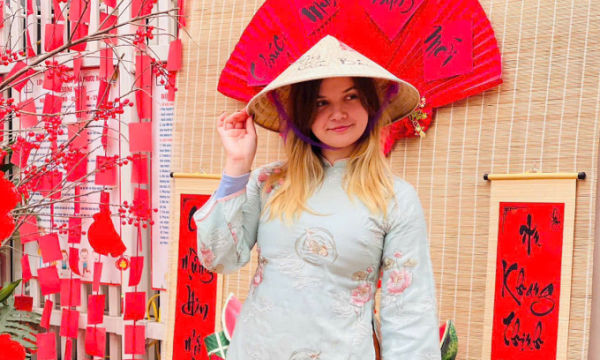
Aleksandra Sorokina, 24, from Russia, joins the trend of posing for photos in the Ao Dai in Hanoi, 2025. Photo courtesy of Aleksandra Sorokina |
For enthusiasts, cafés have become an “ideal studio.” “Instead of paying VND250,000- 500,000 (US$10-20) per hour for a professional studio, I choose cafés with nice spaces and natural light,” Le Thuy, a 27-year-old model in Hanoi, says.
She says one inconvenience of taking photos at cafés is the limited space for props, but she tries to stay organized and ask permission.
At venues that charge photography fees, she is willing to pay, she says. The presence of people taking photos does make it difficult to find a quiet space to meet friends, she admits, adding: “Now, if I want some peace and quiet, I can only go to cafés specifically designed for working.”
Hoang Hai Anh, 21, of Ho Chi Minh City says dressing up for public photo shoots boosts her confidence, and that she often waits hours at popular locations. “Taking photos at places that are popular with the community makes me feel like I’m keeping up with society. Waiting to get a beautiful photo is also part of the experience.”
The trend has prompted some businesses to impose restrictions: In Hanoi and HCMC, many cafés have banned professional cameras or introduced fees of VND300,000-600,000 per hour.
Nguyen Thu Huong, 43, a café owner in Hoan Kiem Ward, says she frequently sees groups of customers bringing suitcases of clothes and occupying restrooms for extended periods to change outfits.
“To protect customers who need a quiet space, we have to limit equipment. Guests who sit and do their makeup for too long are charged VND150,000 per hour. Photography crews are only allowed to stay for one to two hours.”
But on the other hand, some café owners see this as an opportunity for free promotion.
Duy Nam, 32, who owns a café in HCMC, says seasonal décor designed for photos has helped attract younger customers. “When people come to take pictures, it increases visibility for the café.”
 |
|
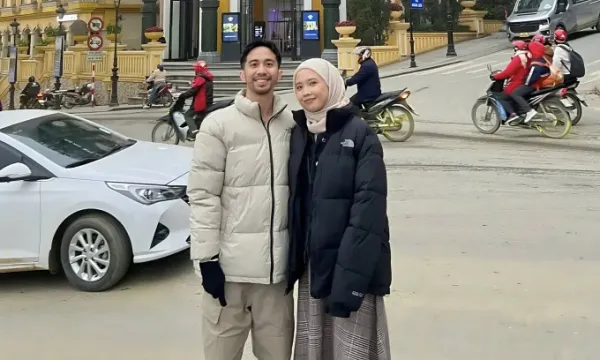
Nur Delima (right), 30 and her husband during their trip to Vietnam in 2026. Photo courtesy of Nur Delima |
Associate Professor Dr. Pham Ngoc Trung, former faculty head at the Academy of Journalism and Communication, says the phenomenon reflects a need to assert personal identity as living standards improve.
He adds that it also serves as an effective promotional channel for destinations, contributing to the growth of the service economy. “Occupying shared spaces for too long to take photos can long can be seen as inconsiderate.”
He says young people should establish more mindful social norms, and it is important to take photos responsibly in public spaces and avoid inconvenience to others.
Monica Niebrit, a 26-year-old American tourist, says the trend helped her discover new places in Hanoi and HCMC. She once hired a photography studio to experience life like a local, and was surprised to see makeup done at café tables. “Everyone likes having nice photos, but in the west people are often hesitant because it’s not a common habit.”
Sorokina says she has become somewhat “Vietnamized,” even wearing traditional ao dai for photos with colleagues during holidays. “I now see it as positive, as long as it doesn’t disturb anyone. Posting photos on social media is also a way for people to share their lives.”