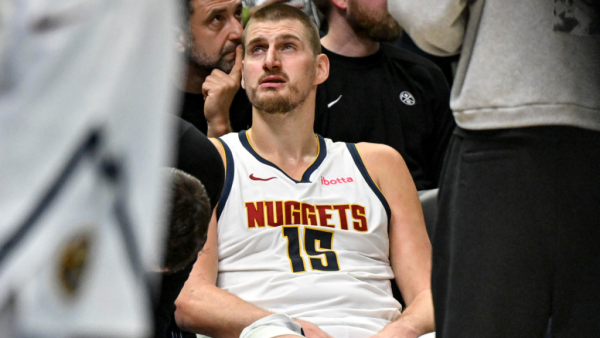
A few minutes after the Denver Nuggets lost Game 4 of their first-round series against the Minnesota Timberwolves, their former coach, George Karl, offered an interesting observation. “Championship windows open and close faster than ever in the NBA,” the former Coach of the Year posted. There’s definite truth to that. Look no further than San Antonio picking second in last year’s draft and winning 62 games this season, or the fact that it’s been eight years since we’ve seen a repeat NBA champion. But where the Nuggets are concerned, the story is a bit more complicated.
It seems like the Nuggets should be at the peak of their powers right now. Jokić was in the MVP race for most of the season. Jamal Murray had his best season. They were unstoppable when healthy in the regular season. They only won their championship three years ago. How could they lose like this? Not in a glorious battle against San Antonio or Oklahoma City like everyone expected, but to an extremely shorthanded Timberwolves team that was already missing many of the pieces that helped them beat Denver two years ago? How could the window close this quickly?
The answer is that it didn’t. Denver’s window didn’t close too soon. It opened too late. On March 25, 2021, the Nuggets traded for Aaron Gordon. It looked like that’s when the window opened. For around three weeks, they were world-beaters. And then Murray tore his ACL. The timing of the injury cost Denver two postseasons. The window didn’t really open until 2023, the year Denver won the title. You have four seasons worth of playoff memories of this team, but it’s a six-year-old core. In the modern NBA, how many cores last that long?
The Nuggets have already taken many of the steps that long-lived contenders take to supplement such groups. They changed coaches last year. They traded a major player — Michael Porter Jr. — in a move that seemed like it would help on the court but was also fairly transparently motivated by finances (the Nuggets managed to duck the luxury tax at the trade deadline). They’re now mostly out of tradable draft picks. There’s not much youth left and, where it exists, it’s no longer cheap. These are the traditional ways in which contenders decay. They just seem like they’re happening for Denver earlier than they should because they didn’t get to reap the short-term benefits of building this team until two years after it came together. This group is older, more expensive and more leveraged than it feels, and that leaves them enormously vulnerable moving forward.
Gordon has struggled with muscle injuries for two years. That probably isn’t getting better in his 30s. Jokić’s defense almost certainly isn’t. They have little to trade in the name of supporting them. And then there’s the money.
Jokić makes the max and has for some time. Same with Murray. Gordon is about to start an extension that takes him from an average of around 16% of the cap to about 20% of the cap, just as his body may be breaking down. Cam Johnson was a step down from Porter Jr. on price, but is still owed more than $23 million. And then there’s Christian Braun, coming off a miserable fourth season in which he didn’t make shots or impact games defensively at nearly the level he did a year ago.
The five of them together, plus the depth players still under contract, essentially take Denver to the second apron line next season… without including breakout wing Peyton Watson, Sixth Man of the Year finalist Tim Hardaway Jr. or filling out the rest of the roster. Running back this roster, the one that couldn’t even beat the hobbled Timberwolves, would mean going perhaps $20-30 million above the second apron as a repeat luxury tax payer.
There are owners who might take on a half-billion-dollar payroll to field a genuine championship contender. Joe Lacob and Steve Ballmer, for instance. Denver has paid the tax consistently in this era, but very little that the Nuggets have done in roughly a quarter-century under their ownership suggests that the Kroenkes will be willing to go to such an extreme. This is a franchise that didn’t get a G-League team until 2021, that still practices in its arena rather than a separate, dedicated facility. They’ve simply never been known as an especially profligate franchise. They let the general manager who built this roster, Tim Connelly, walk for a bigger offer in Minnesota. If there is a firm budget here, the Nuggets probably have to either let Watson walk in restricted free agency or dump the contract of either Johnson or Braun before re-signing him in order to trim the tax bill to a more manageable level.
This is the financial reality of the NBA, especially in a smaller market. It is also, at least from a competitive perspective, absolutely unconscionable. Jokić is the greatest player in franchise history and, even if the team is nearing the end of this version of its lifecycle, he, personally, is still relatively close to the peak of his powers. Denver has almost no history of attracting star free agents, they have basically no picks to trade, and even when they do eventually get their own picks back, the lottery rules are about to change, likely making it more random than ever.
It might be decades before the Nuggets have another player like Jokić. Between the bargain basement rookie deal he signed as a second-round pick, the artificially capped max contracts he’s played on since, the literal revenue his presence has allowed the team to generate at the gate and the hypothetical franchise valuation boost a period of sustained winning can generate, the amount of surplus value employing Nikola Jokić has generated for the Denver Nuggets is almost incalculable. Weakening his team and hurting his chance at a second championship, even if it means saving hundreds of millions of dollars, would send the somewhat insulting message that the team’s business interests outweigh his competitive ones.
And that brings us to the single most important decision of this offseason. Nikola Jokić can become a free agent in 2027. He is now, essentially, on an expiring contract. He could have extended that contract last offseason. There were real financial reasons why he didn’t, and he has indicated at every turn that he plans to do so this offseason. Nonetheless, at this moment, Jokić is only committed to the Nuggets for one more year.
Normally, this is the point where we’d talk about trades and free-agent rumors. By now, you surely know the Lakers have carved out the cap flexibility to pursue a max player in the summer of 2027. They also employ Jokić’s friend Luka Dončić. Realistically, Jokić can play anywhere he wants. There is not a team in the NBA — save perhaps the Thunder — that would not move heaven and Earth to either convince Denver to trade him to them or clear the cap space to sign him outright.
Jokić has made it clear that the team he wants to play for is Denver. “Even if we never win anything else after this, an organic title, it means more to me than anything,” he said earlier this year. After the season-ending loss, he said he wants to be a Nugget forever. It’s ultimately his choice. He’s planted roots in Denver. If he’d rather play his entire career in one city than maximize his chances at another championship in a city, then he’s free to do so. He just doesn’t have to make it easy on the Nuggets.
Jokić is never known to have exerted the leverage his status as a franchise player affords him. He is not, say, LeBron James. While he has seemingly shared preferences with Denver’s front office, such as his interest in playing with Russell Westbrook two summers ago, he is never known to have made demands or used the threat of potentially leaving to compel certain roster moves.
But the Nuggets, right now, simply do not have a big enough margin of error to trim payroll if they plan to genuinely compete with the Thunder and Spurs moving forward. If the goal is to maximize this championship window, Jokić’s best move might be to hold off on re-signing until the Nuggets have shown him they’re willing and able to keep up a championship-caliber roster on the floor. If they want to let a valuable player like Watson or Johnson go for nothing, well, then they deserve to sweat out a year of Jokić rumors even if the end result is still a return.
This might not be in him. Every star is different. Some are more aggressive about these things than others. Some need to be more aggressive about these things than others. It was always easy for Stephen Curry and Tim Duncan to leave their front offices alone because their intentions and capabilities were rarely in question. James has had to take a more active role in his team’s affairs because so many of his teams have been either poorly or frugally run. Cleveland’s mismanagement in LeBron’s first tenure is well known. The Heat waived his friend and teammate, Mike Miller, immediately after their second championship strictly to save money. By the time James returned to Cleveland, he’d had enough. His second Cavaliers stint included only short-term deals because he needed the power to hold his team accountable.
Jokić has always seemingly been on the Duncan-Curry end of that spectrum. That only really works if you play for the sort of organizations Duncan and Curry played for. At this moment, it isn’t clear that Jokić does.
There’s no immediately apparent scenario in which trading Jamal Murray makes sense. He’s going to make his first All-NBA Team this season. He’s 29 and at the peak of his powers. One of Denver’s primary weaknesses is a lack of shot-creation beyond Murray and Jokić, so removing him from the equation would simply put too great a burden on his shoulders.
Besides, trading for picks and young players wouldn’t be especially helpful here. The idea is to maximize Jokić’s presence, while he’s still good enough to potentially be the best player in a series with Victor Wembanyama or Shai Gilgeous-Alexander. The moment that’s no longer true is the moment Denver’s window is officially closed, so unless they could flip any assets gained for Murray into shot-creation that also improves their defense (not possible), there’s no good reason to consider this.
Gordon is the more interesting question. He’s Mr. Nugget, the player that unlocks their ceiling both defensively (he not only defends elite forwards, but can switch onto centers and guards) and offensively (his mind-meld with Jokić as a cutter is unparalleled). He’s also an enormous health risk, and who he is at his best may no longer be as relevant as who he can reasonably be expected to be moving forward.
Does Gordon have much trade value? Perhaps to the right team, though all of the injury risks that apply to Denver would carry over. The Nuggets would never find a player who can do the things he does better than Gordon himself. Maybe they could divide his contract into multiple players who bring different things to the table? Would Watson be ready to replace him as a full-time starter? In some ways yes, in others no. He can cut off of Jokić and he’s made his corner 3s this season. He’s nowhere near as versatile defensively as Gordon, though. He’s better suited defending guards and smaller wings, and Gordon has been their backup center in so many important playoff games that Denver would need a different solution there.
Braun has negative trade value at this stage. Usually, the solution to negative trade value is to trade it for a superior player with an even worse contract. How many such players even exist? It’s not like Jakob Poeltl makes sense for the Nuggets. Johnson is good enough for the Nuggets to safely dump the contract. He’s not so good that he’d be likely to return major value. Their only tradable first-round pick is No. 26 this year, and it’s only movable after the draft.
If there’s a major move here, it’s probably some sort of Hail Mary. Are things bad enough in Houston’s locker room that the Rockets would consider something like Gordon, Braun or Johnson and No. 26 for Kevin Durant? Maybe the same package could swipe Anthony Davis? None of this seems especially likely. If there’s a big name coming to Denver, it’s someone old, someone injured, someone overpaid, or someone scaring off richer suitors through some other means. Don’t count on a big trade coming to the rescue here. If the Nuggets are going to bounce back, it probably means betting on continuity, tinkering around the edges and hoping circumstances eventually prove more favorable.
In a world in which the Nuggets let a key player go and do little to replace him, it is highly unlikely that they will ever have the NBA’s best roster for the remainder of Jokić’s prime. Their best players are unlikely to improve based on where they are on the standard age curve. That’s not true for San Antonio and Oklahoma City, who are already better than the Nuggets are, or for many of the league’s younger, ascending teams. Never say never, of course, but if the healthy Nuggets minus Watson faced the healthy Thunder in a seven-game series next spring, Oklahoma City would be heavily favored.
But here’s the thing about Karl’s theory on windows: they can open and shut quickly, but they don’t need to open or shut just once. Take the Warriors. Their window was wide open for five seasons, from 2015 through 2019. They made the Finals in all five seasons, winning three of the first four and entering the fifth, assuming they could get the injured Kevin Durant back, as heavy favorites. In that series, Klay Thompson tore his ACL and Durant tore his Achilles. Durant left as a free agent weeks later. Golden State fell to the lottery in 2020 and was knocked out in the Play-In Tournament in 2021. Their window, at that moment, appeared closed.
Obviously, it wasn’t. The Warriors won the 2022 championship. I could write 10,000 words on how precisely that happened, but for Denver’s purposes, it boiled down to three things:
We like to believe that the best team wins the championship every year. The reality is that they don’t. The NBA is chaotic. Sometimes championship windows are measured in years. Sometimes it’s days. If the NBA were predictable, we’d expect the Spurs and Thunder to be essentially untouchable for the foreseeable future. Well, a few years ago, that’s where we thought the Nuggets were headed. It doesn’t work that way.
There are going to be years when you’re healthy and those teams aren’t. There are going to be years when those teams make bad decisions that close their windows. There are going to be years when weird stuff just happens and a red carpet to the Larry O’Brien Trophy is cleared for someone you’re not expecting.
But as the Warriors showed us, you can’t just hope the stars align. Fortune favors the prepared. The Warriors paid a huge chunk of change to keep themselves in the hunt. The Nuggets are probably going to have to do the same, because this six-year run has bled them dry. They’re out of assets and financial wiggle room to add external talent. If Watson or Johnson or even Braun isn’t on the team next year, there’s just no obvious way to replace their production. Their margin for error isn’t big enough to lose talent for nothing.
Late-prime Jokić will have a chance to keep competing just as late-prime Curry did if his team takes the gravity of his presence as seriously as Curry’s did. The Warriors have by no means been managed perfectly, but their commitment to Curry’s championship windows has never been in doubt. That expiring contract is Jokić’s greatest weapon in extracting that same commitment out of the Nuggets, because if they’re not willing to make it, there is no shortage of other teams that are.