Early twentieth-century analysis carried out by Henry Ford and his associates focused on examining the flow of operations in various industries. One key finding from observing meatpacking plants, especially those in Chicago, was the disassembly line, which systematically dismantled animals' bodies into parts in a set order. As opposed to constructing something piece by piece, this operation followed an opposite approach that involved breaking up the product from a whole into its constituent parts along a chain of stations. According to research by the University of California, Davis, Ford played the role of not an independent inventor but a synthesizer of knowledge. In meatpacking plants, one could clearly see a staged workflow wherein employees executed certain actions at predetermined stages of production as products proceeded along the production line.
Furthermore, PubMed Central studies suggest that continuous motion in meat processing served as an example of applying the same principle to other industries. In particular, Ford realized that while meatpacking operations involved sequential processing that increased efficiency due to dividing work into repetitive tasks, the process could be inverted and utilized in construction projects.
In addition, Ford created what was later known as a moving assembly line, where the product, and not the laborer, was in motion. This innovation allowed for increasing efficiency and reducing the number of unnecessary moves. Laborers did not need to move around to perform their tasks anymore; their tasks came to them. Literature on Production and Operations Management states that such innovation can lead to high efficiency improvements.
What Ford has accomplished was not inventing something entirely new. What he did was identify a way by which the system already in place could be used. The insight gained from observing the process in the meatpacking industry only led to the creation of the system.
Furthermore, PubMed Central studies suggest that continuous motion in meat processing served as an example of applying the same principle to other industries. In particular, Ford realized that while meatpacking operations involved sequential processing that increased efficiency due to dividing work into repetitive tasks, the process could be inverted and utilized in construction projects.
Turning Disassembly Into Assembly
The important difference in Ford’s way of thinking was the direction in which he applied the concept. Rather than disassembling components, the line could be used to assemble them together. As the goods proceeded through the manufacturing process, different pieces would be assembled, and each operator had their task. The concept needed more than just the observation phase; it needed an adaptation to suit the process being observed. Research on industrial engineering shows that cross-industry transfer of innovation is accompanied by changes to the concept. Conveyors, uniform pieces, and work scheduling were adapted into the system developed by Ford.In addition, Ford created what was later known as a moving assembly line, where the product, and not the laborer, was in motion. This innovation allowed for increasing efficiency and reducing the number of unnecessary moves. Laborers did not need to move around to perform their tasks anymore; their tasks came to them. Literature on Production and Operations Management states that such innovation can lead to high efficiency improvements.
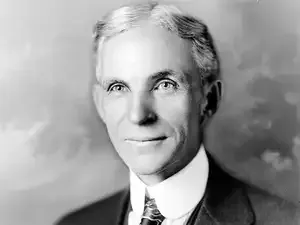
Henry FordImage Credit: Wikimedia Commons/Public Domain
A Model That Reshaped Manufacturing
The effects of the assembly line went much further than the auto industry. It represented a novel system in terms of manufacturing, where efficiency relied on flow and division. As highlighted in the Research in Business History Review, the assembly line became a key component of modern manufacturing in various industries, including electronics and food manufacturing. This system helped the organizations produce their products faster and cheaper, increasing consumer access.What Ford has accomplished was not inventing something entirely new. What he did was identify a way by which the system already in place could be used. The insight gained from observing the process in the meatpacking industry only led to the creation of the system.