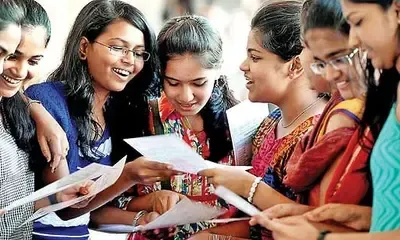
Bengaluru: A record number of students passing the SSLC Examination-1 this year has led to a sharp rise in demand for Pre-University (PU) college admissions across Karnataka.
Except for the COVID-19-affected year 2021, this is the highest number of students passing in the last seven years. In 2021, 8,71,443 students appeared and 8,71,438 passed. This year, 8.56 lakh students appeared for SSLC Examination-1, out of which 7.60 lakh passed, recording a pass percentage of 88.73.
With many students scoring high marks due to internal assessments, the number of high scorers has increased significantly. In 2025, a total of 4,05,227 students scored above 60% across all three SSLC exams, while this year the number has risen to 4,82,218 in Examination-1 alone.
This means nearly 75,000 more students scored above 60% compared to last year. Similarly, students scoring above 80% have increased from 1,52,854 last year to 1,98,610 this year. This has intensified competition for PU seats.
At the same time, more students from CBSE and ICSE backgrounds are choosing the state PU system after Class 10. With SSLC Examination-2 yet to be conducted, the demand for PU seats is expected to rise further. Parents are applying to multiple colleges and, in some cases, are ready to pay higher fees or use influence to secure seats in reputed institutions.
Currently, there are 5,891 government, aided and unaided PU colleges in the state. Seats in reputed colleges are already filled, and cut-off marks in such institutions have crossed 90%.
Government says no shortage of seats
According to the government, there is no shortage of PU seats. Data from the Department of Pre-University Education shows that there are 935 aided PU colleges with 3,20,400 seats, 3,639 unaided colleges with 7,99,680 seats, and 1,317 government PU colleges with 1,77,000 seats.
In total, around 12.97 lakh seats are available across the state. Additional seats are also available in residential PU colleges and BBMP PU institutions.
Concerns over faculty and infrastructure
Education experts have raised concerns that while seats may exist on paper, there may not be enough lecturers or infrastructure to support the large number of students. The highest number of students appearing for II PU exams in the last seven years was 7.02 lakh in 2023.
Demand is particularly high for science and commerce streams. Most seats in these streams in reputed private colleges have already been filled.
Responding to the situation, Director of the Department of Pre-University Education S. Bharath said that even during the COVID period when all students passed SSLC, there was no seat shortage in PU colleges. He added that around 250–300 new PU colleges have been established in the last two to three years, and students will not face difficulties in getting admissions.
He further stated that if any shortage arises, steps will be taken to increase the number of seats based on available infrastructure in PU colleges.