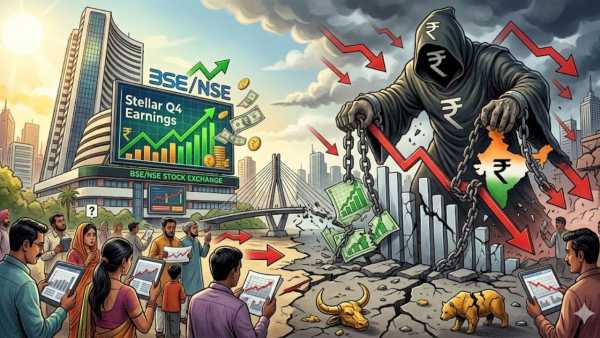
In the recent quarterly results, the performance of the companies has been seen to be much better. Especially the quarterly results of private banks have performed brilliantly. Which includes HDFC Bank, ICICI Bank and Kotak Mahindra Bank. In which there has been a significant increase in profit. On the other hand, the quarterly results of more than two dozen companies like Mahindra & Mahindra, Ambuja Cements, Coforge, Jindal Stainless, Tata Tech, Godrej Properties, Aditya Birla Capital, Exide Industries, BHEL, UBL, PNB, NSE, Hero Moto Corp, GHCL, Poonawala Fincorp, Marico, Ajanta Pharma, Emcure Pharma etc. have been quite impressive.
Even after that, the stock market has not reacted the way it should. Where on May 4, the stock market gained 1000 points during the trading session and finally closed with a loss of around 350 points. On the other hand, on Tuesday both Sensex and Nifty appeared under pressure. According to experts, pressure is not being seen in the stock market just like that. In both the trading sessions of the month of May, a big fall in the rupee was seen and the figure crossed the level of 95.
On the other hand, the prices of crude oil are currently seen at $ 110 per barrel. Also, the period of selling by foreign investors is not over yet. In the current year, foreign investors have withdrawn more than Rs 1.97 lakh crore. On the other hand, in the current month, foreign portfolio investors have withdrawn more than Rs 5 thousand crores. These are the three reasons due to which pressure is being seen in the stock market. Let us try to understand these three in detail…
The tension in the Strait of Hormuz is showing no signs of decreasing. There are reports of some sporadic relief, but after that the tension increases again. Due to which the prices of crude oil are seen not only around $100 but also around $110 per barrel. Due to which tension is being seen in the stock market. Also, the impact of quarterly results and other domestic positive sentiments is not visible at all in the stock market.
Dr. VK Vijayakumar, Chief Investment Strategist of Geojit Investments Limited, said in the media report that the enthusiasm given to the market due to BJP's election victory in West Bengal and strong quarterly results will not last long. He said that the trend of the market will be decided by the events happening in West Asia, especially in the Strait of Hormuz. The increasing tension in the Hormuz region and the rise of Brent crude again to around $ 110 are the factors creating difficulties for the market.
The special thing is that investors completely ignored the huge profits in the quarterly results of many big companies of the country. They believe that increasing import bills could weaken the country's macro-economic fundamentals, leading to a decline in people's purchasing power and companies' earnings.
The Indian rupee slipped to a record low on Tuesday. The attacks between the US and Iran in the Gulf region jolted markets, reducing hopes for a solution to the problem and deepening concerns about the risks facing oil-importing economies. The currency weakened to 95.40 per dollar, which was a decline of 0.3 percent on the day. It also left behind its previous life time lower level of 95.33 made last Thursday. The rupee has fallen 4.5% since the Iran war began on February 28, in line with the decline in the currencies of other oil-importing countries in Asia.
UBS has revised its year-end forecast for the rupee to 96 per dollar, weaker than its previous forecast of 94. At the same time, ANZ analysts estimate that it will weaken to 98 by March 2027. UBS analysts said in a note that the basic issue for the Indian rupee remains the balance of payments. Therefore, measures to increase capital flow should be the main policy priority. The US 10-year bond yield rising to 4.44 per cent and the rupee slipping to a new record low are unfavorable signs from the point of view of foreign investment inflows.
Although foreign investors bought shares worth more than Rs 2,800 crore in Monday's trading session, but analysts say this could be a one-time thing. In recent weeks, HSBC and JP Morgan have downgraded Indian stocks. Rajesh Palvia, head of technical and derivatives research at Axis Securities, said in a media report that although Monday's election results and companies' quarterly results boosted market sentiment, investors remained focused on geopolitical developments.
The conflict in West Asia is still unresolved and crude oil prices remain high. Now the quarterly results of most large-cap companies have come, so the market is now looking for new signals to decide its next move. Summarizing the near-term outlook, Vijayakumar said that in the near-term, the market will only react to Q4 results and comments from the companies' management.