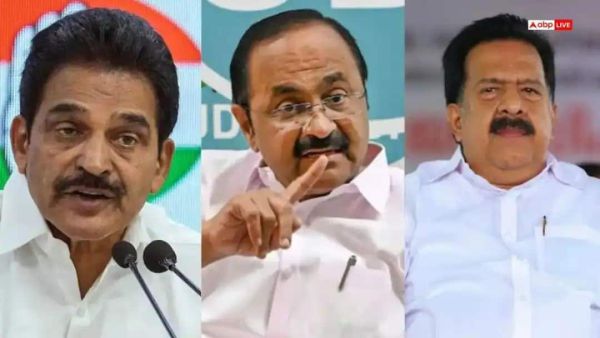
After returning to power in Kerala, the Congress now faces a crucial challenge-selecting the state’s next chief minister. However, the contest is not merely about political seniority or organisational influence, but also about caste equations that continue to shape Kerala politics. Interestingly, all three leading contenders for the top post-Ramesh Chennithala, VD Satheesan and KC Venugopal-belong to the Nair community, considered one of the dominant upper-caste groups in the state. Their candidature has once again brought the debate over social representation and caste balance to the centre of Kerala’s political discourse.
Caste has historically played a significant role in Kerala’s political structure despite the state’s reputation for progressive politics. Hindus account for nearly 55 per cent of Kerala’s population, with around 60 per cent belonging to OBC communities, nearly 30 per cent from general castes, while Scheduled Castes and Scheduled Tribes make up the remaining share. Muslims comprise nearly 27 per cent of the population, while Christians account for around 18 per cent, making minority communities equally influential in electoral politics.
Political parties in Kerala have traditionally attempted to maintain a delicate social balance while choosing leadership faces. The Congress now finds itself under pressure to ensure representation beyond upper-caste communities, particularly after a decade of Left rule led by Pinarayi Vijayan, who belongs to the Ezhava community, one of Kerala’s largest OBC groups.
Kerala has had 12 chief ministers so far, out of which nine were Hindus. Among them, six belonged to upper-caste communities and five were from the influential Nair community. Only three chief ministers have come from OBC backgrounds, representing both the Congress and Left camps over different periods.
Minority communities have also played an important role in the state’s leadership history. Congress leaders AK Antony and Oommen Chandy, both from the Christian community, served as chief ministers and helped strengthen the party’s support base among Christians. Kerala has also had a Muslim chief minister from the IUML.
With Congress preparing to form the government, the choice of chief minister is now being closely watched not only as a political decision but also as a reflection of the party’s approach towards caste and community representation in Kerala.