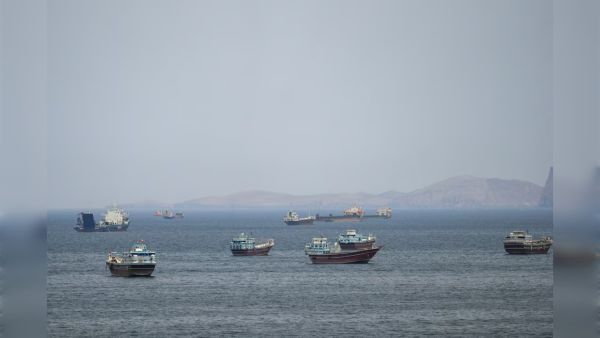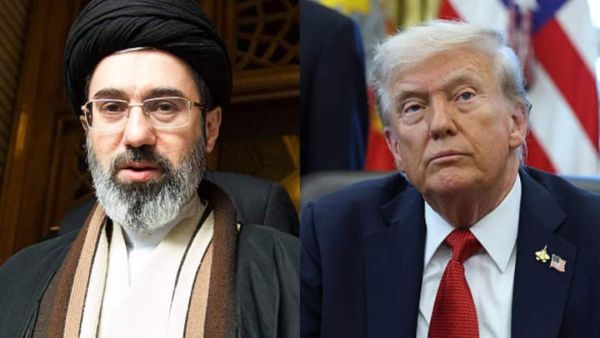
Fresh tensions erupted in West Asia after the United States and Iran exchanged fire in the Strait of Hormuz, with both sides accusing the other of violating a fragile ceasefire that had temporarily halted hostilities in the region.
Speaking to ABC News late Thursday, US President Donald Trump maintained that the ceasefire remained intact despite the latest exchange of attacks, describing the incident as “just a love trap”.
In a subsequent post on Truth Social, Trump claimed the US military had “completely destroyed” Iranian assets involved in the confrontation, including drones and small boats that he said “dropped ever so beautifully down to the Ocean, very much like a butterfly dropping to its grave!”
"Three World Class American Destroyers just transited, very successfully, out of the Strait of Hormuz, under fire. There was no damage done to the three Destroyers, but great damage done to the Iranian attackers. They were completely destroyed along with numerous small boats, which are being used to take the place of their fully decapitated Navy," he wrote on Truth Social.
The US president also repeated his warning that Tehran would face harsher military action if it failed to agree to a nuclear deal with Washington.
“Just like we knocked them out again today, we’ll knock them out a lot harder, and a lot more violently, in the future, if they don’t get their Deal signed, FAST!” Trump wrote.
The renewed violence came as Tehran was reviewing a US-backed proposal aimed at ending the conflict and reviving negotiations surrounding Iran’s nuclear programme. However, the emerging framework reportedly left major disputes unresolved, including Washington’s demand that Iran curb its nuclear activities and reopen the Strait of Hormuz fully to maritime traffic.
The US Central Command (Centcom) said American naval forces came under attack while three US Navy destroyers were transiting the Strait of Hormuz late Thursday.
According to Centcom, Iranian forces launched “multiple missiles, drones and small boats” toward the vessels as they moved toward the Gulf of Oman. The command stated that none of the US assets were hit.
In a statement, Centcom said its forces had “intercepted unprovoked Iranian attacks and responded with self-defence strikes”.
The US military said it retaliated by targeting missile and drone launch sites, command-and-control facilities, and intelligence infrastructure allegedly connected to the attacks.
“Centcom eliminated inbound threats and targeted Iranian military facilities responsible for attacking U.S. forces, including missile and drone launch sites; command and control locations; and intelligence, surveillance and reconnaissance nodes,” its statement said.
“Centcom does not seek escalation but remains positioned and ready to protect American forces,” it added.
Notably, the Centcom statement did not directly mention the ceasefire arrangement that began on April 8 as a two-week temporary truce and was later extended unilaterally by Trump.
Iran, however, accused Washington of violating the ceasefire first by targeting vessels and areas near the strait.
“The aggressive, terrorist, and bandit American army, violating the ceasefire, targeted an Iranian tanker that was moving from Iranian coastal waters” toward the Strait of Hormuz, an Iranian military official said in a translated statement carried by state media.
Iran’s military alleged that US forces struck two ships entering the Strait of Hormuz and also launched attacks on Iranian territory.
Iran's top joint military command accused the US of carrying out airstrikes on civilian locations on Qeshm Island and nearby mainland coastal regions, including Bandar Khamir and Sirik, Reuters reported.
The military said Iranian forces retaliated by attacking US military vessels east of the strait and south of the port city of Chabahar.
Iran’s armed forces “immediately retaliated by attacking US military vessels east of the Strait of Hormuz and south of Chabahar Port, causing significant damage to them,” a spokesperson said, according to state media reports.
However, US Central Command rejected those claims, insisting no American military assets had been struck during the confrontation.
A spokesperson for Iran’s Khatam al-Anbiya Central Headquarters warned that Tehran would continue to respond decisively to any future attack.
“(The) U.S. and its allies must know that Iran will respond forcefully and without the slightest hesitation to any act of aggression or attack,” the spokesperson said, according to Iranian state television.
Iran’s Press TV later reported that conditions around Iranian islands and coastal cities near the Strait of Hormuz had stabilised after several hours of exchanges, saying “the situation on Iranian islands and coastal cities by the Strait of Hormuz is back to normal now.”
Before the latest clashes, Washington had proposed a framework intended to formally end the conflict while reopening diplomatic engagement over Iran’s nuclear programme.
However, the proposal reportedly avoided addressing several contentious demands, including US calls for Iran to suspend nuclear work and permanently secure maritime access through the Strait of Hormuz.