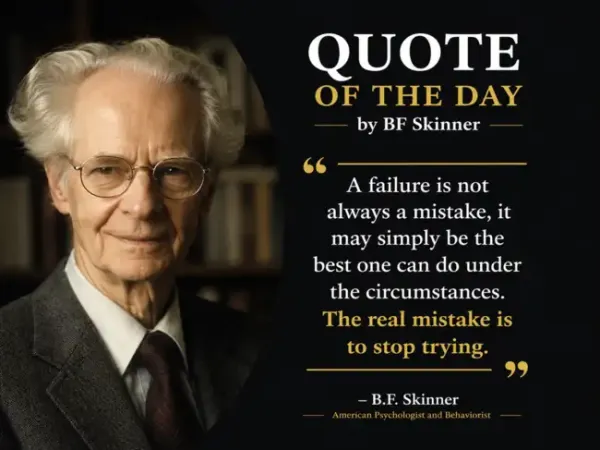
Quote of the Day: "A failure is not always a mistake, it may simply be the best one can do under the circumstances. The real mistake is to stop trying", this quote by one of the world's famous psychologists BF Skinner is a reminder for people that failure should not be seen as something negative or shameful. Just because a person is failing to achieve his goals doesn't mean he should stop trying. In life, people work extremely hard, put in all the effort but still they may not get success and there can be multiple reasons behind it- like unfavourable circumstances, limited opportunities, financial problems and more. But one should always keep trying.
ALSO READ: Quote of the day by psychologist Carl Jung
The quote holds weight for young people because we are in an age of constant comparison, pressure and expectations. Today's younger generation wants quick results, but it takes time, effort, hard work and patience. The quote by psychologist BF Skinner is widely searched on Google under search terms such as 'BF Skinner motivational quotes', 'inspirational thoughts', and 'Gen Z motivation'.
ALSO READ: Quote of the day by Socrates
BF Skinner is trying to say that failure is not the end of the journey and once they understand this, they would be less harsh with themselves and be patient in the process of growth. This motivation is important because many young individuals lose confidence after one setback.
A poor exam result, rejection, career disappointment, or personal struggle can make them feel hopeless. Skinner’s words encourage them to continue trying instead of giving up. The quote teaches resilience — the ability to rise again after failure. It also helps young people understand that success does not happen overnight. Growth comes from learning, improving, and staying consistent even during difficult times.
Interestingly, before making a name in psychology, Skinner initially aspired to become a writer. According to Harvard, his ideas and work were deeply shaped by the philosophy of behaviorism, which focuses on understanding human behavior through observable actions and experiences. Skinner believed that the “goal of a science of psychology was to predict and control an organism’s behavior from its current stimulus situation and its history of reinforcement.”
“Education is what survives when what has been learnt has been forgotten.” “We shouldn't teach great books; we should teach a love of reading.” “No one asks how to motivate a baby.” “The real question is not whether machines think but whether men do.” “We are only just beginning to understand the power of love…” “Society attacks early, when the individual is helpless.” “Men build society and society builds men.” “What is love except another name for positive reinforcement?” “Science is a willingness to accept facts even when they are opposed to wishes.”
ALSO READ: Quote of the day by psychologist Carl Jung
The quote holds weight for young people because we are in an age of constant comparison, pressure and expectations. Today's younger generation wants quick results, but it takes time, effort, hard work and patience. The quote by psychologist BF Skinner is widely searched on Google under search terms such as 'BF Skinner motivational quotes', 'inspirational thoughts', and 'Gen Z motivation'.
Quote of the Day
'A failure is not always a mistake, it may simply be the best one can do under the circumstances. The real mistake is to stop trying'.ALSO READ: Quote of the day by Socrates
Why do young people need this quote?
Young people need this motivation today because they are facing immense pressure at every stage of life — from academics and careers to relationships, social expectations, and online comparisons. Many constantly feel the need to succeed quickly and appear perfect in front of others, especially in the age of social media where achievements are highlighted more than struggles. This creates fear of failure and self-doubt.BF Skinner is trying to say that failure is not the end of the journey and once they understand this, they would be less harsh with themselves and be patient in the process of growth. This motivation is important because many young individuals lose confidence after one setback.
A poor exam result, rejection, career disappointment, or personal struggle can make them feel hopeless. Skinner’s words encourage them to continue trying instead of giving up. The quote teaches resilience — the ability to rise again after failure. It also helps young people understand that success does not happen overnight. Growth comes from learning, improving, and staying consistent even during difficult times.
Meaning of the quote explained
The quote by BF Skinner teaches an important lesson about resilience and self-belief and highlights the fact that failure is not proof of weakness; it is simply part of being human. Generally, people get disheartened and discouraged after one unsuccessful attempt. For instance, students may feel disappointed after poor exam results, athletes may lose important matches, or professionals may fail in business despite hard work. Here BF Skinner's thought comes at play. The psychologist reminds us that one failure does not define a person’s worth or future. What matters more is the courage to continue despite setbacks.Never give up in life
In this quote, Skinner has used a phrase 'real mistake is giving up' and it is the most powerful part. You should understand that success cannot come quickly, except in rare cases. Every failure in life teaches us valuable lessons, gives us experience, and helps people grow stronger mentally and emotionally. People who continue trying despite difficulties often achieve more than those who quit after disappointment. Every setback gives an opportunity to improve, learn from mistakes, and try again with better understanding.BF Skinner: Life, career and work
Born on March 20, 1904, B. F. Skinner went on to become one of the most influential psychologists, behaviorists, inventors, and social philosophers of the 20th century. He earned his PhD in psychology from Harvard University in 1931 and later joined the institution as a professor of psychology in 1948. From 1958 until his retirement in 1974, he served as Harvard’s Edgar Pierce Professor of Psychology.Interestingly, before making a name in psychology, Skinner initially aspired to become a writer. According to Harvard, his ideas and work were deeply shaped by the philosophy of behaviorism, which focuses on understanding human behavior through observable actions and experiences. Skinner believed that the “goal of a science of psychology was to predict and control an organism’s behavior from its current stimulus situation and its history of reinforcement.”