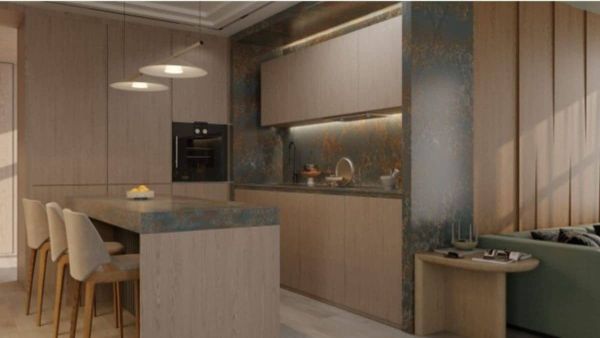
Neutral kitchens have recently become the default choice in modern homes—but not always for the right reasons. For years, they were seen as the “safe” option: easy to live with, broadly appealing, and unlikely to go out of style. The trade-off, however, was often a lack of personality. Rows of beige cabinets, plain countertops, and predictable finishes created spaces that were functional, but rarely memorable.
That perception is now changing. Designers are rethinking neutrality, not as a limitation, but as a foundation—one that allows materials, textures, and forms to take centre stage. The result is a new generation of kitchens where subtlety does not come at the cost of character.
One of the most defining trends in contemporary kitchen design is the growing use of bold veining in stone surfaces. Once limited to subtle, understated patterns, countertops and backsplashes are now embracing dramatic, high-contrast veining that adds movement and character to the space.
These surfaces often become the focal point of the kitchen—whether used in expansive islands, seamless backsplashes, or even integrated sinks. The appeal lies in their ability to introduce visual complexity while staying within a neutral palette. Shades of white, beige, grey, and taupe are elevated through intricate patterns that mimic natural stone formations, creating a sense of depth without overwhelming the design.
Brands such as Specta Quartz Surfaces have responded to this demand with engineered surfaces that replicate bold natural veining while offering consistency and durability. They have introduced designs like Calacatta Ornate & Calacatta Colorado that balance refined base tones with pronounced veining, allowing homeowners to achieve a statement look while maintaining a cohesive, neutral aesthetic.
Beyond veining, texture is playing an increasingly important role in shaping neutral kitchens. Designers are moving away from overly polished, high-gloss finishes in favour of matte, honed, and tactile surfaces that add subtle variation.
Cabinetry with fluted panels, brushed finishes, or soft-touch laminates introduces a sense of depth, while materials like wood, cane, and stone further enrich the visual palette. Even within a single colour family, layering different textures can prevent the space from feeling flat.
This approach reflects a broader shift in design sensibilities—where the focus is less on contrast through colour and more on contrast through material and finish. The result is a kitchen that feels considered and nuanced, rather than stark or clinical.
Another emerging approach is to build texture into the architecture of the kitchen itself. Curved edges, rounded islands, and soft archways are replacing sharp, linear forms, introducing a sense of fluidity and movement.
These elements not only soften the overall look of the kitchen but also add sculptural interest. A curved island, for instance, can become a central design feature, especially when paired with seamlessly finished quartz surfaces from brands like Specta Quartz Surfaces, which help maintain continuity across edges and contours. Arched niches or entryways further break the rigidity of straight lines.
By integrating these forms into the layout, designers are reducing the reliance on decorative add-ons. The space itself becomes expressive, proving that structure can be as impactful as the surface.
While neutral kitchens remain grounded in restrained palettes, small bursts of colour are increasingly being used to add personality. The backsplash, in particular, has emerged as a key opportunity for experimentation.
A muted kitchen can be instantly elevated with a coloured or patterned backsplash—whether through tiles, glass panels, or even stone surfaces such as those by Specta, with subtle tonal variation. These accents act as visual highlights without disrupting the overall harmony of the space.
Similarly, appliances are no longer treated as purely functional elements. Refrigerators, ovens, and small kitchen gadgets are now available in a range of colours and finishes, allowing them to double as design features. Brands like Smeg have popularised retro-inspired appliances in pastel and bold hues, while Hafele offers sleek, design-forward options that blend functionality with aesthetics.
Incorporating such elements allows homeowners to inject personality into neutral kitchens without committing to permanent colour choices.
The evolution of neutral kitchens reflects a broader design philosophy—one that values balance over extremes. Instead of choosing between minimalism and maximalism, designers are finding ways to merge the two.
A neutral base provides calm and continuity, while veining, texture, and carefully chosen accents introduce character. This layered approach ensures that the kitchen remains timeless yet contemporary, adaptable to changing tastes and lifestyles.
Importantly, these trends also align with the practical demands of modern homes. Materials like engineered quartz offer durability and ease of maintenance, while thoughtful layouts and integrated surfaces enhance functionality without compromising on design.
Neutral kitchens today are no longer defined by what they lack, but by how intelligently they are composed. Through the use of bold veining, tactile finishes, architectural detailing, and selective colour accents, they achieve a quiet sophistication that feels both modern and enduring.
As homeowners continue to seek spaces that are visually refined yet deeply personal, the neutral kitchen is proving to be an ideal canvas—one that allows for creativity without excess, and expression without noise.