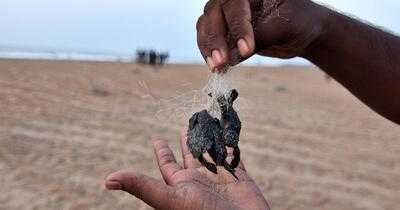
The Rushikulya rookery in Odisha’s Ganjam district is among the most important turtle rookeries in the world. Every year, hundreds of thousands of olive ridley sea turtles (Lepidochelys olivacea) converge here to lay eggs in a synchronous mass nesting event or arribada, with almost 700,000 olive ridleys coming ashore to lay eggs in February 2025 alone.
However, plastic pollution and its associated problems plague this important 10-km stretch along India’s eastern coastline. A recent study by the National Institute of Oceanography, Goa, reports significant presence of plastic waste and discarded fishing nets across four nesting beaches at Rushikulya, reflecting a global crisis of ever-increasing marine plastic pollution.
Nesting among plasticsSurveys across four nesting beaches – New Podampetta, Purunabandha, Siddhantnagar, and Prayagi – during the peak 2025 nesting season recorded more than 1,100 litter items, over 85% of which were plastic. The presence of plastic bottles, wrappers, and bags indicated both land-based runoff and direct human activity as key sources.
Fisheries-related debris, including discarded nets, thermocol, and nylon rope fragments – collectively termed as “ghost gear” or abandoned, lost, and otherwise discarded fishing gear (ALDFG) – made up 41% of all recorded litter across all sites. Fishing nets alone made up around 32% of the recorded litter at New Podampetta, while thermocol too contributed a little over 31% at...
Read more