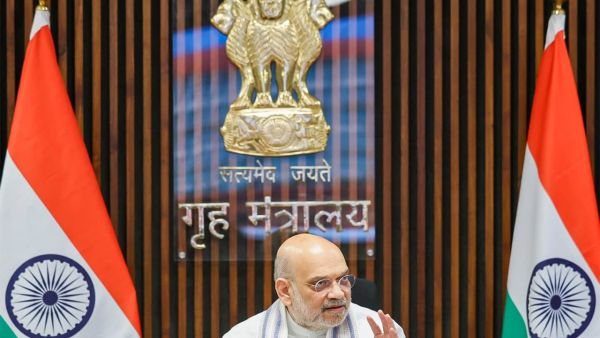
Union Home Minister Amit Shah is set to chair the 26th meeting of the Central Zonal Council on May 19 in Chhattisgarh, where several issues of regional and national importance are expected to be discussed, including strengthening inter-state coordination and improving cooperation in sectors such as nutrition, education, healthcare, electricity, urban development and cooperatives.

The Central Zonal Council comprises the states of Chhattisgarh, Madhya Pradesh, Uttarakhand and Uttar Pradesh. According to officials, the meeting is expected to deliberate on more than a dozen important issues aimed at enhancing interstate cooperation and administrative coordination among member states. Among the key issues likely to be discussed are faster investigation and disposal of crimes against women and children, strengthening rural banking connectivity, implementation of emergency response systems and improving delivery mechanisms in public welfare sectors.
The meeting will be attended by the Chief Ministers of the member states, along with two senior ministers from each state government. Chief Secretaries and senior officials from the participating states, as well as senior officers from the Central government, are also expected to take part in the deliberations. This meeting is being organised by the Inter-State Council Secretariat under the Ministry of Home Affairs, in collaboration with the Chhattisgarh government.
The 25th meeting of the Central Zonal Council was held on June 24, 2025, in Uttar Pradesh's Varanasi. Under Sections 15 to 22 of the States Reorganisation Act, 1956, five Zonal Councils were established. The Union Home Minister is the chairperson of these five Zonal Councils, and the Chief Ministers, Lieutenant Governors, and Administrators of the member states and Union Territories are their members.
Among the member states, the Chief Minister of one state acts as the vice-chairperson of the council on a rotational basis for a period of one year. In addition, each Governor nominates two ministers from the respective state government as members of the council. Each Zonal Council has also formed a permanent committee at the level of Chief Secretaries. Issues proposed by the states are initially presented to the permanent committee of the concerned Zonal Council for discussion. After consideration by the permanent committee, the remaining issues are then presented to the Zonal Council meeting for further deliberation.
Prime Minister Narendra Modi has emphasised the need to leverage cooperative and competitive federalism for the all-round development of the country. With the belief that strong states make a strong nation, the Zonal Councils provide a structured mechanism for dialogue and discussion on issues affecting two or more states or the Centre and states, and through this, serve as an important platform to enhance cooperation.
The role of the Zonal Councils is advisory; however, over the past few years, these councils have proven to be an important factor in promoting healthy bonds of mutual understanding and cooperation in various fields. With the cooperation of all state governments, central ministries, and departments, a total of 64 meetings of the various Zonal Councils and their permanent committees have been held in the last eleven years.
The Zonal Councils also discuss broad issues of national importance, including the speedy investigation of cases of sexual offenses against women and children and the implementation of Fast Track Special Courts (FTSC) for their swift disposal; providing brick-and-mortar banking facilities within the designated area of every village; implementation of the Emergency Response Support System (ERSS-112); and various regional-level common interest issues such as strengthening nutrition, education, health, electricity, urban planning, and the cooperative system. (ANI)
(Except for the headline, this story has not been edited by Asianet Newsable English staff and is published from a syndicated feed.)