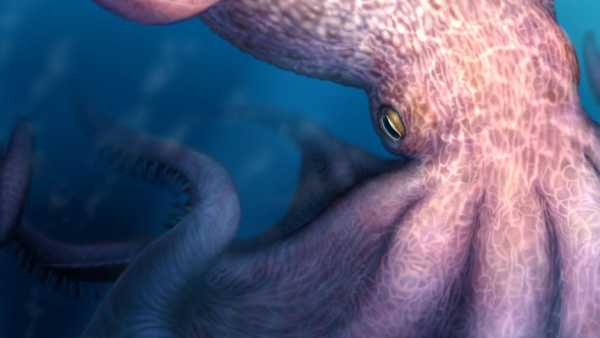
New Delhi: Researchers from Hokkaido University have discovered that the earliest known octopuses were giant predators that occupied the top position in the food web, alongside large and fearsome marine predators. These octopuses played a far more predatory role in ocean ecosystems, as against the octopuses of today, that are intelligent and remarkably flexible animals that lurk in reefs, hide in crevices or drift through the deep sea. The evolutionary history of octopuses is difficult to trace as they are soft-bodied invertebrates that do not fossilise easily. The research is based on the beak or jaws of early octopuses, that can fossilise readily, to reconstruct their evolutionary history.
The researchers used high-resolution grinding tomography and an artificial intelligence model, and discovered fossil jaws hidden inside rock samples from the Late Cretaceous period, between 100 and 72 million years ago. These fossils, recovered from Japan and Vancouver Island were well-preserved in calm seafloor sediments, retaining fine wear marks that reveal how the animals fed. The fossils belonged to a group of extinct finned octopuses, known as Cirrata. Based on the wear marks, the team concluded that these animals were active predators, that likely crushed their prey with powerful bites. The animals reached total lengths of nearly 20 metres surpassing the size of large marine reptiles from the same time period.
For decades, scientists believed that ancient marine ecosystems were dominated by vertebrate predators such as the plesiosaurus, and the mosasaurs, while invertebrates were thought to occupy the lower levels of the food web. The new research suggests that giant octopuses were an unexpected expectation, invertebrates that rose to the top tier of the marine food web and competed with invertebrates. Powerful jaws and the loss of superficial skeletons were common to both octopuses and marine vertebrates, and were essential to becoming huge marine predators. The researchers intend to reconstruct entire ancient marine ecosystems in unprecedented detail. A paper describing the research has been published in Science.