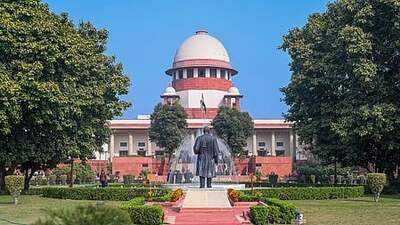
Following the ordinance promulgated by the President of India, the Supreme Court of India now has a sanctioned strength of 38 judges including the CJI. The number of judges in the apex court was increased from 18 to 26 in 1988.
Two decades later in 2009 it was increased to 30 plus the CJI. It was in 2019 when the number of Supreme Court judges was increased last to 33 excluding the CJI. As per Article 124 of the Constitution, the Supreme Court comprises the Chief Justice of India and the number of Judges which the Parliament prescribes by way of law.
A number of Supreme Court judges, including Justice Vikram Nath and Justice J.K. Maheshwari, are due to retire later this year in 2026. Both are members of the Supreme Court collegium being the second and the third most senior judges after the Chief Justice.
The Chief Justice of India justice Surya Kant is due to demit office in February, 2027. The probable successor Justice B.V. Nagarathna, the only woman Justice in the Supreme Court currently, will be the CJI for a short duration of six months or so.
With several other Supreme Court judges due to retire in 2026 and 2027, the government action in increasing the number of judges is being described in official circles as routine. What has however caused consternation is the government’s decision to take recourse to an ordinance, which is promulgated in an emergency and when the Parliament is not in session.
What kind of emergency has driven the government to opt for an ordinance bypassing the Parliament? Retirement dates of judges are known the day they are appointed and the government could have easily brought in a Bill, explained the urgency and get it passed after deliberation. Why the hurry?
Droupadi Murmu approves increase in SC judge strength from 33 to 37“The date of appointment of a Judge of the Supreme Court decides the seniority and eventually who gets to become Chief Justice of India and for how long. Does this explain the 'extraordinary emergency' with which strength of Supreme Court has been increased through an 'Ordinance'?,” asks a social media post by Maadhyam, a handle which acts as a parliamentary watchdog.
The Budget Session ended barely a month ago, Maadhyam points out, and the union cabinet approved this increase in strength merely a few weeks after the session ended. Were they deliberately waiting for the session to end? Or are we to believe that Govt is so poor at planning that it couldn't bring a Bill to this effect in the Budget Session? And that pendency of cases in SC, built over the years, needs such an urgent resolution that Govt couldn't wait till July when Monsoon Session will begin?
While the real intent of the government will be known later, several troubling questions arise. Why is the Parliament being bypassed now? Is this a move to get some particular judges appointed to SC just in time to hear some particular cases pending before the court? Also, what is the rationale behind the number '37'? Why not 36 or 39? How are these decisions taken? What are the factors considered?
It is not always that Chief Justices of High Courts are appointed as judges of the Supreme Court. While seniority is a consideration, other factors are also considered though the collegium is rarely transparent while making its recommendations. However, as of May 2026, the five senior-most Chief Justices of High Courts in India are Justice Arun Bhansali (Allahabad), Justice Ramesh Sinha (Chhattisgarh), Justice Devendra Kumar Upadhyaya (Delhi), Justice Sunita Agarwal (Gujarat), and Justice Gurmeet Singh Sandhawalia (Himachal Pradesh).
While High Court judges who are not Chief Justices can also be appointed as Supreme Court judges before the Chief Justices themselves, the next five senior-most Chief Justices of High Courts in India (ranks 6–10 as of May 2026) are Justice Shree Chandrashekhar (Bombay), Justice Sujoy Paul (Calcutta), Justice Lisa Gill (Andhra Pradesh), Justice Sanjib Banerjee (Meghalaya), and Justice S. Vaidyanathan (Madras).
Bypassing Parliament when seemingly no emergency exists, raises suspicion that this route could be used to please the executive or members of the collegium and facilitate appointment of judges of their choice.
The choice of judges and the dates of their appointment and their retirement dates could provide some clue why the government is in such a tearing hurry to appoint them.
SC raps Centre for last-minute bid to delay tribunal reforms hearing