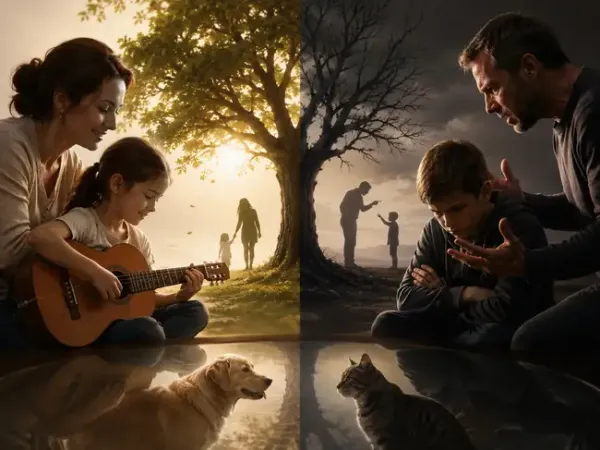
A child smiles exactly like her mother. A teenager reacts with the same impatience as his father. Sometimes it feels sweet and familiar. Other times, it explains a behavior that seems hard to change.
Why do certain habits, talents, and even tempers appear to travel from one generation to the next? Is it coincidence, upbringing, or something deeper?
A well-known French saying captures this truth in a simple, memorable way.
French proverb of the day: ‘Dogs don’t breed cats’
Literally, the proverb says, “Dogs don’t breed cats.” The image is drawn from nature and reflects the same emotions as the saying “apple doesn't fall far from the tree”. Animals give birth to their own kind, and the same idea is applied to families. Children often resemble their parents, not just in appearance but in behavior and personality as well. This translation is commonly explained in French language learning and cultural sources.
The deeper meaning goes beyond physical similarity. It suggests that talents, habits, attitudes, and character traits often pass from parents to children. The proverb can be used in a positive sense to praise inherited ability, or in a critical way to point out an inherited flaw.
This saying fits naturally into many real-life situations. When a young girl plays the guitar beautifully and her mother is also a musician, someone might remark, “Dogs don’t breed cats.” It becomes a warm way of recognizing talent that runs in the family.
The same proverb can also be used pejoratively. If a child has a quick temper like his father, the phrase may be used to highlight how certain undesirable traits seem to repeat across generations. In both cases, the saying reflects a familiar observation.
In homes, schools, and workplaces, people often notice how closely children mirror their parents. Teachers see students who share their parents’ discipline or creativity. Friends recognize shared humor, speech patterns, and attitudes within families. Even career paths sometimes follow family traditions.
The proverb reminds us that children learn from what they observe every day. They absorb values, behaviors, and reactions simply by growing up in a particular environment. Influence at home leaves a lasting mark.
This saying also carries a subtle message of responsibility. If children often reflect their parents, then adults must be mindful of the example they set. Patience, kindness, honesty, and discipline are qualities that children are likely to pick up without being formally taught.
At the same time, the proverb encourages understanding. Recognizing familiar traits in children can help families guide them with patience rather than frustration.
Why do certain habits, talents, and even tempers appear to travel from one generation to the next? Is it coincidence, upbringing, or something deeper?
A well-known French saying captures this truth in a simple, memorable way.
French proverb of the day: ‘Dogs don’t breed cats’
What this proverb means
Literally, the proverb says, “Dogs don’t breed cats.” The image is drawn from nature and reflects the same emotions as the saying “apple doesn't fall far from the tree”. Animals give birth to their own kind, and the same idea is applied to families. Children often resemble their parents, not just in appearance but in behavior and personality as well. This translation is commonly explained in French language learning and cultural sources.
The deeper meaning goes beyond physical similarity. It suggests that talents, habits, attitudes, and character traits often pass from parents to children. The proverb can be used in a positive sense to praise inherited ability, or in a critical way to point out an inherited flaw.
How the proverb appears in daily conversation
This saying fits naturally into many real-life situations. When a young girl plays the guitar beautifully and her mother is also a musician, someone might remark, “Dogs don’t breed cats.” It becomes a warm way of recognizing talent that runs in the family.
The same proverb can also be used pejoratively. If a child has a quick temper like his father, the phrase may be used to highlight how certain undesirable traits seem to repeat across generations. In both cases, the saying reflects a familiar observation.
Significance of the proverb in real life
In homes, schools, and workplaces, people often notice how closely children mirror their parents. Teachers see students who share their parents’ discipline or creativity. Friends recognize shared humor, speech patterns, and attitudes within families. Even career paths sometimes follow family traditions.
The proverb reminds us that children learn from what they observe every day. They absorb values, behaviors, and reactions simply by growing up in a particular environment. Influence at home leaves a lasting mark.
A quiet reminder for parents and families
This saying also carries a subtle message of responsibility. If children often reflect their parents, then adults must be mindful of the example they set. Patience, kindness, honesty, and discipline are qualities that children are likely to pick up without being formally taught.
At the same time, the proverb encourages understanding. Recognizing familiar traits in children can help families guide them with patience rather than frustration.