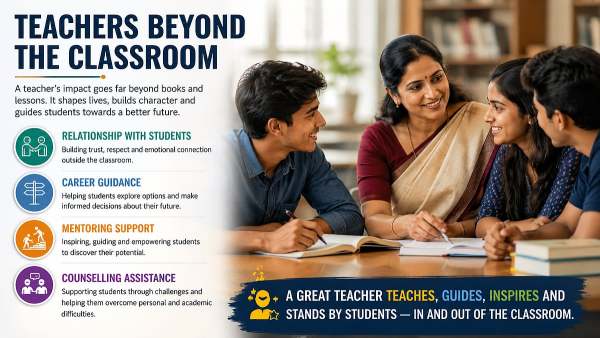
Teachers influence students beyond classrooms through mentorship, counselling, emotional support and career guidance. Informal teacher-student relationships play a key role in shaping character and holistic growth.
People often believe that classroom teaching is the only point of connection between a teacher and students. However, this is not entirely true in the real sense of the term. Research indicates that the quality of the “informal relationship” a teacher develops with students outside the classroom is often more influential than the “formal relationship” inside the classroom in shaping their future lives.
There is no denying that the formal relationship within the classroom, through transfer of knowledge, sharing of ideas, debates, activities, observations, questioning, and even arguments among peers and teachers, helps in creating more informed individuals. Such interactions contribute significantly to intellectual growth and academic development.
On the other hand, the informal relationship outside the classroom is subtler and more human in nature. It contributes immensely to the character formation of students. While the formal relationship is often “transaction-oriented” and driven by learning outcomes, the informal relationship is rooted in empathy, emotional bonding, trust, and friendly guidance that supports the “holistic developmental needs” of students.
Therefore, it is often observed that the better the informal relationship between teachers and students, the stronger the emotional bonding and the greater the developmental orientation of students. A teacher should thus consciously strive to develop positive emotional connections with students outside the classroom in addition to maintaining a formal academic relationship within the classroom, which is more regulatory and duty-bound in nature.