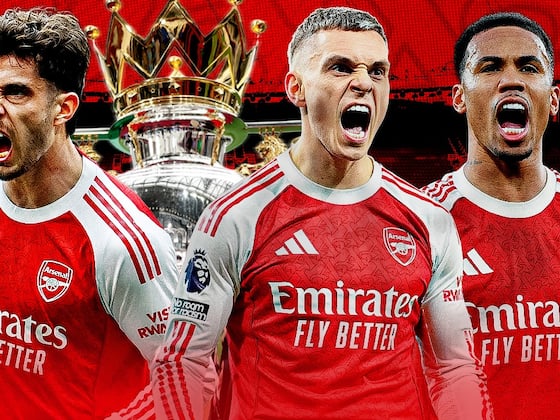
From stoppage-time dramas to commanding displays, we look back at the eight fixtures that proved most crucial to Arsenal’s 2025-26 Premier League title-winning campaign.
Every victory brings three points, but some wins carry far more emotional and strategic weight than others.
The Gunners secured 25 wins on their way to being crowned champions. Some of those triumphs came through dominant performances, some via late comebacks or last-gasp winners, and others were gritty battles where they simply found a way to prevail.
Each of those matches played its part, but these eight stand out as the key moments that finally ended Arsenal’s 22-year wait for the Premier League trophy.
We start with a match Arsenal did not actually win.
When Arsenal and Manchester City met at the Emirates Stadium in September, the two primary title contenders played out a thrilling draw. Gabriel Martinelli’s 93rd-minute equaliser rescued a vital point for the home side.
In truth, Arsenal deserved that result. Few teams have ever managed to dominate a Pep Guardiola side as Arsenal did that day. In Guardiola’s 601st top-flight match as a manager, his City team had just 33.2% possession—the lowest figure recorded for any of his sides in a league fixture.
City also registered only seven touches inside Arsenal’s penalty area, their fewest in a Premier League game under Guardiola.
The result meant Mikel Arteta became the first manager to go five consecutive league games unbeaten against Guardiola. Psychologically, it was enormous. For years, Arsenal had been the challengers, but this felt like a turning point where the balance of power began to shift.
At that moment, however, City were not even Arsenal’s closest rivals. Liverpool had started the season with five straight wins and topped the table after that weekend, while City had managed just seven points from their opening five games—their worst start since 2006-07 under Stuart Pearce.
Even so, Arsenal’s draw served as an early statement, and preventing City from claiming three points would prove vital later in the title race.
The following weekend brought another major challenge.
St James’ Park had been a difficult venue for Arsenal, where they had lost their previous three visits without scoring. For much of this match, that trend seemed set to continue as Nick Woltemade’s goal had Newcastle leading deep into the game.
But Arsenal fought back. Mikel Merino flicked home from a short-corner routine to equalise, and then Gabriel Magalhães powered in Martin Ødegaard’s corner with virtually the final touch to complete a stunning 2-1 comeback.
“That feels absolutely huge,” said Sky Sports commentator Gary Neville, and few would disagree.
It was the second-latest Premier League game in which Arsenal had trailed and gone on to win—after their 3-1 victory over Norwich City in April 2013, when Mikel Arteta scored the equaliser in the 85th minute.
Having salvaged a late draw against City the week before, Arsenal again left it late, but this time secured all three points—especially significant after Liverpool’s 2-1 defeat at Crystal Palace the previous day.
Next came a more straightforward but equally important win.
Arsenal comfortably beat West Ham in a Saturday afternoon kick-off. Declan Rice opened the scoring against his former side, and Bukayo Saka added a second-half penalty in Mikel Arteta’s 300th game in charge.
The real impact came later that evening when Liverpool lost 2-1 to Chelsea, allowing Arsenal to move to the top of the Premier League table for the first time that season. The Opta supercomputer subsequently made them title favourites—a status they would retain for the rest of the campaign.
Not every victory was smooth sailing, however.
In early December, Arsenal laboured to beat bottom-placed Wolves, failing to register a single first-half shot on target at home for the first time since December 2024 against Manchester United.
They eventually went ahead through a fortunate sequence—Saka’s deep corner hit the post, bounced off Wolves’ goalkeeper Sam Johnstone, and went in for an own goal. When Tolu Arokodare equalised in the 90th minute, it looked disastrous, but Arsenal immediately responded, forcing another own goal as Yerson Mosquera headed into his own net under pressure from Gabriel Jesus.
It was an unconvincing performance, but one that champions must sometimes grind out. In previous seasons, such lapses might have been costly; this time, Arsenal found a way.
Later that month, Arsenal faced Aston Villa—a side managed by former Gunners boss Unai Emery, who had led Villa to 11 straight wins across all competitions. Another victory would have drawn Villa level on points with Arsenal at the top of the table.
The first half ended goalless, but Arteta’s half-time talk sparked a transformation. Within seven minutes of the restart, Gabriel and Martín Zubimendi scored to make it 2-0. Leandro Trossard and Gabriel Jesus added further goals in a dominant second half, during which Arsenal posted their highest xG (2.59) and joint-most shots (15) in a single half of league football in 2025-26.
The 4-0 win sent Arsenal five points clear at the top, ensuring they ended 2025 as league leaders.
Though Arsenal were 29 points ahead of Spurs in the table when the north London derby came around, nerves were evident. Four days earlier, they had squandered a two-goal lead to draw 2-2 with bottom-side Wolves, conceding a 94th-minute equaliser at Molineux.
With City just two points behind after beating Newcastle, the pressure was on. Spurs, under new manager Igor Tudor, were still winless in 2026, but the potential for a new-manager bounce loomed.
The first half ended 1-1, but Eberechi Eze inspired Arsenal to a dominant 4-1 victory. Having scored a hat-trick against Spurs earlier in the season, Eze added two more, becoming only the second player ever to net four or more goals in north London derbies in a single season—the first being Ted Drake in 1934-35.
Arsenal’s 31st league game of the season, against Everton at the Emirates, also proved critical. Below par for most of the night, the Gunners needed two very late goals to win 2-0. Viktor Gyökeres broke the deadlock in the 89th minute after a Jordan Pickford error, before 16-year-old Max Dowman scored into an empty net deep into stoppage time to become the youngest goalscorer in Premier League history at just 16 years and 73 days—surpassing the previous record by 197 days.
The victory grew even more significant when Manchester City drew 1-1 with West Ham later that evening.
Finally, Arsenal’s clash with West Ham near the season’s end became the defining test. With City having beaten Brentford 3-0 the previous day, Arsenal could not afford to falter. West Ham, battling relegation, looked set to earn a draw until Leandro Trossard struck in the 83rd minute. Even then, VAR came to Arsenal’s rescue in stoppage time when Callum Wilson’s apparent equaliser was ruled out for a foul on David Raya.
Raya had earlier made a superb save from Mateus Fernandes to keep the scores level. The 2-1 win left Arsenal with just two games remaining—against Burnley and a Crystal Palace side distracted by their Conference League final—and effectively secured their first league title since 2004.