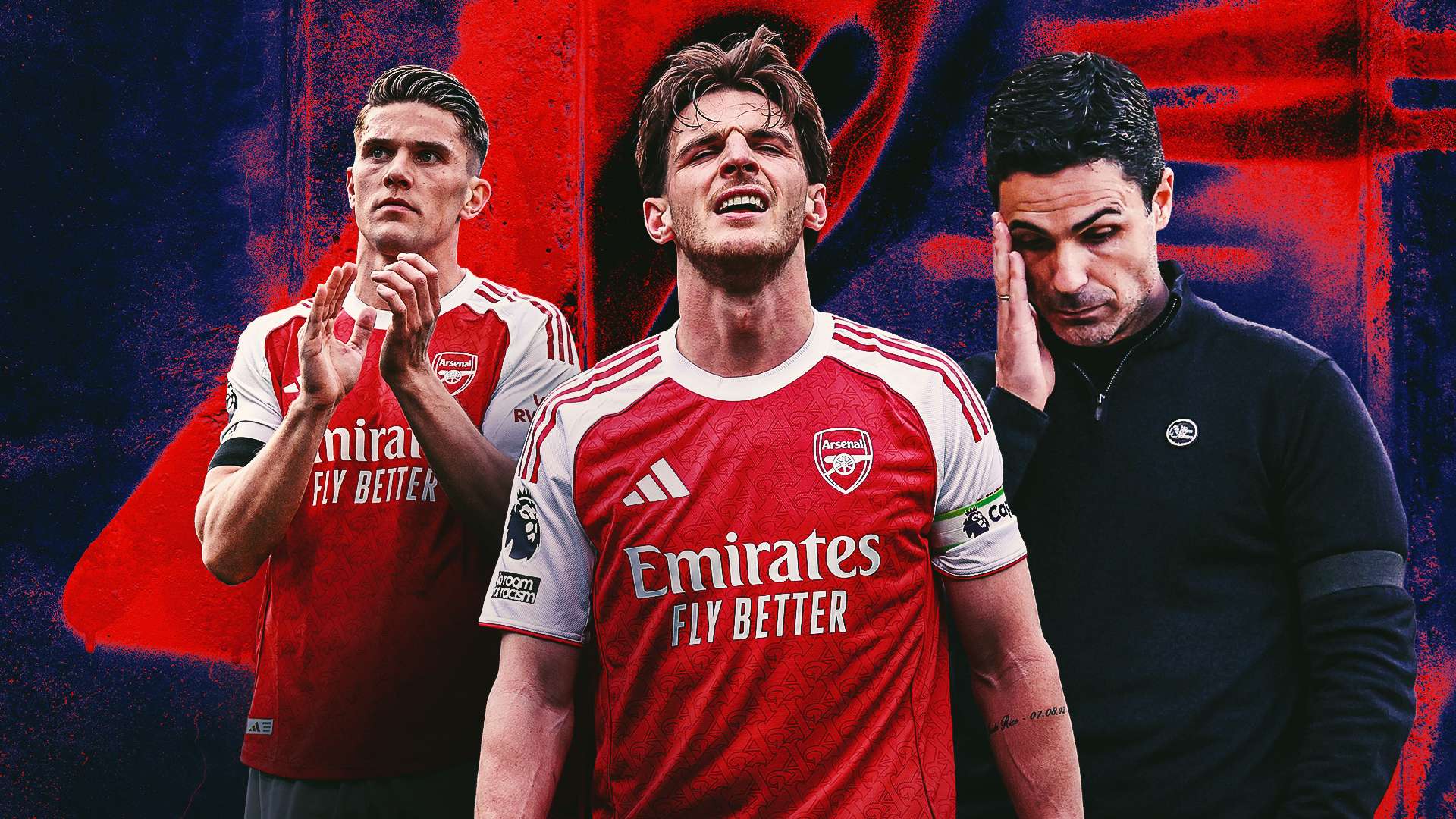
The banner that Manchester City fans displayed on the south stand of the Etihad Stadium on Sunday perfectly captured the mood — “Panic on the streets of London.” After a crushing 2-1 defeat to their Premier League title rivals, Arsenal now hold only a three-point lead over Pep Guardiola’s side, having also played one game more.
This means that if City defeat Burnley at Turf Moor on Wednesday, they will move to the top of the table on goal difference with just five rounds left in the season.
The turnaround is staggering. Less than a month ago, Arsenal were 10 points clear following a 2-0 win over Everton, which had the Emirates Stadium buzzing. Supporters believed that a 22-year wait for the league title was finally nearing its end.
Now, that optimism has turned to dread. The Gunners’ long-suffering fans fear another painful collapse in the title race, as Mikel Arteta’s men have lost their last two league matches.
So, what exactly has gone wrong for Arsenal? Who bears the most responsibility for their late-season collapse? And can they still salvage their campaign before the final whistle of the season?
The Guardiola effect
Much of the fallout from Sunday’s top-of-the-table clash at the Etihad has focused on Arsenal — and understandably so. The Gunners’ storyline is compelling and, potentially, historic for all the wrong reasons. Yet, the majority of the pressure Arsenal are feeling stems from Manchester City’s resurgence — and that deserves recognition.
This isn’t a vintage Guardiola team by any stretch. Their elimination from the Champions League by an average Real Madrid side managed by Alvaro Arbeloa proved as much. City have also suffered five league defeats this season — a number unthinkable during their title duels with Jurgen Klopp’s Liverpool.
However, City haven’t lost a domestic match since their comprehensive defeat to local rivals Manchester United back in January. That run has put them within reach of a domestic treble — a testament to Guardiola’s brilliance.
He has been backed well by the club’s owners, with key signings like Marc Guehi and Antoine Semenyo transforming the season. But Guardiola deserves full credit for elevating Abdukodir Khusanov, trusting Nico O'Reilly, unlocking Rayan Cherki’s unpredictable brilliance, and — crucially — settling on his best starting eleven and sticking with it.
That consistency has seen City bounce back from March draws against Nottingham Forest and West Ham to produce four consecutive statement victories — two against Arsenal, and one each over Liverpool and Chelsea. While City thrive under pressure, Arsenal appear to be crumbling under it.
The weight of history
Arsenal’s nervousness is understandable. The club hasn’t lifted the Premier League trophy since 2004, and this season was supposed to be their chance to end that drought.
Despite Liverpool attracting headlines with their £450 million summer spending spree, Arsenal actually recorded a higher net expenditure. The general consensus was that Arteta had assembled the deepest and most talented squad in English football.
The hype reached absurd levels — former player Theo Walcott even suggested that the Manchester United side that won the Premier League and Champions League in 2008 might not be able to “compete” with this Arsenal team, while Piers Morgan claimed the Gunners could win the quadruple, calling them “the best squad in the history of club football.”
While such statements were wildly exaggerated, they reflected the unrealistic expectations surrounding Arteta’s side. The more than £1 billion spent since his appointment made winning a major trophy non-negotiable.
As Arsenal legend Nigel Winterburn told GOAL in November, “I don’t think there have been any excuses from Arteta and the club. If we’re being ruthless, over the last three seasons, we just haven’t been quite good enough. But this is the strongest Arsenal squad at the Emirates era in terms of depth, and I believe we’ll be very hard to beat.”
That confidence held up until last month. Before March 22, Arsenal had lost just three of 49 games in all competitions. Since then, they’ve lost four of their last six — with the 2-0 defeat to City in the Carabao Cup final at Wembley proving particularly damaging. That match could have ended their trophy drought and sent a message to their rivals, but instead, it exposed frailties in both Arteta’s tactics and his players’ mentality.
Running out of steam
Injuries have hit Arsenal at the worst possible time. Bukayo Saka, Jurrien Timber, and Mikel Merino are all sidelined. Saka’s third spell on the injury list this season is especially painful, given his status as Arsenal’s most dangerous attacking outlet. Timber’s influence from full-back has also been significant, while Merino’s absence has limited rotation options in midfield — leaving Declan Rice and Martin Zubimendi visibly fatigued.
Supporters believe exhaustion has been a major factor in Arsenal’s slump, with the midfield engine lacking its earlier intensity. Arteta has blamed the Premier League’s demanding schedule, saying it “takes the hell out of you,” but critics argue that he has failed to rotate his squad effectively to prevent burnout and injuries.
Despite having plenty of attacking depth, Arteta has shown little trust in former Brentford captain Christian Norgaard to start regularly. His reluctance to rest Rice and Zubimendi may now cost him dearly.
Shortage of leaders
Against City, Zubimendi showed slightly more energy than in recent games, but he still failed to control the midfield — a stark contrast to his early-season form when Arteta labelled him Arsenal’s “best player.”
Rice, the bookmakers’ favourite for Player of the Season, also struggled badly in the biggest game of the campaign. He lost more than half his duels, made just one successful tackle, and gave away possession 13 times — second only to captain Martin Odegaard, who lost it 16 times.
Odegaard was Arsenal’s most creative player on the day, yet he again failed to deliver when it mattered most. Until he leads the team to silverware, doubts about his leadership will persist. Some fans argue that Gabriel Magalhaes would be a better captain, but his petulant behaviour against Erling Haaland — including a headbutt that could have earned him a red card — revealed otherwise.
With leadership like this, it’s no wonder Arsenal falter when the pressure is on.
Nervous management
Managers set the tone, and Arteta’s visible anxiety on the sidelines mirrors the tension among fans. Known for his passionate touchline behaviour, Arteta’s current demeanour reflects self-doubt rather than authority.
Unlike his mentor Pep Guardiola, Arteta is not yet a proven winner. He learned what it takes to win titles under Guardiola but has yet to show he can replicate it alone. Three straight seasons finishing second would weigh heavily on any manager, and perhaps that pressure explains some of his recent unorthodox motivational tactics.
Arteta deserves credit for transforming Arsenal into a European powerhouse — consecutive Champions League semi-finals prove that — but despite massive financial backing, he has only one FA Cup to show for it. The decision not to start Viktor Gyokeres, the striker touted as Arsenal’s answer to Haaland, against City raised eyebrows. Reports suggest the club plans to invest further in attacking reinforcements this summer — a surprising move if another season ends without major success.
At that point, even Arteta’s most loyal supporters might begin to question the process rather than trust it.
‘It’s not over yet’
Despite the gloom, Arsenal’s season isn’t finished. They still have a chance to win both the Premier League and the Champions League. Even if City win their game in hand, Arsenal’s remaining fixtures — all against teams in the bottom half of the table — offer a favourable run-in. With Arteta likely to adopt a more attacking approach, the Gunners could yet improve their goal difference significantly.
In Europe, they’ve already beaten their Champions League semi-final opponents Atletico Madrid this season and could set up a blockbuster final against Bayern Munich or Paris Saint-Germain in Budapest on May 30. However, the challenge of facing Diego Simeone’s well-drilled side twice could test Arsenal’s mental and physical limits.
Arteta insists that the “fire” within him still burns brightly, but both he and his players are clearly under pressure. Declan Rice’s rallying cry at the Etihad — “it’s not done” — was spot on. But if Arsenal fail to beat Newcastle at home on Saturday, real panic might once again sweep through North London.