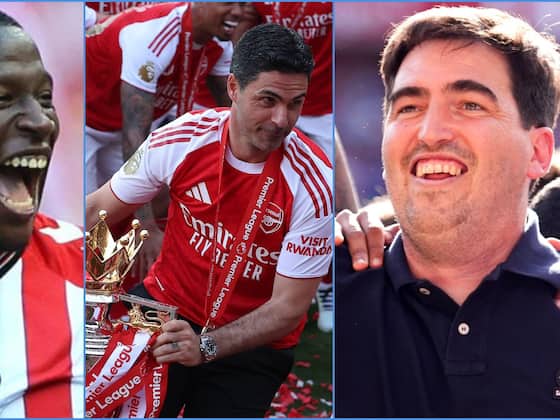
Mikel Arteta transformed one title-chasing project into another from the ground up, with Andoni Iraola, Unai Emery, and Regis Le Bris emerging as his main rivals for the Manager of the Season accolade.
Before discussing those who fell short, it’s only right to acknowledge the individuals and teams who can look back on the 2025/26 campaign with genuine pride.
What a remarkable journey it has been.
“Advice?” Arteta reflected. “What I’ve learned most is that you have to be ruthless, consistent, and embody the club’s culture every single day to build a winning mentality.”
There were no grand declarations or cinematic storylines as seen in other managerial arcs, yet in hindsight, Arteta’s restoration of a fallen powerhouse after taking charge mid-season now feels almost inevitable.
At his first press conference as Arsenal manager in December 2019, the Spaniard explained in detail why he left his Manchester City ‘family’, saying, “We had a dream to do something in England with Pep that people said was impossible, because we would be bullied in the Premier League.”
Nearly seven years later, Arsenal and Arteta have no equals left to intimidate.
It was a bold move by Arteta. His final match as Pep Guardiola’s assistant was a 3-0 victory over Freddie Ljungberg’s struggling Arsenal, a side defined by on-field disarray and boardroom instability that left them languishing in 10th place—similar to where Liverpool were before Jürgen Klopp arrived.
Staying on to one day succeed Guardiola would have been the obvious route. Instead, Arteta chose the harder path, betting on himself and building a title contender from scratch in his first managerial role, rather than inheriting ready-made champions later.
With Guardiola now stepping away just as Arteta reaches the summit, the symbolism is hard to miss—the apprentice has become the master. The cycle that few believed in at the Emirates until it was undeniable has come full circle.
This Premier League title is a story of trust, patience, alignment, and unwavering belief in a long-term vision. It required significant investment—most importantly, in the right people at the right time.
Arteta, once the most questioned and criticised of all, now stands as a Premier League champion in his own right.
Manchester United’s resurgence under new leadership has been astonishing. Only two clubs in Premier League history have improved their league position more dramatically in a single season than this transitional United side—and neither had to deal with Ruben Amorim’s erratic decisions.
It stands as a masterclass in bold decision-making. The so-called ‘bizarre’ and ruthless choice to replace Gary O’Neil’s stability with Andoni Iraola’s dynamic chaos paid off beyond measure.
“We just felt that if we wanted to succeed as much as we believe we can in this transfer market and change our style of football,” said chairman Bill Foley in June 2023, “we needed to go in a different direction.” That direction turned out to be upward.
Iraola’s third and final season proved to be his masterpiece: generating over £270 million through player sales, offloading five key starters for at least £40 million each, and nurturing young, untested talents who thrived when given a platform.
Bournemouth have now improved their league placement for six consecutive seasons and set new top-flight points records for three years in a row. Iraola was the perfect appointment at exactly the right time.
“I want Bournemouth to play in Europe – that’s our goal,” Foley said in December 2023. “I truly think we can reach Europe within five years.” An 18-match unbeaten streak – bettered by only six Premier League clubs in history – ensured that goal was achieved far sooner than expected.
Few coaching feats in British football history match what Unai Emery accomplished with Aston Villa: turning a disastrous transfer window and a five-game winless start into a fourth-place finish and a Europa League triumph that ended a long trophy drought.
It may not warrant a Manager of the Year shortlist nod, but it is a remarkable achievement and a testament to Emery’s tactical brilliance.
Guiding a club outside the traditional elite into European competition via league position four consecutive times is an extraordinary record. Doing it with a free signing like Victor Lindelof as the most-used addition is nothing short of incredible. Aston Villa are now arguably one of the best-positioned challengers for next season’s title under Emery.
Sunderland’s relegation in the expected goals table highlighted their statistical struggles, yet Regis Le Bris consistently reminded everyone that “data cannot account for the human element.”
He reiterated this point after completing a league double over Chelsea, which secured Sunderland’s first European qualification in 52 years.
As only the fourth newly-promoted club in Premier League history to qualify for European football through league performance, Sunderland’s success stands out in an era where promoted sides often struggle. Still, replicating their model will be nearly impossible without the intangible “connections” that Le Bris has cultivated.
Sunderland’s rise has been uniquely self-defined—built through timely, calculated changes in the boardroom, the dugout, and the squad.
“We won’t play like Guardiola or De Zerbi, because we are Sunderland and I’m Regis Le Bris,” he declared upon taking charge of a bottom-half Championship club two years ago. Now, Europe is about to witness that philosophy firsthand.
It’s worth noting that Brentford lost their manager, captain, goalkeeper, and two top scorers last summer, yet still came within one goal of securing European football for the first time in their history.
The frustration lies in knowing that goal could have altered their fate in any of their final matches from March onwards. Seven draws and a narrow 2-1 loss in their last ten games left them just short of a Conference League berth on goal difference, and of the Europa League by a single point.
Andrews, the set-piece coach turned first-time senior manager, admitted he “would have snapped your hand off” for such an outcome at the start of a season where many predicted relegation battles.
Brentford not only cleared that expectation but set themselves higher ambitions through sheer performance. Falling just short of those goals still represents a season of triumph by any fair assessment.
Lewis Dunk’s subdued celebrations after a 3-0 home defeat on the final day summed up Brighton’s bittersweet finish.
They entered the last match chasing Champions League qualification but ended celebrating Europa Conference League football after Sunderland overtook them and Brentford nearly ended their continental hopes altogether.
As manager Fabian Hurzeler put it: “On one side, it was terrible timing for that kind of performance. But on the other, when you look back at the season as a whole, it’s still a major achievement.”
After enduring a mid-season stretch of one win in 14 games that saw them crash out of the FA Cup and drop to 14th place, Brighton’s late resurgence leaves a sense of both accomplishment and regret at missed opportunities.
Leeds United’s survival story under Daniel Farke also deserves praise. Considering there were two points when his job seemed at risk – one even before promotion from the Championship was secured – their comfortable safety and FA Cup semi-final run mark a huge success.
It underscores how little faith existed in Farke’s ability to keep a team afloat in the Premier League. Yet, the former Norwich manager steadied the ship, adapted his tactics, and proved his resilience.
This Leeds season can be neatly divided into two phases: before and after their visit to the Etihad. That halftime tactical gamble and the response it inspired over the following months defined Farke’s evolution at this level. One pivotal match reshaped his managerial reputation.
Farke has now earned the right to plan for a second consecutive Premier League season without constant speculation about his future.