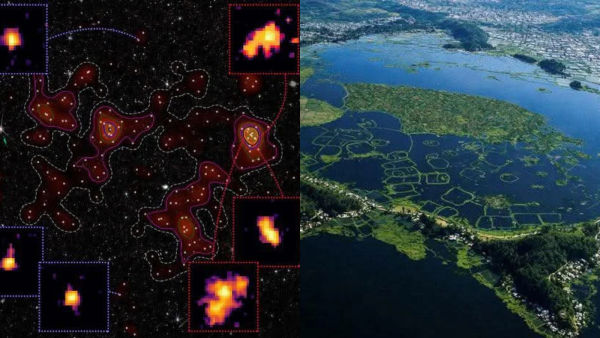
Imphal: An Indian researcher based in Japan has named a newly discovered large structure of galaxies after Manipur’s Loktak Lake, seeking to “immortalise” the northeastern state’s identity in the cosmos.
Dr Ronaldo Laishram, who led an international research team as a postdoctoral researcher at the National Astronomical Observatory of Japan (NAOJ), said the structure was studied using the Subaru Telescope in Hawaii and the James Webb Space Telescope.
“The study, which began around October 2024 as part of a broader ongoing research programme, was published this month in the ‘Astrophysical Journal Letters’,” he told PTI over the phone.

Laishram said the idea of naming the structure after Loktak Lake came to him immediately after the discovery.
“When I first discovered it, the first thing that came to my mind was to do something for my home, Manipur. Loktak is the mirror and lifeline of Manipur. It is not just a lake – it is deeply woven into the identity, the stories, and the lives of our people. I wanted to place Manipur and Loktak in the story of the universe itself,” he said.
The 29-year-old researcher from Khangabok in Thoubal district said he considered several names linked to Manipur’s cultural and historical identity before finalising Loktak.
“I thought of several names associated with Manipur’s history and identity. Taoroinai, a mythical serpent deeply associated with Manipur’s cultural and religious legacy, also came to my mind. But, when I saw the four separate concentrations of galaxies all linked together into one larger system, Loktak felt like the most natural name,” he said.
“There was also a moment years ago when I took an aerial photograph and saw Loktak from above. That image stayed with me, the way everything was connected. When I looked at this cosmic structure, that memory came back,” Laishram said.
Describing the significance of the lake, Laishram said it is the largest freshwater lake in the northeast, and serves as a lifeline providing livelihoods to thousands of fishermen.
“It also hosts the only floating national park in the country where Sangai, the brow-antlered deer, lives. By naming this discovery Loktak, I want to immortalise its name forever in the cosmos,” he said.
He said the naming has generated curiosity among researchers abroad about the lake and Manipur. “That curiosity is exactly what I hoped for. Loktak deserves to be known,” the researcher said.
Laishram said the findings of the discovery suggest that even 12.6 billion years ago, when the universe was about 1.2 billion years old, a galaxy’s surrounding environment influenced its growth.
Galaxies in crowded regions were already evolving differently from those in quieter regions, offering fresh evidence that a galaxy’s environment affects its development, he said.
Laishram is the son of Laishram Mahajon Singh and Laishram Sanahanbi Devi, and is the youngest among five siblings from Khangabok village in Thoubal district.
A computer science and engineering graduate from JSS Science and Technology University (SJCE), Mysuru, he later completed his Master’s and PhD in astronomy and astrophysics at Tohoku University, Japan.
Recalling his childhood fascination with astronomy, Laishram said he became curious about the night sky after spotting a bright object, while playing in a field in his village at the age of six.
“Since then, I would regularly look at the night sky to watch the stars. That curiosity never left me, it only grew stronger with every question I could not answer,” he said.
Laishram and his associates also launched the Manipur Astronomical Society in 2025 to bring together astronomy enthusiasts and researchers on a common platform.