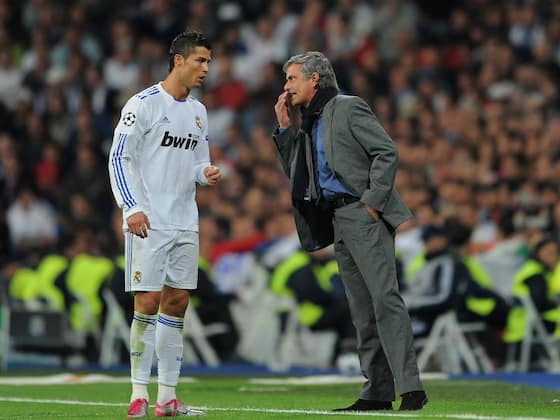
No one closely following Real Madrid should be surprised by Jose Mourinho’s comeback, thirteen years after his turbulent exit with one La Liga trophy to his credit. Florentino Perez, the club’s long-serving president, seems to operate from a very limited managerial contact list — essentially containing only a few trusted names. Each time Perez experiments with a fresh face in the dugout, the experiment tends to end with regret.
“This new guy isn’t working. The players hate change. When can we call Ancelotti?”
“He’s not available, boss.”
“Alright, get me Zidane then!”
Eventually, when every other option is ruled out, Perez always circles back to the familiar. And so, here we are again – Mourinho is back in Madrid.
But is that really a bad thing? At Real Madrid, cutting-edge tactical innovators rarely succeed. The environment demands something different. Carlo Ancelotti and Zinedine Zidane – Perez’s most successful appointments – were both pragmatists. Their football was attractive, yet flexible, moulded around the strengths of their players rather than forcing them into rigid systems. With great players, you don’t need excessive tactical complexity to achieve greatness. And lest we forget, Real Madrid have lifted the European Cup fifteen times.
Mourinho, though not identical in style to Ancelotti or Zidane, shares their pragmatic streak. His first tenure at the Bernabeu was a wild ride filled with both triumph and turbulence. His hallmark success came from convincing world-class players to buy into a disciplined, counterattacking setup. During his second UEFA Champions League triumph, Mourinho’s Inter famously eliminated Pep Guardiola’s Barcelona while holding just 14% possession, with Samuel Eto’o tracking back as a makeshift left-back.
One of the defining moments of Mourinho’s first stint at Real Madrid was the 5-0 thrashing in the 2010 Clasico. That humiliation, though painful, gave him the mandate to reshape Madrid’s approach using the hard-edged, resilient tactics that had brought him glory at Porto, Chelsea and Inter. It became a statement: Barcelona might be superior in possession football, but Mourinho’s Madrid would fight them differently – or suffer further embarrassment.
It paid off, to an extent. The ugliest parts of Mourinho’s first spell came off the pitch, reaching a low point when he infamously poked Barcelona assistant coach Tito Vilanova in the eye during a post-match melee sparked by a harsh Marcelo tackle on Cesc Fabregas. Yet, his peak came soon after, as his side stormed to the 2011-12 La Liga title with a record 100 points and 121 goals.
By his third season, however, the atmosphere soured. Mourinho’s relationships with senior players and the media deteriorated rapidly. The infamous “third season syndrome” struck, as his charm turned to confrontation. His failure to capture the Champions League meant that the task of restoring continental dominance fell later to Ancelotti and Zidane.
In 2026, Mourinho no longer features in the top tier of global coaching candidates. Yet, many believe Real Madrid’s pampered stars could benefit from his strict discipline, especially after their late-stage collapse under Ancelotti and the short-lived Xabi Alonso project. Perhaps two trophyless seasons have created the same sense of urgency that followed the 2010 Clasico. From the fans to the president, everyone must now accept the need for structure. The era of Real Madrid improvising their way to success may be over, at least for the time being.
But can Mourinho still deliver? He hasn’t won a league title since Chelsea’s 2014-15 Premier League triumph. The football landscape has evolved, embracing possession and attacking flair while leaving so-called defensive traditionalists like Mourinho and Rafael Benitez behind. His stint at Fenerbahce ended after 14 months, with the club president citing uninspiring football rather than poor results.
Real Madrid supporters got a glimpse of Mourinho’s recent highs during his time at Benfica, when goalkeeper Anatoliy Trubin’s dramatic goal secured a place in the Champions League knockout play-offs – only for them to face, ironically, Real Madrid again. That tie became controversial due to Gianluca Prestianni’s abuse of Vinicius Junior, and Mourinho’s defensive reaction – blaming Vinicius for his celebrations – drew criticism. His comments were seen as insensitive, questioning why controversy seemed to follow the Brazilian star wherever he played.
Benfica ended their domestic campaign unbeaten but without silverware, drawing 11 of 34 league matches. Reports suggested Mourinho’s approach wasn’t devoid of attacking intent, but his refreshed tactical ideas failed to produce the consistency needed to outscore Porto, who finished with fewer goals but more points.
Over the past decade, Mourinho’s record has been respectable but hardly spectacular – not the profile one might expect for the world’s most successful club. Compared to Alonso, who brought fresh ideas and a strong Real Madrid connection, Mourinho feels like a less exciting appointment. Alonso’s downfall came when he couldn’t manage the egos of both the players and Perez himself, despite being only four points behind Barcelona when he was dismissed mid-season.
Under Perez, success at Real Madrid has always stemmed from pragmatic, player-oriented management. While that approach has secured multiple European titles, it has coincided with underachievement in La Liga – seven domestic championships in 23 seasons is a poor return for a club of Madrid’s stature. Perez’s insistence that Madrid were ‘robbed’ of several titles is viewed by many as delusional.
His conservative leadership has narrowed the club’s ambitions. Mourinho’s appointment is unlikely to change that. At 63, he is more like a rock legend seeking one last hit than a revolutionary. Yet, there’s still a possibility it could work. Mikel Arteta’s success with Arsenal demonstrates that well-drilled pragmatism can still thrive. And with players like Kylian Mbappe and Vinicius Junior, Mourinho has the tools to execute his trademark counterattacking style. Though older and perhaps mellower, he remains a master of commanding the spotlight with his blend of charisma and controversy.
Real Madrid’s resilience is legendary. A club of such stature, history, and magnetism for talent is never far from success. Perez is staying put at 79, so the cycle will roll on. And who knows—Mourinho might just guide this gifted squad to another trophy. It won’t be a revolution, but then again, no one really expected one.