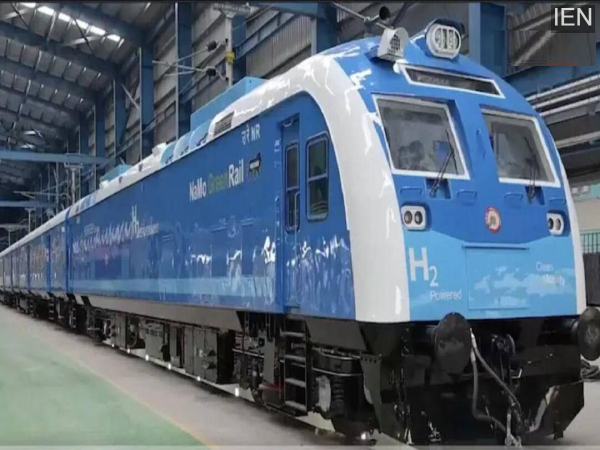
Hydrogen Train Route: The Ministry of Railways has made a major announcement regarding the approval of the country's first hydrogen train. This train has been designed specifically to keep the environment free from pollution.
First Hydrogen Train: Indian Railways has approved a 10-coach trainset equipped with hydrogen fuel cells for the Jind-Sonipat section of the Northern Railway. With this development, the path for the operation of the country's first hydrogen train is now completely clear; according to the Railways, operations for this hydrogen train will commence very soon. Capable of reaching a maximum speed of 75 kilometers per hour, this hydrogen train will be powered by a 1200-kilowatt hydrogen fuel cell propulsion system.
What are the key features of this hydrogen train?
Essentially, the most distinctive feature of this train is that its operation generates absolutely no pollution. This is because, for fuel, the hydrogen fuel cell technology utilizes a chemical reaction involving hydrogen to generate electricity, and its only emission is water vapor. For this very reason, it is considered cleaner and more environmentally friendly compared to traditional diesel or fossil- fuel-based trains.
With this initiative, India has joined the select group of nations utilizing hydrogen technology in rail transportation. Countries such as Germany, Japan, China, and the USA are already working with this technology. However, this technology is currently in its nascent stages, and testing or operational deployment is taking place in very few countries across the globe.
Indigenous Hydrogen Storage Facility Provided
The Jind-Sonipat railway section in Haryana has been selected as the pilot route for this project. An indigenous hydrogen storage and refueling facility for the train has also been established in Jind. The Petroleum and Explosives Safety Organization (PESO) has issued the necessary licenses for the storage and distribution of compressed hydrogen gas at this location.
In a statement issued by the Railways, it was noted that the department has also developed a hydrogen compression system to facilitate refueling operations. Alongside this, arrangements have been made for technical assistance and essential spare parts to ensure that the system operates in a safe and reliable manner. A standby compressor unit is also being arranged to serve as a backup.
With safety in mind, several ultra-modern sensors—such as hydrogen leak detectors and flame detectors—have been installed. These will undergo regular inspection and cleaning to prevent any potential accidents.
Maintenance Manual Prepared
Operation and maintenance manuals for the hydrogen train and plant have been prepared by the Research Designs and Standards Organisation (RDSO). Furthermore, specific safety protocols and provisions for regular audits have been established for the maintenance facility at Shakurbasti.
The Railways has stated that, during the initial phase, trained technical personnel will accompany the train to ensure that no operational issues arise. The Railways has also mandated measures such as 24x7 monitoring, the deployment of certified staff, and regular inspections.