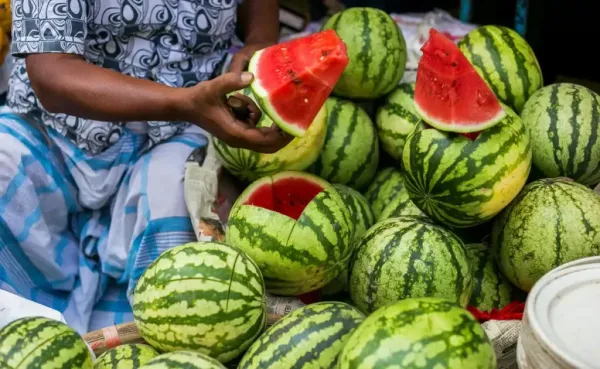
Watermelon is a classic summer fruit, but recently there have been several cases of illness and death from eating watermelon. Whatever may be the reason behind this, many claims have surfaced on social media, in which it has been claimed that chemical dye is added to watermelon. Food Safety Standards Authority of India (FSSAI) has revealed the truth behind this. You must have also seen many influencers claiming that if the water turns red after soaking the watermelon in water, it means that artificial dye has been added to it. Due to such misconceptions, people have stopped eating watermelon out of fear. If you believe these claims, then know what FSSAI has to say about this.
watermelon injection
You must have often heard on social media or around you that red dye is added to watermelon to give it a bright red color. According to FSSAI, this is not possible. In fact, he says that when you put dye in a watermelon, it doesn’t go in completely. This causes dark red marks or spots at the injection site.
The reason for this is also its high price.
Its production is very high during watermelon season and its demand is also very high in the market. So, if you talk about injecting red color into watermelon, it is not logistically possible. First of all, this will increase expenses significantly. It is not possible to inject such large quantities into watermelon. This will also require more labour.
The watermelon will start rotting.
The idea of injecting into watermelon is also not entirely correct because when you inject into watermelon, the bacteria will go into the watermelon. Due to this, the watermelon will rot quickly and its taste may get spoiled. Therefore, the claim of injecting color into watermelon is completely false.
Watermelon, Powerhouse of Nutrients
In this way, you can easily include watermelon in your diet and reap its benefits. According to the US Department of Agriculture, watermelon contains about 91 percent water. It also contains many nutrients like calcium, magnesium, potassium, phosphorus, fluoride, vitamin C and folate.