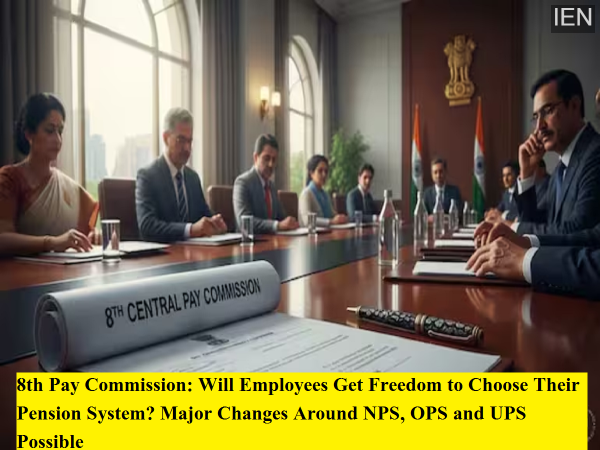
The discussion around the 8th Pay Commission is no longer limited to salary hikes and fitment factors. A major new debate has now emerged among central government employees regarding retirement security and pension stability.
Lakhs of government employees are increasingly worried about how much pension they will actually receive after retirement, especially under the current National Pension System (NPS). Amid these concerns, discussions are reportedly gaining momentum around giving employees greater flexibility to choose between different pension structures in the future.
Although the government has not made any official announcement yet, employee unions and pension groups believe that significant developments related to pension reforms could emerge over the next two to four months.
For many government employees, retirement security has become just as important as salary revision under the 8th Pay Commission.
At present, most central government employees recruited after January 1, 2004 fall under the National Pension System (NPS).
Under this system:
Employees contribute a fixed portion of salary
The government also contributes to the pension account
Retirement pension depends largely on market-linked investment returns
Because pension payouts are linked to market performance, many employees fear uncertainty regarding their future retirement income.
Employee organizations argue that fluctuations in financial markets could directly impact pension stability after retirement.
According to reports and discussions between employee unions and the commission, one major proposal being explored is giving employees more freedom to choose their pension structure based on their financial comfort and retirement expectations.
The idea behind this discussion is to provide:
Greater pension security
More retirement stability
Better clarity on future pension income
Reduced dependence on market fluctuations
Although the proposal is still under discussion, many employee unions are demanding a system where workers can choose between different pension models instead of being restricted to a single framework.
The growing debate around pension reforms has once again brought Old Pension Scheme (OPS) and Unified Pension Scheme (UPS) into focus.
Under the Old Pension Scheme:
Pension was calculated based on the last drawn salary
Dearness Allowance (DA) was also included
Pension remained largely guaranteed
There was no direct market risk
Because of these features, many employees still consider OPS more financially secure and predictable compared to NPS.
The government recently introduced the Unified Pension Scheme (UPS) in an attempt to provide a middle path between OPS and NPS.
UPS reportedly tries to combine:
Contribution-based structure like NPS
Some level of guaranteed pension protection
The goal is to offer employees more retirement stability while keeping the pension system financially manageable for the government.
Now several employee organizations want the government to further strengthen pension guarantees and improve long-term retirement security.
Several employee associations, including the All India NPS Employees Federation (AINPSEF), have reportedly raised concerns before the commission regarding the future of retirement benefits.
According to employee groups:
Pension should not depend entirely on market performance
Retired employees need stable monthly income
Pension should rise with inflation
Retirement planning should become more predictable
Unions are demanding a stronger safety mechanism similar to OPS where pension amounts remain relatively stable and secure.
One of the major demands from employee organizations is linking pensions more effectively with inflation.
Employee unions argue that rising healthcare costs, household expenses, and inflation are making retirement planning increasingly difficult.
Because of this, organizations are asking for:
Guaranteed minimum pension
Inflation-adjusted pension growth
Long-term retirement protection
Reduced pension uncertainty
These issues are expected to become important discussion points during upcoming 8th Pay Commission consultations.
The discussions are not limited only to regular retirement cases.
Employee groups are also demanding reforms for employees opting for Voluntary Retirement Scheme (VRS).
According to sources, one proposal under discussion suggests that employees taking voluntary retirement should begin receiving pension benefits immediately from the next day after retirement.
Unions argue that employees who have served the government for decades should not face uncertainty or delays regarding pension access after opting for VRS.
Although employee demands are increasing, experts believe the government may approach pension reforms cautiously due to long-term financial implications.
A fully guaranteed pension system similar to OPS could significantly increase:
Government expenditure
Pension liabilities
Fiscal pressure on future budgets
This is one of the key reasons why policymakers may prefer a balanced approach instead of completely replacing NPS.
Experts believe the government may try to design a hybrid structure that offers:
Better security than NPS
More sustainability than OPS
Controlled fiscal burden
The latest discussions indicate that the 8th Pay Commission may become one of the most wide-ranging commissions in recent years.
The focus is now expanding beyond:
Salary hikes
Fitment factor
DA merger
HRA revision
and moving toward broader employee welfare concerns such as:
Pension security
Retirement stability
Family pension benefits
Inflation protection
Long-term financial planning
At present, no final decision has been officially announced regarding pension choice or structural changes.
However, continuous discussions between employee unions and the commission have raised expectations among lakhs of central government employees and pensioners.
With retirement security becoming one of the biggest concerns for government staff, the coming months may prove crucial in determining whether employees will receive more flexibility and stronger pension protection under the future framework.
For now, all eyes remain on the 8th Pay Commission and the government’s next move regarding pension reforms.