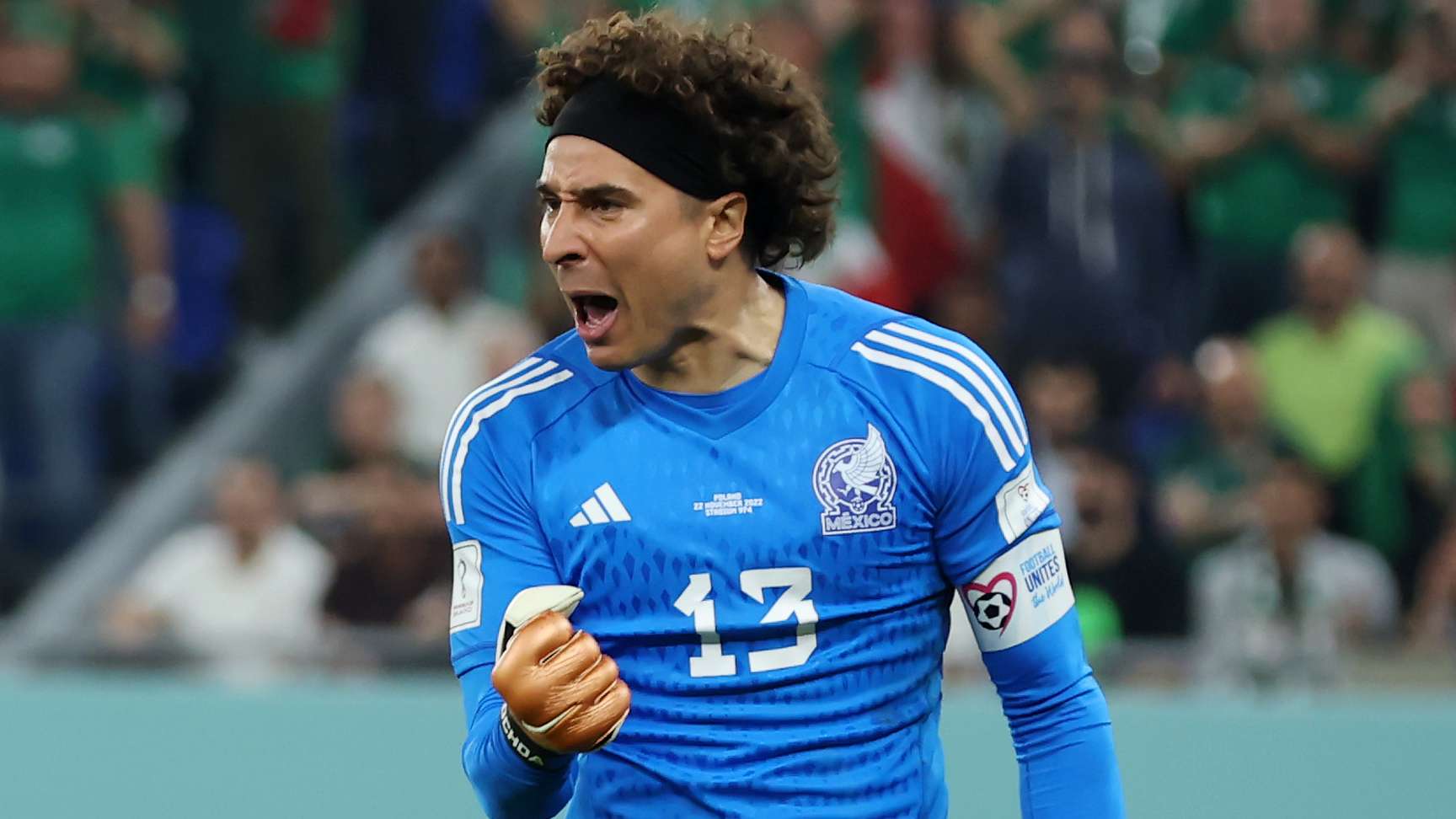
Guillermo Ochoa, the veteran Mexican goalkeeper, spoke to GOAL about his dream of making history by playing in a record sixth World Cup, hoping to add one last memorable chapter to a career built on iconic saves, resilience, and immense pride in representing Mexico.
Long before Ochoa became synonymous with the World Cup, before his unforgettable performances in Fortaleza and Doha, before the headband and the legend that reappears every four years, there was Puerto Ordaz.
In June 2007, deep in Venezuela, Mexico faced Brazil in the Copa America. The Brazilian lineup featured Robinho, Diego, Vagner Love, and Elano. Ochoa, then just 21 and still fighting for his place in the national team, produced a stunning display as Mexico triumphed 2-0. The scoreline alone doesn’t tell the full story—it was Ochoa’s fearless goalkeeping, diving to deny Brazil’s attackers and standing firm under pressure, that revealed a glimpse of what was to come.
Nineteen years later, that night carries a different meaning. It marked the emergence of a player who refused to fade away. Now 40, Ochoa is pushing toward what would be his sixth World Cup appearance—a feat no player has ever accomplished before this cycle. He knows the challenge ahead is immense.
“It’s not an easy record to break. There is no player with six World Cups, so it’s a big challenge for me,” Ochoa told GOAL during an interview on the set of Michelob ULTRA’s FIFA World Cup commercial.
This sense of challenge has defined Ochoa’s entire career. He had everything in Mexico—playing for Club America, the country’s most successful team, brought him fame and security. He could have remained there, signing long-term contracts and becoming a legend without ever stepping out of his comfort zone.
Yet Ochoa chose differently. GOAL revisits the journey of the Mexican football icon who embraced the tougher path as he prepares to take the field on football’s grandest stage, possibly for the final time.
The harder road
Ochoa’s decision to move to Europe didn’t simplify his journey—it made it more complex. His overseas career took him through France, Spain, Belgium, Italy, and Portugal. There were relegation battles, limited opportunities, and difficult stints, like his time at Malaga under Javi Gracia, where chances were scarce. For Ochoa, these years were less about silverware and more about perseverance.
That’s why his story cannot be told only through the highs. His move to Europe was not for guaranteed success; it was about testing himself against greater challenges. Football became his window to the world, even when that world didn’t always offer kindness.
“I’m always trying to be fit,” Ochoa explained. “It’s not easy after so many years in football, but the most important thing is the mental side.”
His body has carried him through two decades of intense competition, but his career has been driven by something less tangible—his unwavering belief that another opportunity can always be earned, and another save can still change the narrative.
A man for the moment
Ochoa’s defining moment came against Brazil in Fortaleza during the 2014 World Cup. Neymar’s header seemed destined for the corner, but Ochoa stretched and turned it away. Paulinho’s close-range strike was blocked, and Thiago Silva’s powerful header was denied as well. Brazil, playing at home, could not beat him.
For Mexico, the 0-0 draw became a symbol of defiance. Ochoa didn’t just keep Brazil at bay; he gave Mexican football a timeless moment. Fortaleza became the stage where his legend solidified.
Eight years later, in Qatar, he added another unforgettable chapter. In Mexico’s opening game against Poland, the match was tense when Robert Lewandowski stepped up for a penalty. Expected to score, the Polish striker was denied as Ochoa guessed correctly, diving to his left to save. Once again, when Mexico needed a hero on the World Cup stage, Ochoa delivered.
The World Cup brings out his best
“The most important thing is the mental side, the mindset to be prepared to play for your country in front of millions of people watching on TV and in the stadium,” Ochoa said. “It’s a big, big stage.”
Now comes the crucial question—can he make it one more time?
Ochoa is chasing what no one has ever done before: appearing in a sixth World Cup. Even if he participates in just one match, or in a different role than in 2014, 2018, or 2022, it would place him in an unmatched category of football history.
“I’m working for that,” Ochoa said. “But I am very positive, very happy, because I’m very close to doing it. I’m working hard to realize this dream.”
Will Mexico’s new generation rise?
For Ochoa, chasing dreams has always meant moving forward—leaving Las Águilas, accepting tough club roles, and living through constant speculation about whether the next generation of goalkeepers would finally replace him.
That question now extends to Mexico’s upcoming talents. Could Raúl “Tala” Rangel be the one to make a breakthrough in Europe? Could another young player follow Ochoa’s path—or even surpass it?
Ochoa’s continued presence with the national team still matters deeply, even without a guaranteed starting spot. His involvement speaks volumes about his enduring pride. He’s not merely pursuing a personal milestone; he’s carrying Mexican football’s legacy into yet another uncertain summer.
“It’s something against the odds [Mexico lifting the World Cup], something more difficult for us as the Mexico national team,” Ochoa admitted. “But at the end, you are in one competition. You have to be there to compete, and you never know.”
That has always been Ochoa’s philosophy—you never know when a save can change a match, when a goalkeeper can turn a draw into legend, or when a young player in Puerto Ordaz begins a 19-year dialogue with history.
Whether Javier Aguirre grants him the opportunity for that sixth World Cup remains uncertain. But Ochoa’s legacy is secure: a Mexican goalkeeper who always chose the tougher road because comfort was never his goal.
For Ochoa, football has always been more than a profession—it’s been a way to explore the world and, every four years, a chance to make the world stop and watch.