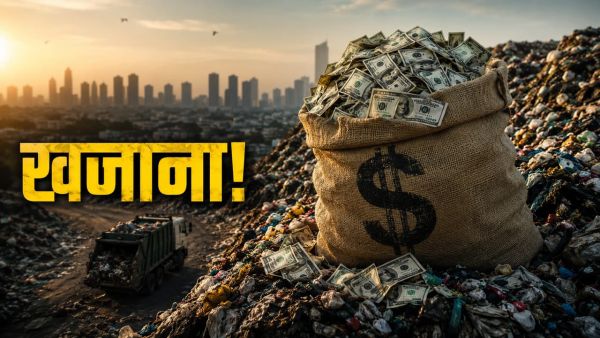
New Delhi: The huge mountains of garbage in Indian cities, which till now were considered only a source of trouble and disease, are actually set to become the biggest economic engine that will change the destiny of the country. According to a recent and shocking study by the Council on Energy, Environment and Water (CEEW), India's urban organic waste (cooking leftovers, vegetable peels and gardening waste) could create a huge market worth around $51 billion (over Rs 4.2 lakh crore) by the year 2047. But the real suspense lies in whether India will be able to turn this waste crisis into its biggest strength in time?

Data from the report show that about 1.71 lakh tonnes of urban solid waste is generated every day in India, of which half is entirely organic (wet waste). The surprising thing is that even in today's modern era, only 61 percent of this total waste is processed.
The remaining waste rots in drains, illegal dumping sites or landfills. When this waste is burnt in the open, the deadly PM2.5 pollution in cities increases by 10%. What is even more dangerous is that methane gas released from rotting garbage is many times more deadly a greenhouse gas than carbon dioxide. Between 1994 and 2020, emissions from India's waste sector have increased by 226 percent. If strict steps are not taken today, by 2047 this waste will reach beyond 208 million tonnes annually, which is a sign of a major environmental disaster.
CEEW has put forward three possible futures (models) for India that will decide how our cities will look in 2047:
Hidden at the center of this entire change is the magical fuel – Bio-CNG. When wet waste is compressed, it becomes the cleanest alternative to fossil fuels (petrol-diesel). Currently, 96% of India's capacity is devoted to composting, while 'biomethanation', the most profitable and energy-saving sector, contributes only 4%. Changing this balance is the biggest challenge.
Solid Waste Management Rules, 2026 have come into force in India since April this year, which make it legally mandatory to segregate waste at source (home/hotel). India has schemes of 16 ministries like Swachh Bharat Mission-Urban, GOBARdhan and SATAT, but the real suspense and problem lies in their coordination and poor implementation. Even today, municipalities pay contractors not on the basis of 'quality of waste separation' but on the basis of 'weight of waste'. outcome? Mixed waste goes directly into the dumping ground and spreads fire and pollution. According to CEEW Fellow Prarthana Borah, “Waste management is not a sanitation function, but the infrastructure for clean air.”
If India overcomes these obstacles, then in the coming time, garbage will prove to be the biggest source of eradicating poverty in the country and bringing prosperity of $51 billion.