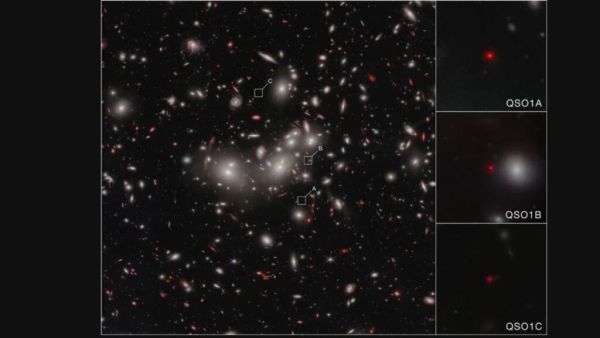
New Delhi: The James Webb Space Telescope has revealed a surprising discovery that could alter scientists’ understanding of how galaxies and black holes formed in the early universe.
Researchers have identified a giant black hole linked to an ancient object known as Abell2744-QSO1raising questions about whether some black holes emerged before the galaxies that host them.
Abell2744-QSO1 belongs to a mysterious class of distant objects astronomers call “Little Red Dots.” First detected by JWST in 2022, these compact objects are believed to be among the oldest known structures in the cosmos.
Using the telescope’s advanced Near Infrared Spectrograph (NIRSpec), scientists measured the motion of gas surrounding the object. The observations allowed researchers to calculate the mass of its central black hole with unprecedented accuracy.
The analysis revealed that the black hole has a mass roughly 50 million times that of the Sun. Even more remarkable is its age, it existed only about 700 million years after the Big Bang.
What has puzzled astronomers is the relationship between the black hole and its host galaxy. The black hole accounts for nearly two-thirds of the galaxy’s total mass, a proportion vastly larger than what is seen in galaxies today.
For comparison, central black holes in modern galaxies, including the Milky Wayrepresent only a small fraction of their galaxies’ overall mass.
Current models suggest that supermassive black holes gradually grow within already-developed galaxies by accumulating material over time. The newly observed object appears inconsistent with that explanation.
Its unusual mass ratio suggests the black hole may have formed before most of the galaxy’s stars and structure came into existence.
Scientists are now exploring alternative theories, including the possibility that some black holes formed directly from enormous clouds of primordial gas shortly after the Big Bang.
With JWST continuing to identify more “Little Red Dots,” researchers hope to determine whether such early supermassive black holes were common. If confirmed, the findings could significantly reshape current theories about the origins of galaxies and the evolution of the universe itself.