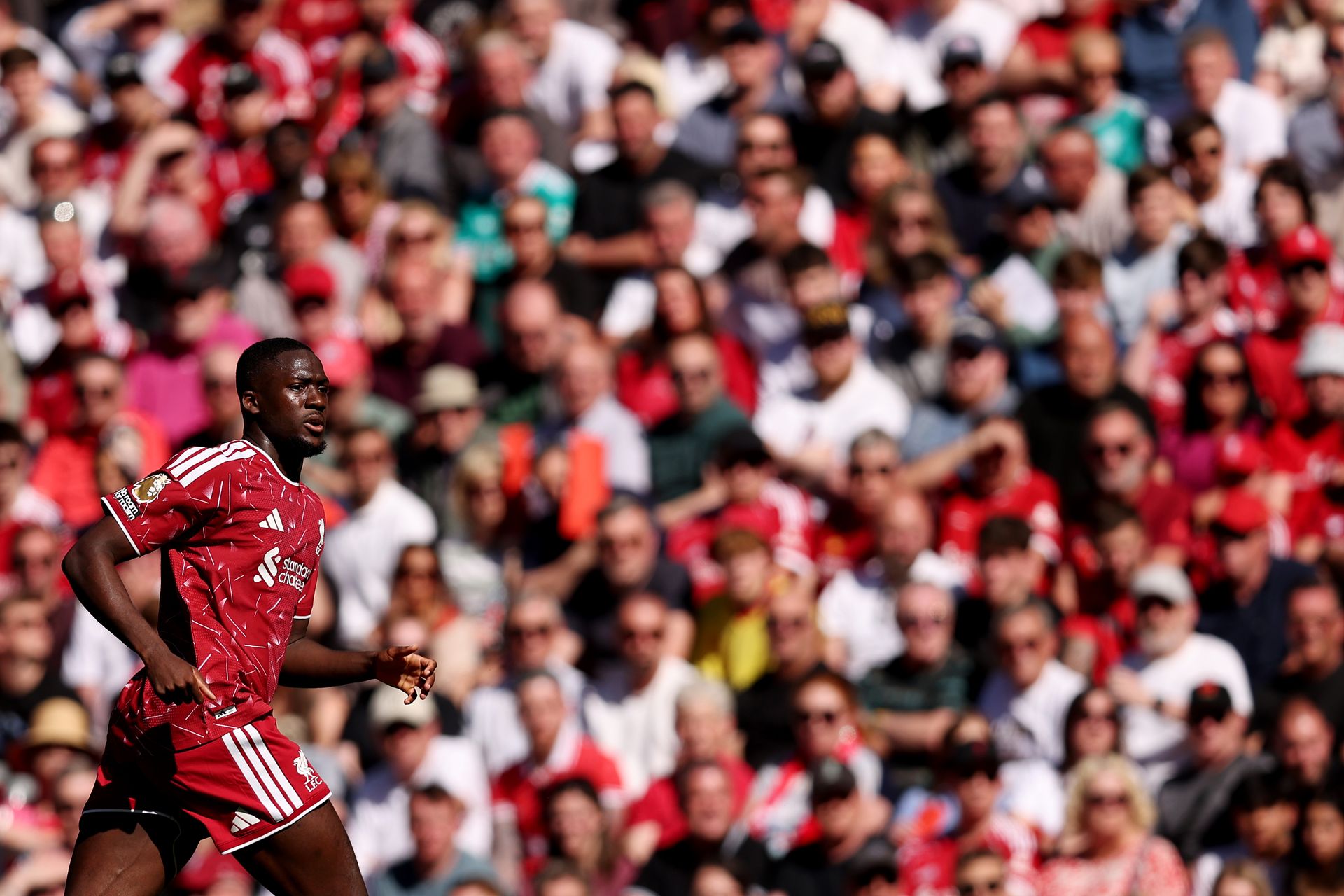
Ibrahima Konate is set to be the next Liverpool first-team player to depart Anfield on a free transfer, adding to a growing list of high-profile exits. But is the club’s approach as irrational as it seems?
Konate is expected to leave Liverpool this summer after two and a half years of contract discussions failed to produce an agreement.
The French defender will join Mohamed Salah and Andy Robertson in leaving the club without a fee this summer. Meanwhile, Virgil van Dijk and Alisson appear likely to follow next year unless they are sold before their contracts expire.
This pattern is nothing new. Georginio Wijnaldum, Roberto Firmino, Emre Can, Adam Lallana, James Milner, Naby Keita, Divock Origi, and Alex Oxlade-Chamberlain all left Liverpool in similar circumstances.
A genuine Bosman transfer was only avoided in Trent Alexander-Arnold’s case after Real Madrid paid €10m to bring him in early so he could feature in the Club World Cup.
That’s a significant amount of value walking out of Anfield without financial return. But whether this truly represents a problem depends on perspective.
It’s worth noting that several of those players were in their 30s, having given years of loyal and successful service to the club. Others had suffered injury setbacks before their exits.
That leaves only a few who departed at a profitable age, notably Wijnaldum, Keita, Origi, and perhaps Alexander-Arnold, if one considers his transfer as below market value.
The extent to which Liverpool really missed these departing players is debatable. Take Wijnaldum, for example: his exit was heavily questioned at the time, given that he had featured in every Premier League match the previous season.
Yet, the following campaign saw Liverpool climb from third to push Manchester City to the wire in the Premier League, reach the Champions League final, and capture both the FA Cup and League Cup.
Most of these departures came before Liverpool’s Premier League title triumph in 2024/25, which was then followed by a massive summer spending spree.
Regardless of opinions about the specific signings, the scale of Liverpool’s spending showed they were far from cash-strapped. That was to be expected, considering they were the top-earning English club in the Deloitte Money League that season.
Additionally, Liverpool have made several big-money sales over recent years. Among them: Luis Diaz (€70m), Darwin Nunez (€53m), Fabinho (€46.7m), Sadio Mane (€32m), and Jordan Henderson (€14m).
Most other outgoing transfers have involved academy products or squad players. The club earned €35m from Jarell Quansah, €26m from Rhian Brewster, and a combined €61.8m from Sepp van den Berg, Caoimhin Kelleher, and Fabio Carvalho’s moves to Brentford. Add to that €23.2m for Benn Gannon-Doak, €20m for Neco Williams, €14m for Harry Wilson, and €10m for Tyler Morton. And that’s not even the full list.
If one looks at it positively, Liverpool seem content to allow some of their biggest names to see out their contracts while generating income by selling fringe players unlikely to break into the senior squad.
Since signing van Dijk from Southampton in 2018 for what was then a record fee, Liverpool have built a reputation for investing heavily only when they believe a player truly merits it.
From 2020 onwards, Liverpool have paid transfer fees for only 19 players, including Ben Davies from Preston and Marcelo Pitaluga from Fluminense—fees comparable to what Championship clubs, not Premier League sides, would typically pay.
For better (as in 2024/25) or worse (as in 2025/26), that approach has provided the Reds with more financial and squad stability than many of their rivals, and spared them some of the turmoil seen at clubs like Manchester United and Chelsea.
Simply put, Liverpool have never been a club to throw excessive money at players just to keep them.
They could have done so with Konate if they had wanted to. They could have locked in new deals for Salah and van Dijk much sooner. Perhaps even Alexander-Arnold. But such moves raise expectations—when one player’s ceiling rises, others demand parity, and that applies to both existing squad members and new recruits.
From the club’s viewpoint, allowing players like Konate, Keita, or Wijnaldum—important but not indispensable figures—to leave might help reinforce their stance in negotiations. When Liverpool make an offer, it signals genuine intent, not a bargaining chip to generate fees. The message is clear: take it or leave it.
That’s the generous interpretation. The harsher one is that Liverpool’s handling of contracts and transfers increasingly appears disorganised and, to many fans, undermines their once-sterling reputation for smart market dealings.
The Salah and Alexander-Arnold sagas, in particular, have brought unwanted public scrutiny and embarrassment.
Nevertheless, Liverpool can weather such criticism if results on the pitch improve. It is no coincidence that discontent over their transfer strategy has grown after a disappointing season—especially given Konate’s underwhelming performances.
Ultimately, judgement will be delivered where it matters most: on the field. A return to winning trophies will silence the doubters. But continued decline will only amplify the criticism.