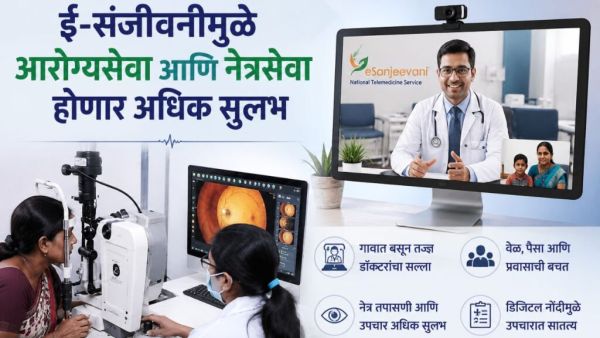
The national telemedicine service ‘eSanjeevani’ is making healthcare more accessible and efficient thanks to cutting-edge technology. Due to this digital revolution, the gap between urban and rural healthcare is reducing and patients can get consultation from expert doctors at their homes. Let’s know the key features of how e-sanjeevani has made healthcare and eye care easier and how it is benefiting this sector. Dr. Vikas Jain, Group COO, ASG Eye Hospital From the(Photo courtesy – istock)
A breath of hope! Doctors helped a paralyzed patient who was on a ventilator for six months to breathe independently again
Bringing equal healthcare to every citizen of the country is a major challenge facing India’s public healthcare. However, in the past few years, digital technology has started to change the way healthcare is delivered. It is becoming possible to reach the previously underserved population with healthcare. According to the information of the Government of India, more than 33.8 crore patients have been served through the country’s national telemedicine service called ‘e-Sanjeevani’.
Increasing use of telemedicine and digital health platforms – has been the most important reason behind this change. ‘E-Sanjeevani’, a national telemedicine platform launched by the Ministry of Health and Family Welfare, Govt., has become one of the largest digital health initiatives of its kind today. Through this platform, doctors can interact with each other through health and wellness centers, and patients can also directly interact with doctors through online OPD services. According to government statistics, crores of patients have benefited from teleconsultation facility through ‘e-Sanjeevani platform’. This shows that both doctors and patients are becoming more aware and positive towards receiving healthcare remotely.
Along with ‘telemedicine’, artificial intelligence (AI) and data-driven technologies – are also increasingly used in healthcare. AI systems can better help doctors in diagnosing diseases by analyzing large amounts of medical information such as medical images, patient records and examination reports. Machine learning algorithms trained on large datasets help identify symptoms associated with diseases such as tuberculosis, cancer and heart disease. This enables doctors to diagnose diseases earlier and make more accurate medical decisions. It has been shown that AI-based clinical tools can increase the efficiency of investigations and enable more efficient use of available resources in health centers where there is a shortage of specialist doctors.
Digital transformation is also a big benefit of new technology for the eye care sector – technology is playing an important role in bridging the gap in availability of specialist doctors and examination facilities. Trained technicians or health workers can take pictures of the retina at local health centers and send them remotely to an ophthalmologist for examination. This method of ‘Teleophthalmology’ is enabling early detection of eye diseases even in areas where ophthalmologists are not readily available. Also, people in rural and underprivileged areas can get the benefit of specialist eye care.
Does eating raw onion have benefits or harms to the body? Does onion consumption cause intestinal infection? Know in detail
AI-enabled Retinal Imaging System – Early Symptoms of Diabetic Retinopathy can be detected early. Machine learning technology can help doctors identify potential eye problems by studying images of the retina. Therefore, it can be understood early which patients need further specialist examination. This technology makes it possible to perform eye examinations even in primary health centers. Ophthalmologists can focus more on patients who need serious treatment.