“That was the most surprising thing to me,” said the 31-year-old English teacher, who lives in Long Bien Ward.
In 2022, he left his hometown London and moved to Hanoi to experience a city with four distinct seasons. But he was taken aback during his very first summer.
In early April, the weather was still pleasantly cool, but a few days later, the city was hit by an intense heatwave.
Struggling to adjust to the sudden change, he and his foreign friends had to alter their daily routines. They spent most of their time sheltering in shopping malls, cafés, or at home with the air conditioner on.
For days on end, he avoided going outside altogether. This summer, during the peak heatwave in late May, the primary school where he teaches extended students’ afternoon nap time from one hour to two because the children became more fatigued after physical activities.
The six-kilometer commute from school to his home also became a major challenge, and he said there were days when he had to stop at a convenience store and enjoy the air conditioning for 10 minutes to cool down.
He said it is fortunate that air conditioning is widely available throughout Vietnam. “I can’t imagine how I would survive a Hanoi summer without air conditioning.”
|
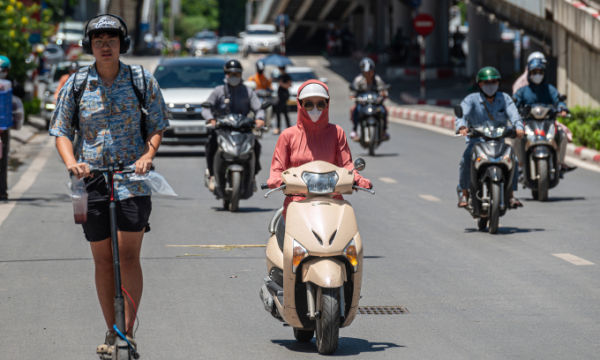
Residents cover themselves from head to toe to protect against the scorching heat while traveling through Hanoi during the peak of a heatwave on May 26. Photo by The Bang |
For Nigerian national Godspromise Iveoghene Egbeji, Hanoi’s summer has been a daunting experience despite his familiarity with high temperatures in Africa.
He said at home in Borno State, temperatures often exceed 40 degrees Celsius, but the air is much drier, allowing sweat to evaporate quickly and making the heat feel more tolerable. With Hanoi’s high humidity, sweat lingers on the skin and leaves him feeling constantly sticky and uncomfortable.
Last week, he bought a cooling jacket equipped with built-in fans and cooling plates that continuously blow cool air inside the garment while he is outdoors. But he also drinks three liters of water a day and limits unnecessary travel. “Even after spending decades in Africa, I’ve never experienced a heatwave like the one we had last week. The heat leaves me exhausted, unmotivated, and unable to concentrate on work.”
The heatwave that lasted from May 22 to 27 disrupted daily life across northern and central Vietnam. At the Lang meteorological station in Hanoi, temperatures reached 41.1 degrees Celsius on May 26, not far from its all-time high of 41.3 degrees recorded in May 2019.
Sumeet Saksena, a senior fellow at the East-West Center in the US specializing in environmental health, said a combination of factors makes Hanoi feel like an “outdoor furnace.” Having spent 16 years researching air pollution, environmental health, and the impacts of urbanization in Hanoi, he said the primary cause is the urban heat island effect.
Rapid urban development has replaced trees, ponds, lakes, and open spaces with concrete, brick, and asphalt, which absorb heat during the day and release it back into the environment later, making the city center warmer than surrounding areas.
Hanoi’s geographical characteristics and hot, dry wind patterns also contribute to trapping heat over the lowland region, he explained.
“Heat becomes trapped between high-rise buildings, making the air feel dense and oppressive.”
These weather conditions could overwhelm the body’s natural cooling mechanisms, particularly for newcomers arriving from cooler climates, he said.
Immigrants moving recently to Vietnam could experience heat exhaustion, with symptoms like dizziness, headaches, and nausea.
 |
|
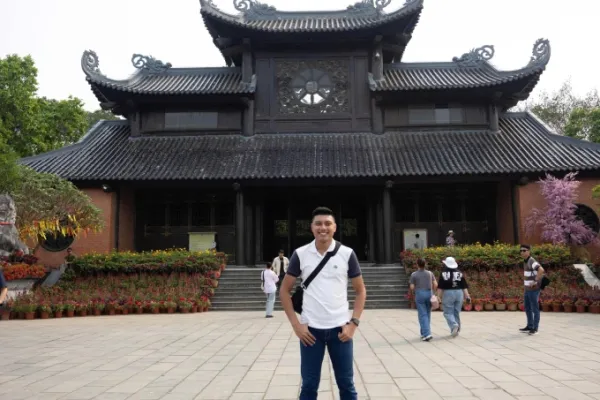
Karim Raof during a trip to Hanoi in 2025. Photo courtesy of Karim Raof |
Karim Raof, a 30-year-old Malaysian student, has been studying in Hanoi for the past seven months, and used to believe he was accustomed to warm weather, but the weather has caught him by surprise.
He said when temperatures reach around 40 degrees at midday, just a five-minute walk is enough to leave his shirt soaked with sweat.
Even at night, he sometimes struggles to sleep despite using both a fan and air conditioning. Raof said that while Malaysia is warm year-round and often benefits from cooling breezes, Hanoi’s summer feels more oppressive because of its high humidity. He was also surprised to see people taking advantage of the extreme heat to fry eggs or dry meat outdoors.
Over time, he has picked up some heat-coping strategies from locals. Unlike in Malaysia, where people typically wear light and airy clothing, many Hanoians cover most of their body when going outside to protect themselves from the sun, he said. “I’ve started bringing a jacket or wearing a hat whenever I go out during the day, just like they do.”
Saksena said foreigners need to adjust their daily routines to cope with the heat. He recommended avoiding strenuous outdoor activities between 10 a.m. and 4 p.m., opting instead for early mornings or evenings when temperatures are lower.
In addition to drinking water, the body also needs electrolytes such as sodium and potassium,and electrolyte drinks, coconut water, and light broths help replenish minerals more effectively, he said.
He also encouraged people to wear loose-fitting, lightweight, and light-colored clothing to improve heat dissipation.
When coming indoors after being out in the sun, air conditioners should not be set to extremely low temperatures immediately, and the body needs time to adjust gradually rather than being exposed to a sudden shift from intense heat to cold air, he added.